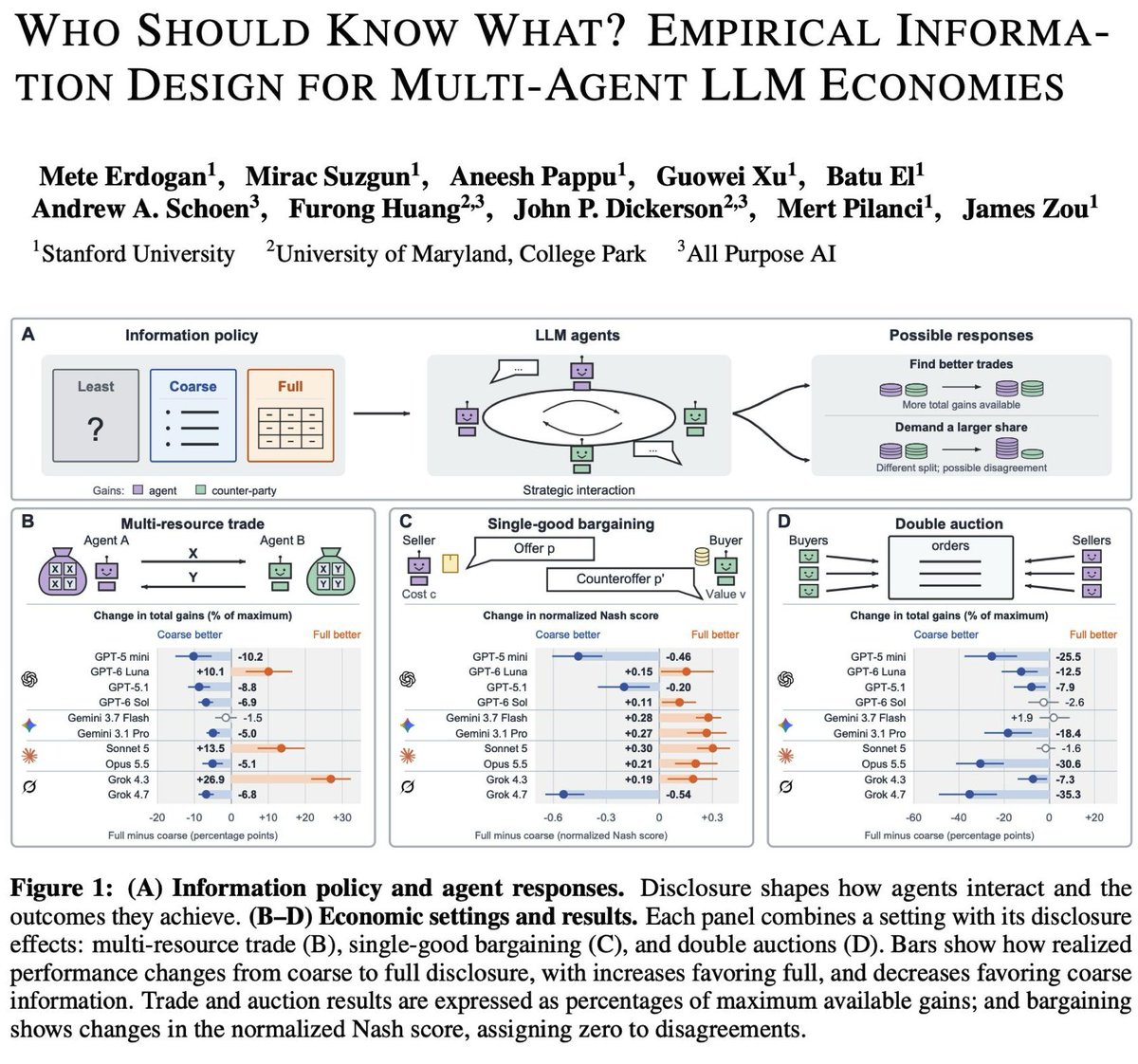
🤖 Can giving AI agents more information make outcomes worse? 🤔
In our recent study of ten frontier LLMs, we explore how information shapes agents negotiating and trading on our behalf. More information can help them find better trade opportunities yet reduce collective gains.
Excited to partner with @naturemethods to launch AI Bytes, a new monthly column explaining AI concepts to life science researchers!
Our first piece discusses foundation models for biology @CarlMaZijian https://t.co/P9JzQFG0JO
Topic suggestions welcome!
1/ AI agents are already trading and bargaining on our behalf. But how does the information we give them shape their behavior & collective welfare? Does transparency always improve outcomes, or can it reduce efficiency? We study this across ten frontier LLMs in strategic markets.
🚀We use GPT-6-Astra to build minute-long 3D Blender animations from text prompts, each dozens of shots with realistic motions of people, humanoid robots, animals, and mechanisms.
Introducing DyCraft!
@StanfordSVL#Blender3D#LLM 🧵1/6
We measure the creativity of AI Scientists with a single equation:
c = (1 − p) · u · (1 − v)
• Originality (1 − p): How unlikely the idea is to be proposed
• Utility (u): How well the idea actually works
• Non-obviousness (1-v): How hard it is to predict the idea's success beforehand
By definition, an idea can work incredibly well and still be uncreative if every model would have proposed it.
So we built BVSR to make AI scientists more creative.
(i) Blind Variation raises (1 − p) and (1 − v): Deliberately withhold task information during ideation to encourage more original, less obvious ideas.
(ii) Selective Retention protects u: An original idea is only valuable if it works. But experiments are expensive, so we learn from previously verified proposals to identify which new ideas are worth testing.
Excited to be at #CoRL2026 next week to present CHORUS!
happy to chat about collaborative, cross-embodiment learning, & feel free to drop by our poster on Monday 🦾
AI agents enter the wet lab.
In new @Nature N&V article, I discuss recent advances in agents running automated labs and ideas on how to make these systems more reliable. https://t.co/iKlJUktXwc
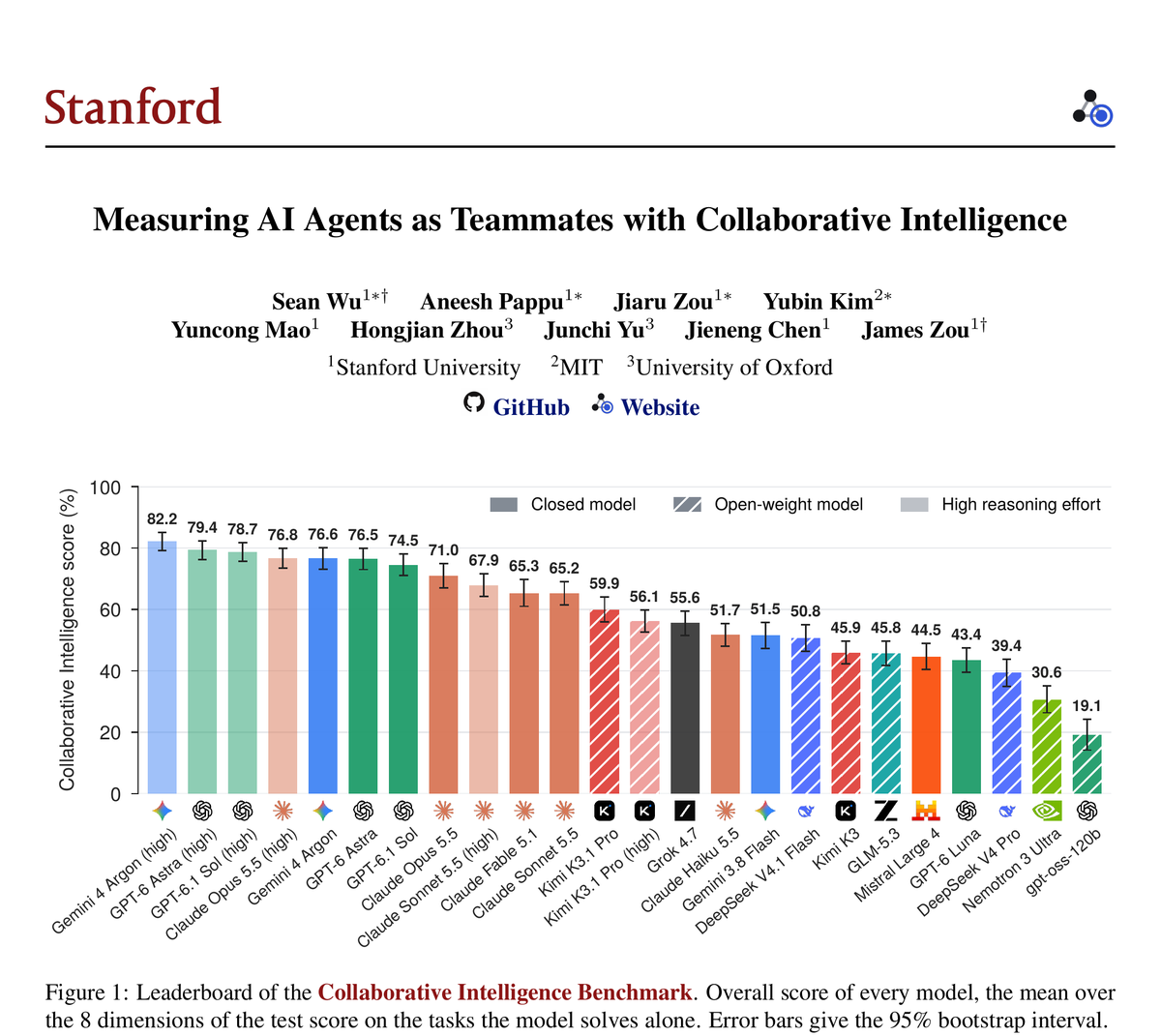
The Collaborative Intelligence Benchmark paper is out!
We tested 18 AI models as teammates on 240 tasks. The best model scores only 82.2 out of 100.
Frontier models almost never cheat. But when a teammate pushes back, they give in!
Read the paper at https://t.co/ATgHIv9iuw
1/n Within 15 months of publication, most of the LLM claims we tested either no longer held or showed substantially diminished effects. How long does our knowledge of AI hold up? In our new study, we revisit 50 findings to see what fades, what persists, and what gets stronger. 🧵
AI is now taking on some of the hardest open problems that scientists have posed. But research is broader than solving problems. Can AI also propose research questions that experts find genuinely interesting?
We built After42 to find out. Experts judged 45 of its 135 final questions genuinely interesting, across mathematics, statistics, theoretical computer science, and physics, with wide variation across subfields.
The key idea: develop questions by trying to solve them.
We also asked whether AI can judge which questions are interesting. We find that model judges' top choices align with expert consensus but do not consistently capture individual experts' preferences.
We release the expert-assessed questions as an open resource for researchers to discuss, refine, and pursue, as a step toward integrating AI into the broader research enterprise.
https://t.co/iOrs6L7E9Y
Congrats to @humansand on today’s release of Ampersand!
Benchmarked on our Collaborative Intelligence Benchmark, Ampersand beats the open-weight SOTA (59.1% vs 49.8%), with big gains on conflict and info sharing.
our benchmark: https://t.co/5CDXGnXFVH
Last month, 10,000 OpenAI agents cracked a $1M Millennium Prize problem together.
We found OpenAI models are also the best overall teammates.
Introducing 🐟 the Collaborative Intelligence Benchmark, measuring how well AI models work as teammates. 🧵
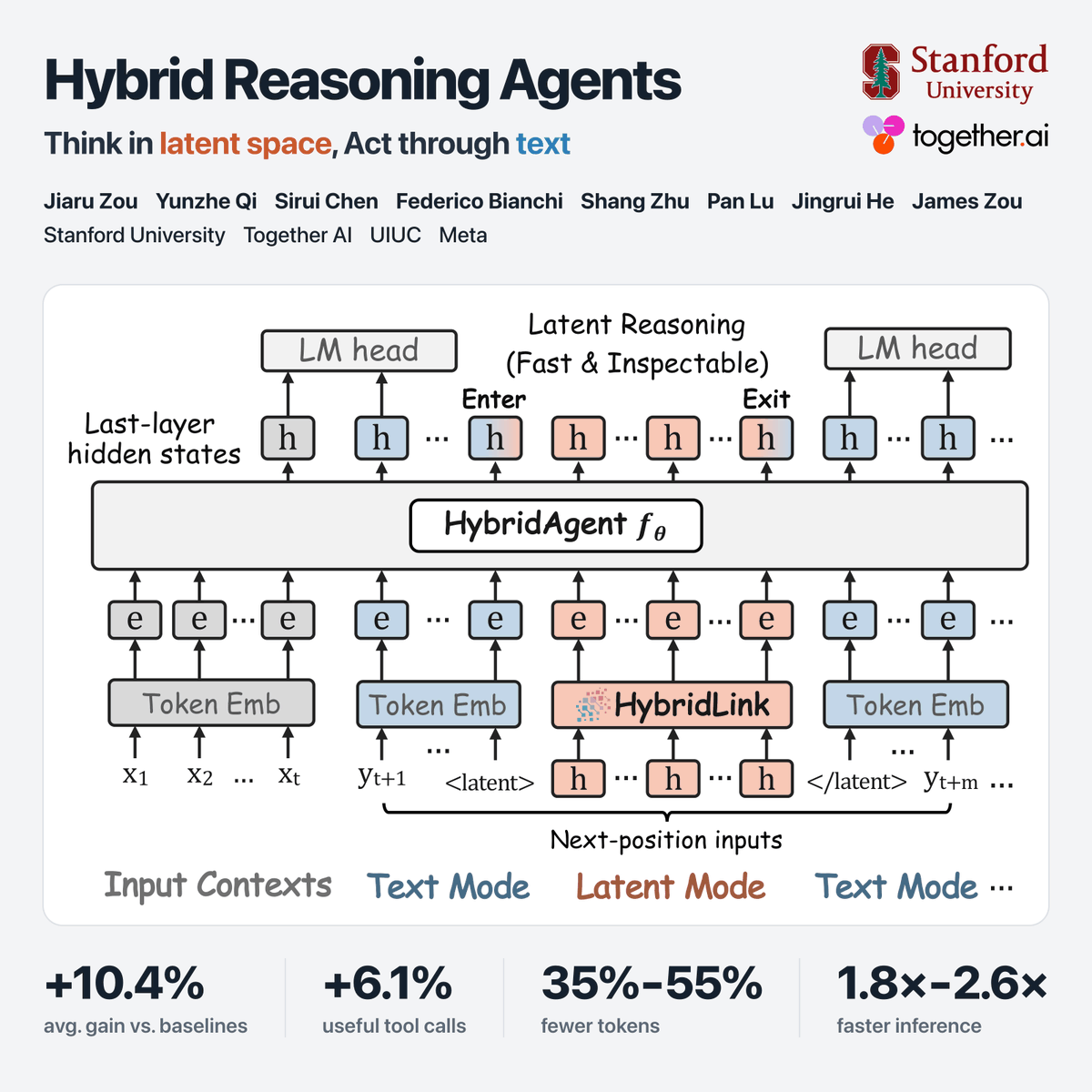
Your LLM agent has to think out loud, token by token, before it can search, run code, or act in the world.
We humans don’t. We ponder in silence and speak when it matters.
Human language was never meant to be the limit of machine thought.
Introducing 🌗Hybrid Reasoning Agents
- Think in latent space, act through text
- Two modes, one unified multi-turn flow
- No black box, fully readable latent thoughts
- Any LLM can become a HybridAgent
AI-generated scientific output is scaling beyond available human review capacity. Scaling scientific discovery requires scaling verification.
We introduce OSVerify, a framework for one-sided verification: rejecting as many invalid solutions as possible while preserving rare valid ones for expert review.
We used OSVerify to referee 11 recent OpenAI math preprints, identifying 5 major and 13 minor issues, all verified by human experts.
Our key insight: checking a proposed error can be easier than judging an entire solution. Instead of directly judging solution correctness, OSVerify decouples verification into error proposal (searching for potential errors) and error validation (checking whether they are real and substantial).
On competition and research mathematical benchmarks, OSVerify reduces invalid solutions requiring expert review by 46% on average compared to voting under the same low-FNR constraint, or 57% with an RL-trained validator.
Verification can also guide discovery. OSVerify can be integrated into existing scientific discovery workflows. Paired with an agentic math solver, it helped resolve 3 open conjectures in the Langlands program and contributed to resolving the Manin constant conjecture. All proofs were confirmed by mathematicians.
Our broader goal is to provide verification-based evaluation signals for scientific discovery, enabling test-time scaling and self-improvement even when reliable automatic evaluators are unavailable.
Project: https://t.co/pSW9iJhvHg
Paper: https://t.co/WUXDDhIz0o
GitHub: https://t.co/2BF5EfdbUe
[1/n]
Appearing today in Nature, https://t.co/Ey6EJIw7BM we report the engineering of protoglobin nitrene transferases for the synthesis of chiral oxazolidinones. It’s been ~1300 days since my first glance at this project. A long but joyful journey!
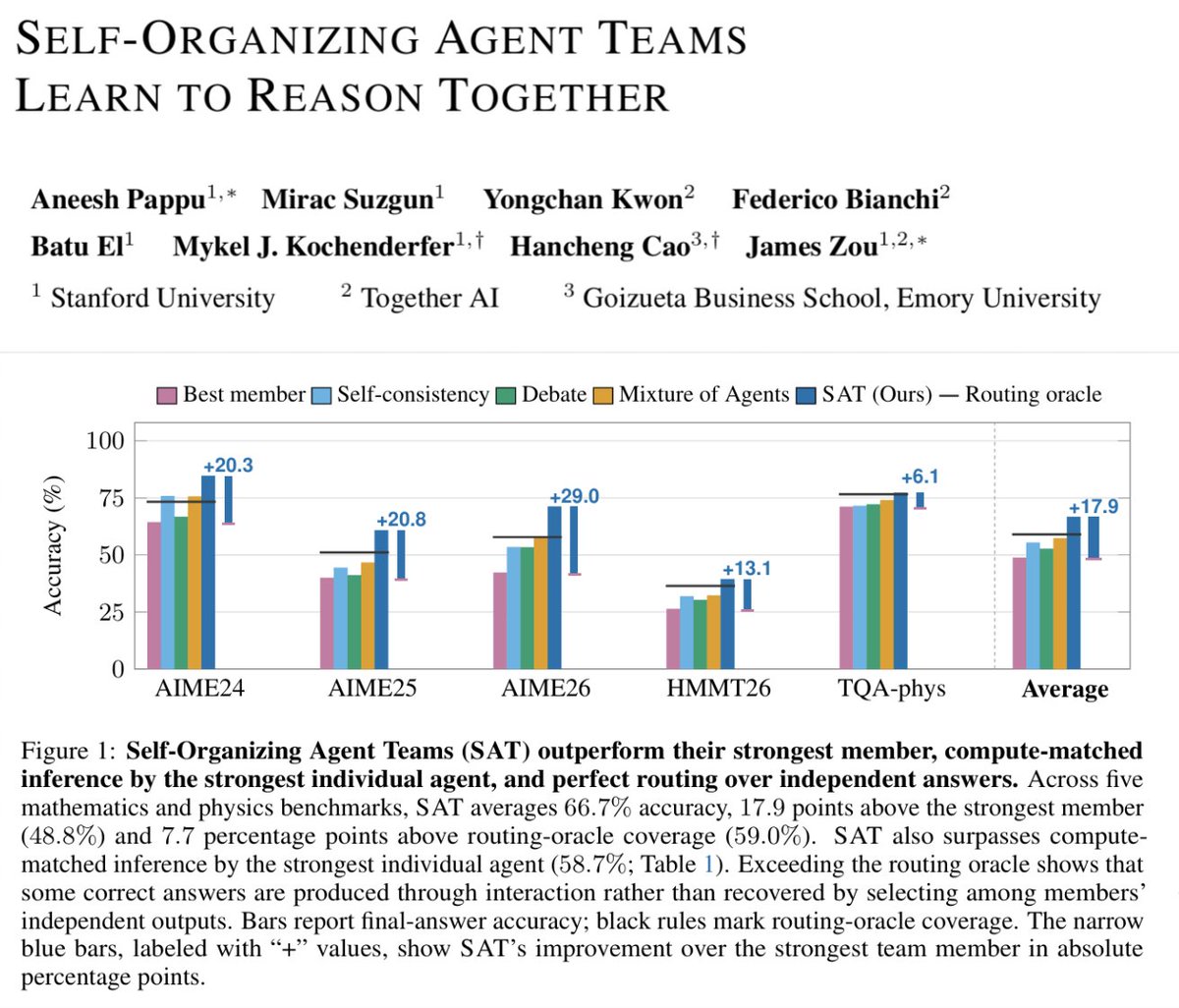
The recent breakthrough in Navier-Stokes has garnered a lot of attention to the new possibilities that emerge when agents work together.
We have been interested in this question for a while. How can a team of agents achieve more than agents working alone?
I'm excited to finally share our new work, "Self-Organizing Agent Teams Learn to Reason Together" 🧵