Trump’s visit to China is a reaffirmation of a major change. During the visit, what China and the US reached was not a breakthrough-style thaw, but a framework consensus on “maintaining stability amid competition.” This precisely indicates that the US diplomatic strategic focus has changed from “how to mobilise partners to confront China” to “how to maximise gains while stabilising China”.
The “blood bag model” has become the policy choice of the Trump administration – since it cannot profit by confronting China, it now turns to maximise the utilisation of the partners, exploiting their anxiety toward China. The US wants to convert the relations to make them continuously dependent and pay a high premium for that dependence.
The “chess piece model” and the “blood bag model” are fundamentally different: in the former, allies are still chess pieces with partial autonomy, while in the latter, they are merely repeatedly exploited and discarded after use.
Only by understanding this distinction can one decipher the seemingly contradictory phenomena in the current and future international landscape: China and the US continuously release signals of détente on the surface, but the US keeps escalating its security rhetoric, especially when it comes to one-on-one conversations with its partners.
There is a clear logic behind this. If China is no longer portrayed as a terrifying threat, the junior partners lose their source of anxiety, and the US loses the pretext to “bleed” its allies. At the same time, the US is not willing to openly confront China, because it is simply unwilling to bear the high costs such confrontation inevitably entails.
"India’s decision to relax Chinese FDI restrictions arrives at a moment when Washington is moving in the opposite direction. The implications for Indian firms embedded in global supply chains are not trivial."
https://t.co/grAx9Ni0uf
@oliverwkim "In our world, we know of no escape from poverty other than climbing the value chain. And perhaps the boldest attempt in recent memory is Indonesia’s gamble on nickel."
https://t.co/TRtY03xa2i
'If you want to feature on his recommended books list next year, just get the freebie version of ChatGPT to fart you out something called Rome: the First Reich. He will find it “fascinating”, “unexpected”, and “really thought-provoking”.'
https://t.co/UJ9VwPIrmp
"According to the International Renewable Energy Agency (Irena), the Middle East has less than 1 per cent of the world’s renewable capacity. But from a low base, it is also the fastest-growing region outside China, in terms of adding capacity."
@wstv_lizzi: "DeepSeek’s success as an isolated fluke would be shortsighted. Its achievements illuminate both the ingenuity born of constraints and the cracks in America’s current strategy."
https://t.co/HZECmxSxxj
"A little-known Chinese hedge fund has thrown a grenade into the world of artificial intelligence with a large language model that, in effect, matches the market leader, Sam Altman’s OpenAI, at a fraction of the cost."
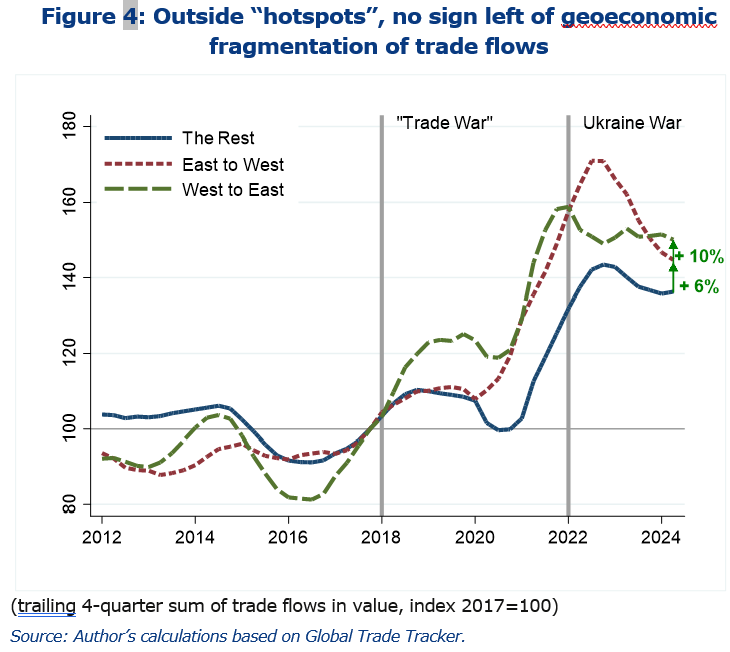
"This results in severe imbalances that give rise to increasing economic and political tensions. Widespread geoeconomic fragmentation of world trade is not visible, at least so far. In contrast, the geopolitically-motivated challenges to international coordination are striking."
"Geopolitical tensions have thus played a key role in shaping trade patterns in recent years, but not in the sense usually assumed. Rather than through political alliances or affinities, their most decisive influence has probably been over China’s economic policy choices."
Geoeconomic fragmentation, trade cold war?
Well… Take out 2 hotspots (Russia, China-US flows –5% of world trade), and there is nothing left to see: trade between (IMF-defined) “blocs” is no less dynamic than the rest.
https://t.co/omb5GQWcdk
@MacaesBruno: Remarkably, the very traits Westerners have projected upon the rest of the world – a cult of force and lack of concern with legitimate forms and processes – are quickly being re-appropriated by Western democracies themselves. Orientalism is coming home
An agreement between India and the U.S. on a fab for semiconductors explicitly to be used in defense technology is a seminal moment in the bilateral relationship. https://t.co/AN2jDUFRwJ
@warghetti: "And yet I have come to the point where words fail. Not because the words themselves aren’t up to the task of describing the savagery. But because I’m coming to terms with the inability of those words to effect any change in some listeners."https://t.co/T6kevEBAU3