Programmable accounts can now be on both sides of an atomic delivery-versus-payment (DvP) trade on Arxium.
For corporate treasuries, this means each side can exchange an asset for payment while enforcing its own account policies.
Both accounts apply their own spending limits, approved recipients, and current signing requirements. These checks hold even when the other party initiates the trade.
If either side fails its checks, the trade doesn’t settle. If both pass, the asset and payment settle together.
Each treasury keeps control over what its account is allowed to do, regardless of who starts the trade.
6,054,303 model states checked. 0 forks found.
We model-checked the rules Arxium uses to finalize blocks, using TLA+ and TLC.
The model follows the rules our validator software actually runs. It includes four validators, the nodes responsible for confirming blocks, with one allowed to act maliciously.
Every reachable state in that model was checked. No two conflicting blocks were accepted as final. That’s what “no forks” means here.
We also tested whether the model would catch a failure. We removed two key safety rules, one at a time. Both changes produced forks. With the actual rules in place, none were found.
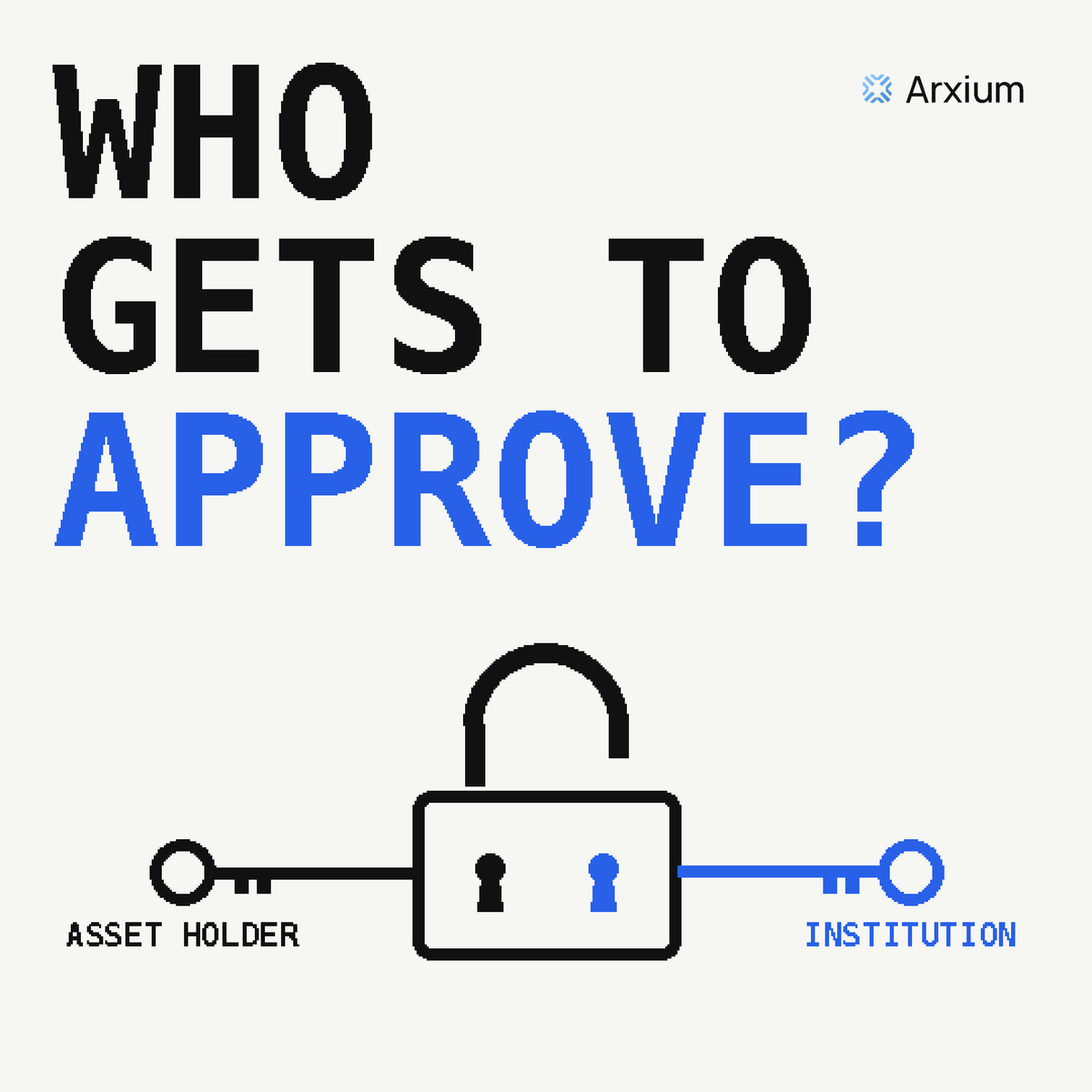
Who gets to approve a transaction when more than one party is involved?
Arxium supports configurable account authorization policies. An account can be configured to require multiple signatures, including signatures from both an asset holder and an institution.
Builders can use this to design treasury operations, institutional workflows, and shared account management with approval logic enforced at the protocol level.
KYC expires. Investor eligibility changes. A credential that was valid last month might not be valid today.
Arxium lets issuers define which attestations an asset requires and how recent they must be. The protocol checks eligibility on transfers, while personal data stays with the KYC provider.
For builders, that means working with verified claims without putting sensitive identity records on-chain.
Blocks, transactions, account history, validator activity. There’s a lot happening under the hood, and builders need access to it.
Retracer is taking shape as the data layer behind Arxium Explorer and Wallet, with REST APIs, searchable on-chain history, and real-time event streams via SSE and webhooks.
Explore retracer: https://t.co/BEeCcU6sFE
Validator honesty should be verifiable.
Arx Verify checks signed fault evidence and state proofs locally using WASM. No node, chain code, or network access required.
It verifies signatures, detects double-signing, and identifies execution disputes.
Explore the details: https://t.co/fkMX7oWtFF
Building a regulated product means knowing how it behaves before anyone relies on it
Arxium DevNet gives builders a place to:
• Claim test ARX from the faucet
• Explore the network through guided tracks
• Register assets and test their rules
• Inspect transactions, assets, and blocks in the public explorer
A place to test ideas, understand the network, and see how products behave under real constraints. So when it’s time for mainnet, builders know what they’re deploying
DevNet is coming soon. Start thinking about what you’ll build
Some issuer actions are too important to depend on one wallet
With multisig in Arxium Console, control can be shared across a team:
• Add multiple authorized signers
• Require more than one approval for issuer actions
• Prevent one person from acting alone
So if someone wants to make an issuer-level change, one click isn’t enough. The other required signers have to approve it too
Putting an asset on-chain shouldn’t mean losing control of who holds it.
Arxium Console will let builders set:
• KYC and accreditation requirements
• Allowed jurisdictions
• Holding limits
• Controls to freeze an asset or a specific holder
The network will enforce these rules at the chain level on every transfer, keeping ownership restrictions in place after issuance.
Try it on devnet soon.