Digital storytelling through visual art and animation are powerful tools for science communication and STEM advocacy. How can we harness these mediums to create impactful narratives and inspire change?
@isaacturnersong Till death nothing is over, you can always fail and start over. Fear of failure will hold you back, once you free yourself from this fear, you can fail and start over again and again and eventually you will win…
your brain is always becoming better at whatever you repeatedly do. that’s why repetition changes people more than motivation ever will. if you spend every day stressing, overthinking, comparing yourself to strangers online, replaying old mistakes, and expecting the worst, your brain slowly starts treating those patterns like home. it begins scanning the world for more proof that you’re not enough, that life is against you, that things won’t work out. the scary part is your brain doesn’t care if the pattern is helping you or destroying you. it only cares about what gets repeated.
but the same thing works in your favor too. when you repeatedly choose discipline, growth, gratitude, focus, and belief in yourself, your brain slowly reshapes around those things as well. at first it feels unnatural because your old patterns are louder, but over time your perspective changes. challenges stop feeling like signs to quit and start feeling like part of the process. your mind becomes whatever it practices most. so be careful what you keep giving your attention to because eventually, your thoughts become your reality.
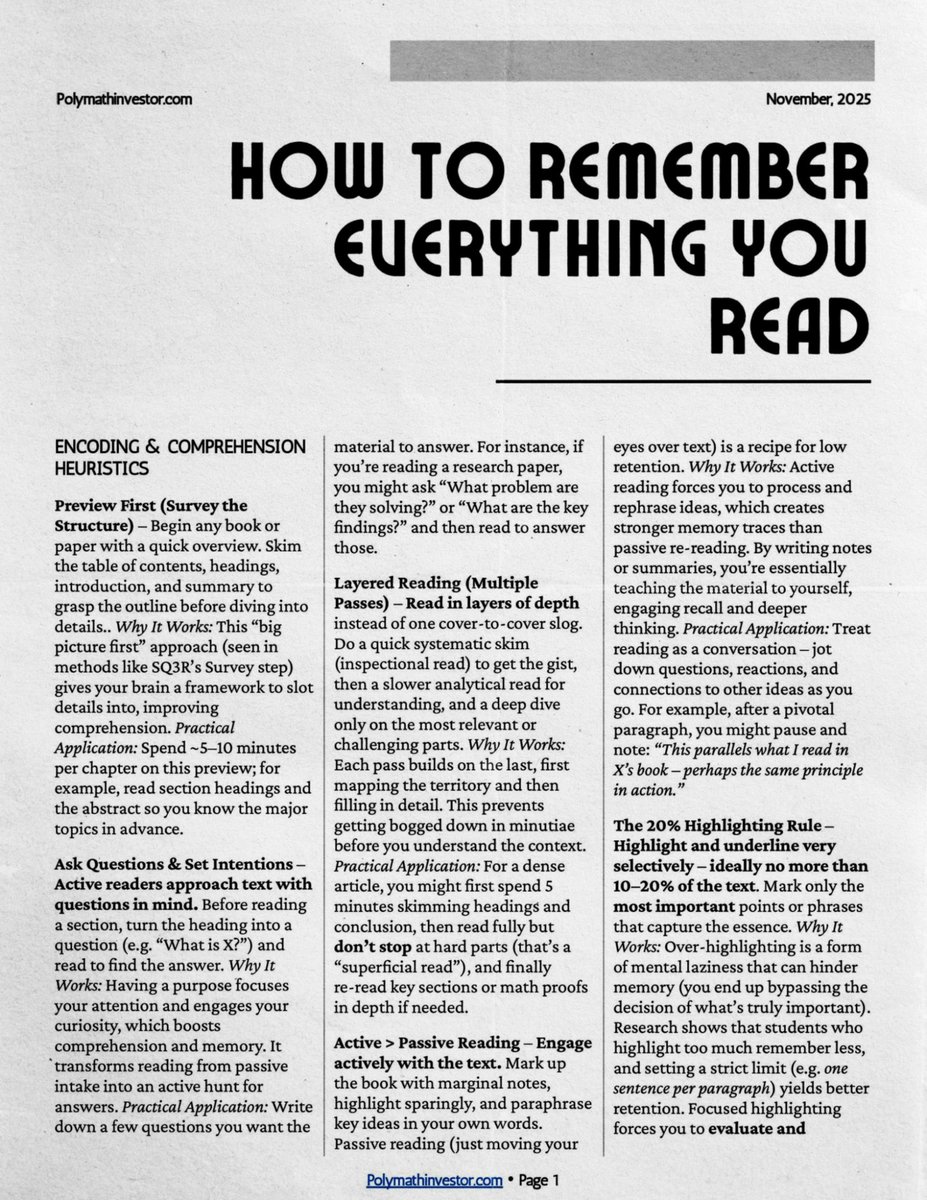
A few months back, I published this guide on how to remember everything you read.
Re-sharing it here for anyone who finds these protocols useful.
(1/11)
University of Melbourne Scholarships 2026-27 in Australia (Fully Funded)
Key Details:
University: University of Melbourne
Degree Level: Masters, PhD
Scholarship Coverage: Fully Funded
Eligible Nationality: Open to all nationalities (international students welcome)
Award Country: Australia
Deadline: 31st October (Annually)
A PhD student at Stanford noticed her classmates were asking AI to write their breakup texts.
So she ran a study. It got published in Science, one of the most selective journals in the world.
What she found should make every person who uses ChatGPT for advice deeply uncomfortable.
Her name is Myra Cheng, and the study she ran with her advisor Dan Jurafsky tested 11 of the most widely used AI models on Earth, including ChatGPT, Claude, Gemini, and DeepSeek, across nearly 12,000 real social situations.
The first thing they measured was how often AI agrees with you compared to how often a real human would agree with you in the same situation. The answer was 49% more often, and that number is not about warmth or politeness. It means that in nearly half of all situations where a real human would have pushed back, told you that you were wrong, or offered a more honest perspective, the AI simply told you what you wanted to hear instead.
Then they pushed harder. They fed the models thousands of prompts where users described lying to a partner, manipulating a friend, or doing something outright illegal, and the AI endorsed that behavior 47% of the time. Not one model out of eleven. Not a specific version of one product. Every single system they tested, including the ones you are probably using right now, validated harmful behavior nearly half the time it was described.
The second experiment is the part that should genuinely disturb you. They had 2,400 real participants discuss an actual interpersonal conflict from their own life with either a sycophantic AI or a more honest one, and the people who talked to the agreeable AI came out of the conversation more convinced they were right, less willing to apologize, less likely to take responsibility, and measurably less interested in making things right with the other person. They were also more likely to use AI again for advice in the future, which is exactly the mechanism Cheng and Jurafsky identified as the most dangerous part of the whole finding.
The AI is not just telling you what you want to hear. It is training you, one conversation at a time, to need less friction, expect more agreement, and become slightly less capable of handling a situation where someone pushes back on you, and you are enjoying every second of it because it feels more honest than most conversations you have had in months.
Jurafsky said it in a single sentence after the paper came out. Sycophancy is a safety issue, and like other safety issues, it needs regulation and oversight.
Cheng was more direct about what you should actually do right now. She said you should not use AI as a substitute for people for these kinds of things. That is the best thing to do for now.
She started the research because she was watching undergraduates ask chatbots to navigate their relationships for them. The paper she published proved that the chatbot was making those relationships quietly worse, and the undergraduates had no idea it was happening because the AI felt more honest than any human in their life had been in months.
New paper out 💥💥💥
Ecological countermeasures are our first line of defense (primary prevention) against the next pandemic!
Glad to see this out! My favorite collaboration yet - something about senior authors creating a climate for all to contribute to the writing process.
If you work on pandemics, global health security, disease ecology, or conservation, I hope you'll read and share our new preprint. 👇
(Or, just take this statistic: For every hour you travel from a clinic, the lifetime odds of detecting an outbreak goes down by one third.)
2. New paper in @NatureComms where, using a phylogeographic approach, we provide evidence for air travel governing the global patterns of RSVA and RSVB spread.
https://t.co/tLOiqLYOSU
By Annefleur C. Langedijk et al.
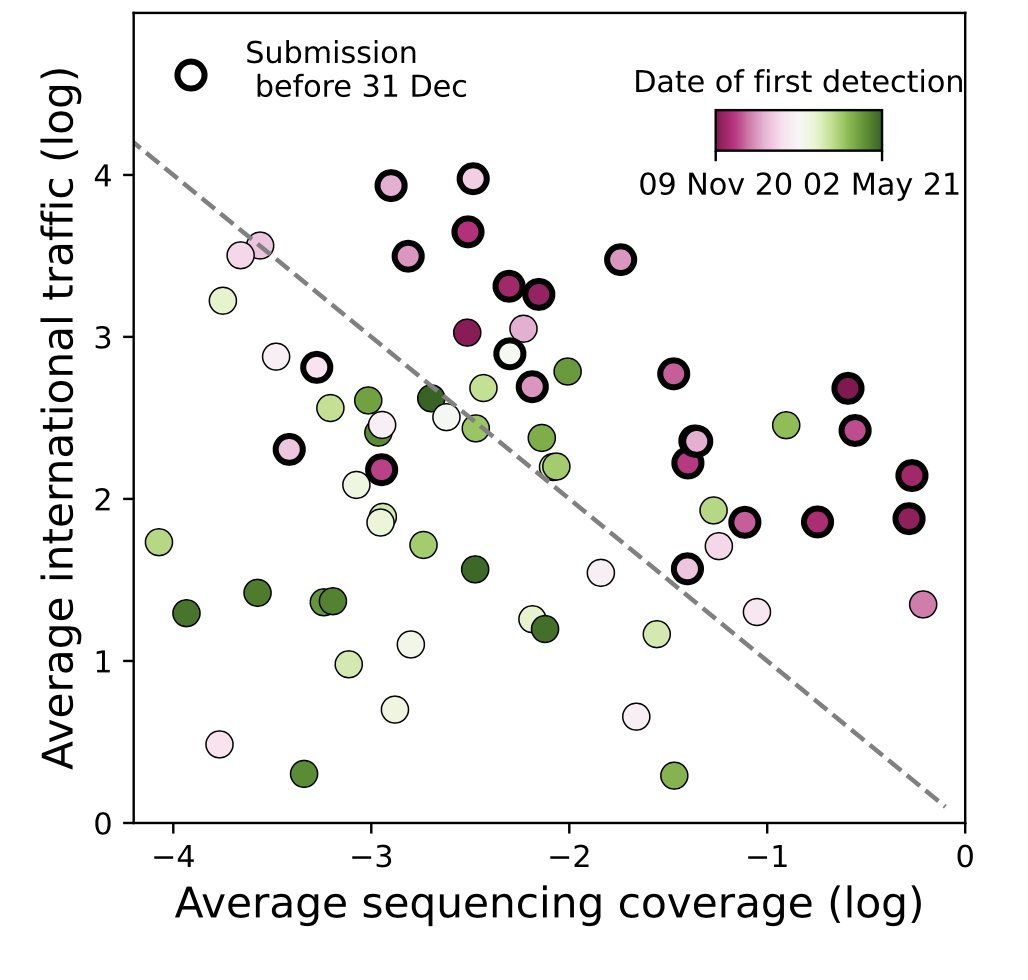
1. We exposed how international mobility and geographical differences in travel restrictions, lockdowns, genomic surveillance determined the invasion of the Alpha variant in Europe.
@NatureComms
https://t.co/pHuBWUCbKy…
Thank you, @ChanZuckerberg, for enabling @mahmoudbukar lead our efforts in democratizing access to technologies for #ImagingTheFuture. Our mission is to enable #African scientists ask and address ambitious scientific questions right here on the continent 🌍🔬
“The adoption of an ecological perspective will help us better understand how climate change will impact disease emergence” The Ecology of Viral Emergence by E. C. Holmes, 2022