“Let us prepare our minds as if we’d come to the very end of life. Let us postpone nothing. Let us balance life’s books each day. … The one who puts the finishing touches on their life each day is never short of time.” Seneca
The Rwanda Energy Group's Energy Development Corporation Limited has issued a pre-qualification call for Independent Power Producers to develop a landmark floating solar and battery storage project at Lake Sake, Ngoma District, Eastern Province, Rwanda.
SCOPE:
-Project Capacity: 200 MWac floating solar power plant
-Battery Storage: 800 MWh BESS (4-hour storage)
-Infrastructure: Associated grid evacuation infrastructure
-Long-term operation and maintenance under a Power Purchase Agreement
-Evening peak shaving and solar energy shifting
-Frequency and voltage support
-Reduced solar curtailment and improved grid stability
-Black-start capabilities
PRESS STATEMENT
WHY KENYA'S ELECTORAL SYSTEM MUST PASS THE CONSTITUTIONAL TEST
Fellow Kenyans,
Yesterday, I appeared before the High Court in a constitutional case concerning the Independent Electoral and Boundaries Commission (@IEBCKenya) and the integrity of Kenya's electoral system.
The petition asks the Court to test the entire chain of our elections - how Kenyans register, how they are identified at the polling station, how their votes are cast and counted, and how results are transmitted, verified and declared - against the standards the Constitution itself sets.
That question is simple to state: Does Kenya's electoral system meet the constitutional test?
Article 81 requires that elections be administered in a manner that is impartial, neutral, efficient, accurate and accountable. Article 86 requires that, whatever method is used to cast, count and transmit votes, that method be simple, accurate, verifiable, secure, accountable and transparent. The Elections Act sets the same standard for the technology IEBC deploys.
The Constitution anticipates an electoral process that is not just free and fair, but one that is also tamper-proof. Free and fair speaks to conduct on the day; tamper-proof speaks to the design of the system itself - whether it can withstand interference at any point in the chain, and whether that can be proven, not merely assumed.
To be clear, this case is not just simply about paper versus electronics.
Kenya's system already combines both - paper ballots, electronic voter identification, and electronic transmission of results. Technology, properly designed and independently verifiable, can be a powerful ally of electoral integrity: it can reduce unnecessary human discretion, create reliable audit trails, make results easier, not harder, to verify, and significantly reduce the cost of elections.
But technology is not self-certifying. It does not become trustworthy simply because it is technology. Like every other part of the electoral chain, it must be shown to satisfy the Constitution's own tests of transparency, verifiability, security and accountability - and, ultimately, to be tamper-proof.
That is the real question before the Court: does the entire electoral chain - registration, identification, casting, counting, tallying, transmission, verification and declaration - give Kenyans sufficient safeguards that their vote, once cast, cannot be manipulated, mishandled, or rendered impossible to verify?
This is not a personal quarrel with @IEBCKenya. It is a constitutional and public-interest matter.
Sovereignty in this country belongs to the people, and the vote is the sole instrument by which that sovereignty is exercised. An electoral system that cannot be meaningfully verified is not one the Constitution permits us to accept on faith.
I want to be precise about where this matter stands. The High Court has not ruled on the merits. The parties were heard, and the constitutional questions remain before the Court. I respect that process fully and will abide by whatever directions and determination the Court makes.
My role as a citizen, a public representative, and the petitioner in this matter is to ensure these questions are placed squarely before the Court and answered according to the Constitution and the law, not according to convenience or assumption.
Kenyans should not have to be told their votes were counted correctly. They should be able to verify it. That is the standard the Constitution sets, and it is the standard we are asking the Court to enforce.
The vote belongs to the people. The Constitution protects it. Our electoral system must do the same - free, fair, and tamper-proof.
We proceed, firmly and within the law.
God bless Kenya.
Okiya Omtatah Okoiti
When Companies make decisions about where to put their investments, the dispute resolution regime in place is key because disputes arise all the time. The “Mambo Matatu, pack and go” approach where the President can just shut down your business is very bad for investment and consequently, job creation. It is why we in Linda Mwananchi insist on a return to the Rule of Law. Thats our Plan!
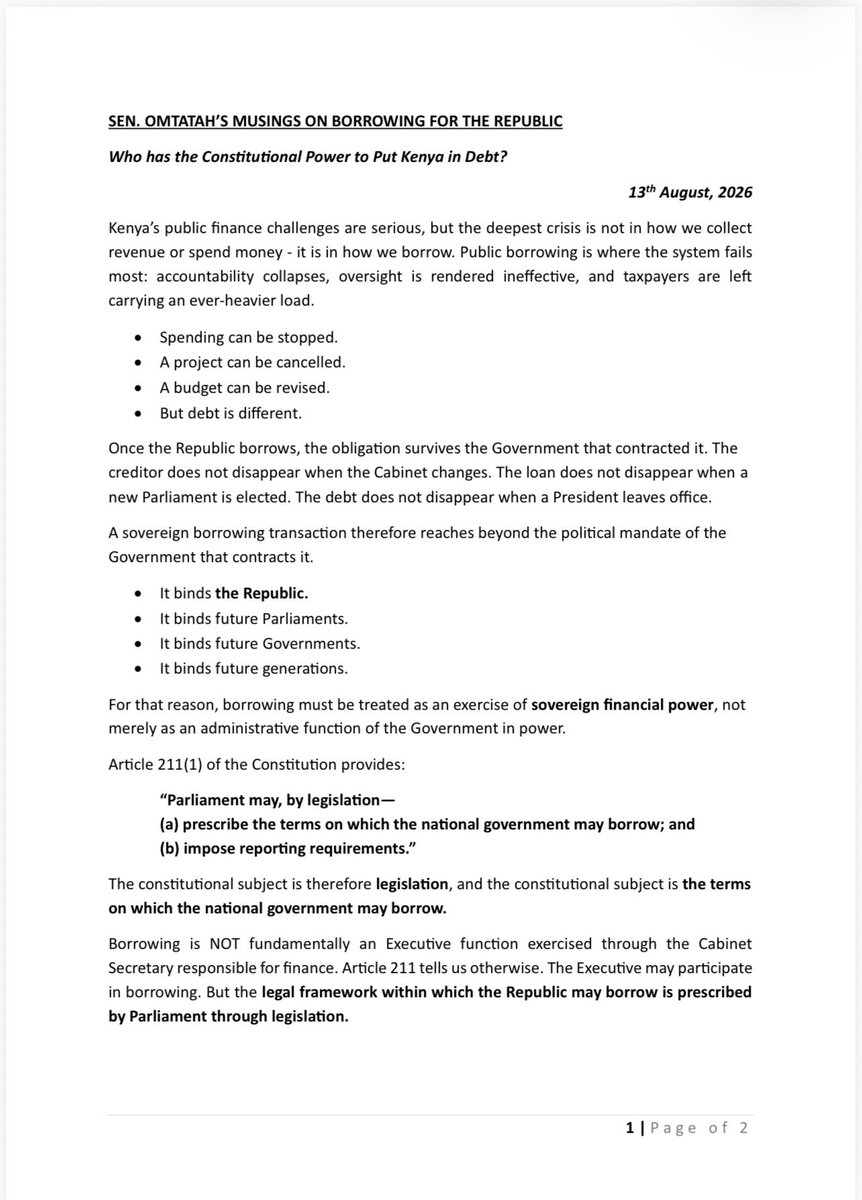
SEN. OMTATAH’S MUSINGS ON BORROWING FOR THE REPUBLIC.
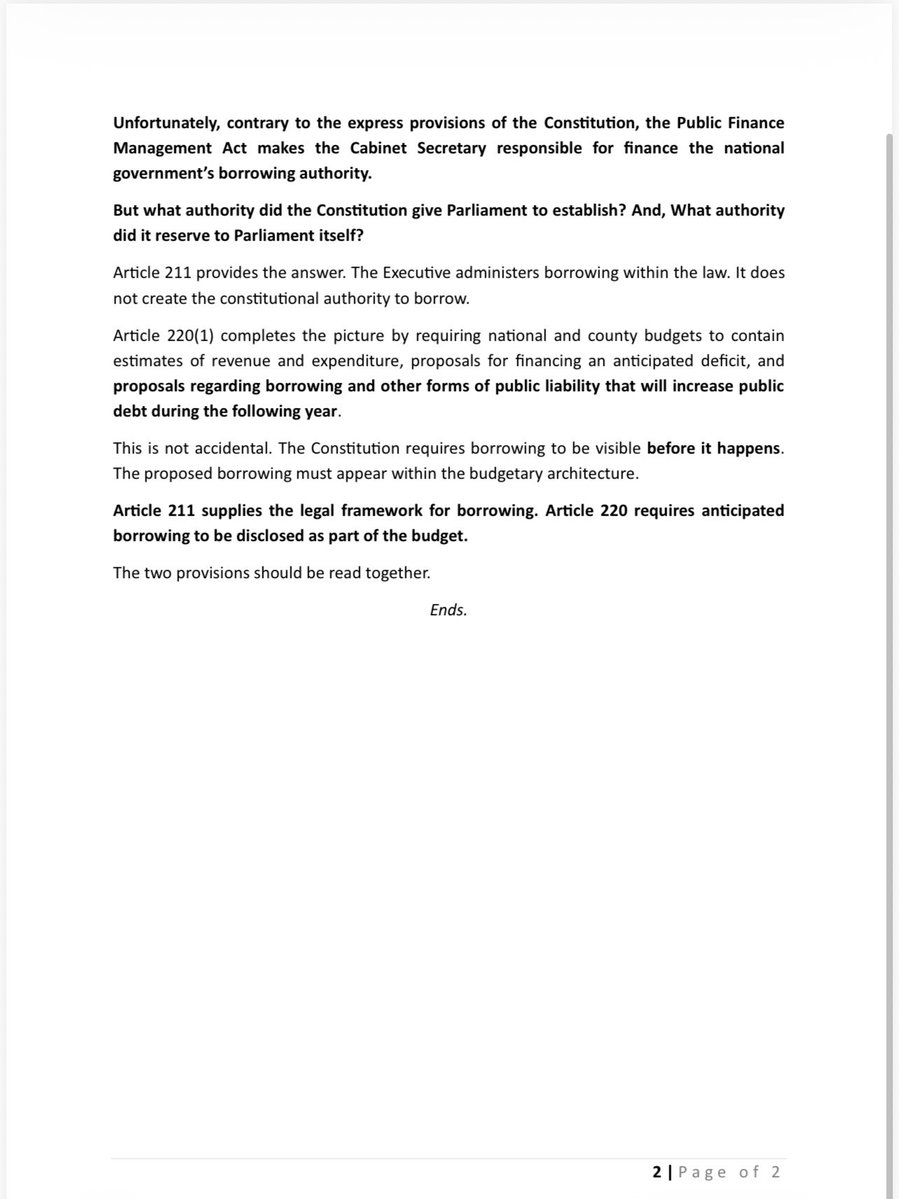
The REAL DANGER of public debt is not simply how much Kenya borrows, but WHO has the constitutional power to BIND THE REPUBLIC to that debt.
Does the Executive borrow, or does Parliament? Under Article 211, it sets the constitutional framework within which Kenya may borrow.
Debt outlives governments. It binds future Parliaments and generations. This deserves serious constitutional scrutiny.
I'm reminded of this day in August 2022 when I got the idea that I could do a public tally of the election. As they say, the rest is history. Days later, I delivered a full tally of the presidential election. Come 2027, we shall do it even better.
Dr Besigye to Judge Baguma:
Possibly, you may have to try us in absentia, so that it hastens the process, we give up our right to defend ourselves, you write a judgement and we deal with the judgment.
PRESS STATEMENT BY SENATOR OKIYA OMTATAH ON THE PUBLIC DEBT CASE RULING
Fellow Kenyans,
Today, the High Court delivered an important ruling in our public debt case.
The Court upheld the @IMFNews claim of diplomatic immunity and struck it out of this petition. While we respect the Court’s decision, accountability for Kenya’s debt burden cannot end there.
We are preparing a separate legal challenge to the Bretton Woods Agreements Act, 1963, against the Constitution of Kenya 2010 to ensure all actors involved in Kenya’s debt processes are subjected to proper scrutiny.
Most importantly, the Court rejected attempts by the Attorney General and other respondents to have this case dismissed. The judges ruled that our petition will proceed to a full hearing on its merits.
The Court also dismissed applications by the former Auditor General, former Controller of Budget, the current Auditor General, and the current Controller of Budget seeking to shield themselves from these proceedings.
This is a significant victory for transparency, accountability, and the Kenyan people.
We will amend our petition as directed by the Court and return on 22nd July 2026. Our mission remains unchanged: to establish how Kenya accumulated trillions in public debt, how the funds were utilized , whether the public benefited and whether the law was followed at every stage.
This case is about protecting the future of our nation and the interests of every Kenyan taxpayer.
We remain focused, determined, and committed to seeing it through.
God Bless Kenya.
#DeniBandia #OdiousDebt
@Safaricom_Care Please help me understand this logic. When I am out of data bundles, I cannot purchase a data bundle through the Mysafaricom app. Why absurdly would you not zero-rate access to the app that ensures your customers keep buying into your products🤷🏾♂️
There’s a Kenyan guy who critics Kenyan movies and TV shows and as a filmmaker, I LOVE his content. I’ve seen one where he talks about Sarah Hassan’s ceiling. I agree. One day I decided Kenya is no longer my competition, I ventured out, pitching myself to international filmmakers. I took a hiatus from Kenyan film for two years.
Those two years were difficult for me. I went broke and jobless until one day, that call came that changed my life. Now, I don’t have an Oscar MYSELF, yet, nor I’m not yet where I want to be, but I’ve shot Hollywood movies, European TV shows and countless award winning international TVCs, I’ve travelled the world to so and many of those movies are award winning.
Today, I have written a movie about a certain terrorist attack in Kenya and pitched it to one of my American friend who’s a known director globally. He wants to do it, he’s trusted the story enough that he and his partner have put their money into the project. Sure, they’ll own 60% rights and while we are a team of 3 writers and 6 story developers and 4 researchers, I’m the lead writer and the credits will read “written and Created by Quincy Wandera”. We are now working on the final script. Maybe that’s my Oscar moment.
All this because I took a risk to be broke and now, it’s paying off. My Kenyan film community, we CAN compete with the world. But we have to WANT to do it.