🔥 FUN FACT: Bitcoin was never meant to reach exactly 21,000,000 BTC because rewards are paid in whole satoshis, and the final fractions are rounded down and can never be issued.
JPMorgan just published the scariest oil chart I’ve ever seen.
World inventories are in freefall.
And when this line hits 6.8 — the global energy system doesn’t slow down.
It breaks. 🧵
Tom Lee explains his $62,500 ETH price target
“If we clear this Middle East problem and the US economy holds up through higher oil, I think we’re looking at a bull market that could run through 2028. A major move in equities is the setup… and here’s something to keep in mind. Since the war started, the best performing asset in the world — outperforming energy stocks — was Ethereum. It outperformed the S&P 500 by almost 20 percentage points, and you can see it has massively outperformed gold and silver. And if you take a look at Ethereum’s chart over the last 10 years, I think it’s going through a massive consolidation.”
In its first consolidation of 2016, Ethereum went on to rise by 227x. In the second consolidation of 2018 and 2019, Ethereum rose by 54x. Tom points out that Ethereum is in the midst of its third consolidation:
“I think there is a massive move coming in Ethereum, driven by a couple of things: tokenization and agentic AI… I think this means you can get something like a 25x for Ethereum.”
Tom gives a quick overview of the tokenization thesis:
“I think we’re going through an important moment in the financial system that’s not too different from 1971. Tokenization is making almost every asset synthetic, and it follows a roadmap that happened when the US went off the gold standard in 1971. This led to a huge unleashing of innovation and products from money market funds to currency futures to CDOs to indexed futures all because the US was trying to preserve the sovereignty of the dollar when we went off the gold standard. I think that’s happening today because we’re digitizing everything.”
He points to the following quote from JPMorgan CEO Jamie Dimon (formerly one of crypto’s biggest skeptics): “Crypto is better than the current financial system.”
Tom continues:
“I think everyone who’s building in crypto is going to develop these future products — stablecoins, tokenized equities, monetized reputation. It’s also part of the future agentic system.”
On a separate slide he points out all of the things Agentic AI will need that work better on crypto rails. Two are identity and payments. “Agents almost certainly won’t want to use PayPal or Visa or MasterCard to do micropayments,” Tom argues.
Lastly, Tom turns to price:
“Blockchains should gain relevance against against crypto’s store of value, which is Bitcoin. In our minds, the way to think about the future of Ethereum is its price ratio to Bitcoin The 8-year average was 0.0479. The high was 0.087… We think fair value for Bitcoin is $250,000, so if Ethereum goes back to the 8 year average, that’s $12,000 ETH. If Ethereum goes back to its 2021 high, that’s $22,000 ETH. But of course I think it’s better positioned today than it was in 2021. So that gets us to what we think is the ‘payment rails’ number — that Ethereum is going to be roughly a quarter of the value of Bitcoin. And that gets you to $62,500. And that’s kind of following the previous historical price cycles.”
Source: @signalweek (May 2026)
Read Etherealize's "Productive Money" report on the path to $250,000 ETH below 👇
Central banks are moving to Ethereum. 🚨
UBS. Société Générale. Banque de France.
Not experimenting. Not piloting.
Bringing real repo markets on-chain.
The global repo market is worth $12.5 trillion.
1% on-chain means $125,000,000,000 flowing into Ethereum.
> BlackRock tokenized bonds.
> Franklin Templeton tokenized ETFs.
> Central banks tokenizing repo markets.
Retail is still debating which L2 will win.
Institutions already chose the base layer.
They're not coming to Ethereum.
They're already here.
STABLECOINS JUST FLIPPED THE US BANKING SYSTEM (ACH) 🚨
Stablecoins processed $7.2T in February, surpassing ACH at $6.8T for the first time ever.
That’s not crypto hype -- that’s core financial infrastructure getting replaced in real time.
This is the signal: capital is moving to rails that are 24/7, global, and instant. No banks, no weekends, no borders. Cross-border flows and B2B settlement are driving this -- not retail speculation.
Bitcoin is the reserve asset, but stablecoins are becoming the plumbing of the system. Follow the rails, follow the liquidity. 🌊
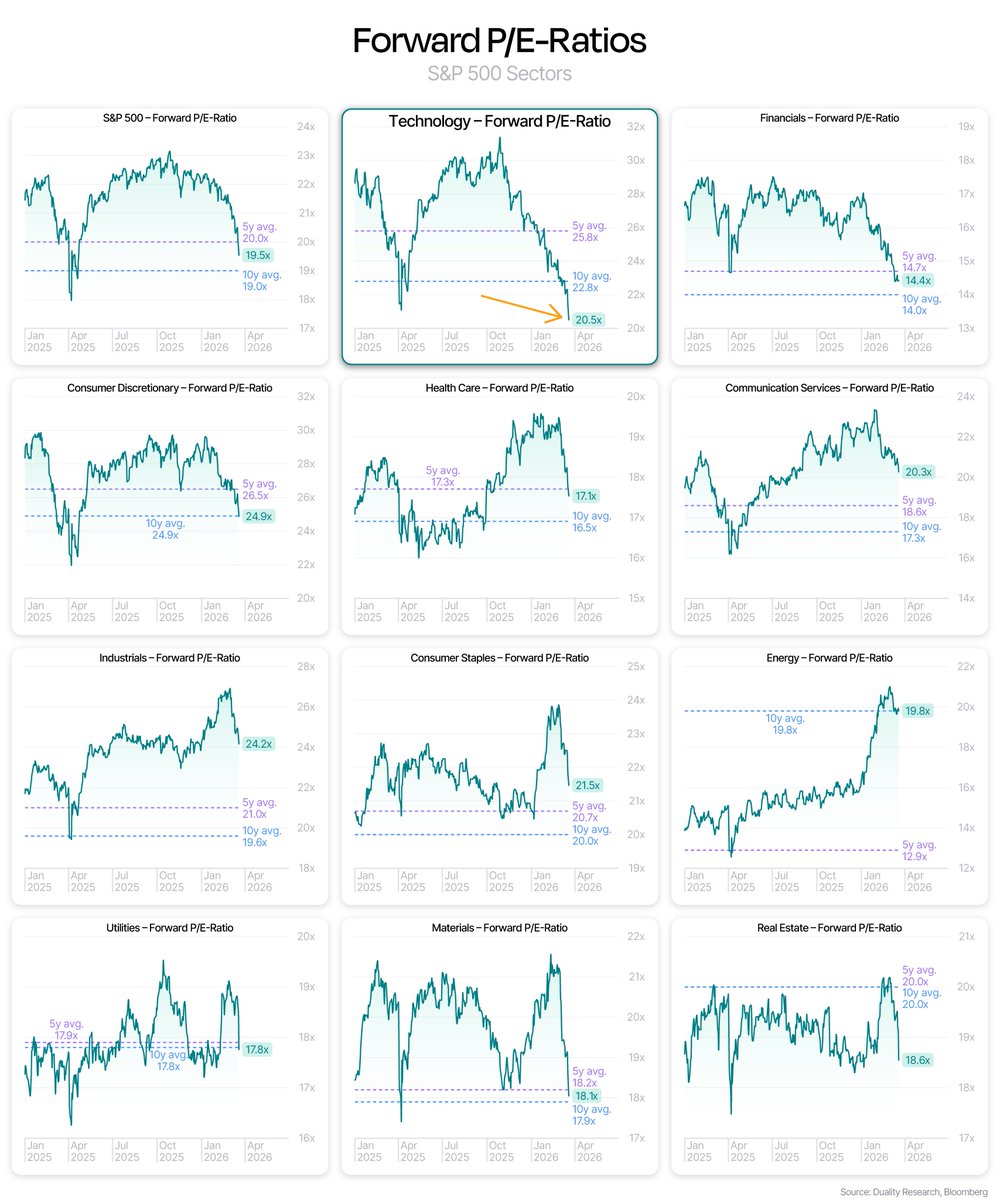
The S&P 500 Technology sector is now trading below last year’s tariff-selloff lows.
As a result, Tech trades at a 21% discount to its 5-year average P/E ratio and 10% below its 10-year average, making it the most discounted sector in the S&P 500.
Is the market setting up for a rally?
The S&P 500 is down -5% since the Iran War started, now 15 trading days into the sell-off.
In previous geopolitical conflicts, US stocks bottomed around day 15 on average, based on over 30 major geopolitical shocks since 1939.
The current sell-off is tracking almost exactly in line with the historical average and median path.
After the typical bottom, the average recovery lasted for ~40 trading days.
From there, stocks tended to move higher after reaching their pre-event levels.
Is the usual geopolitical playbook set to repeat?
Most professionals are about to be blindsided by the biggest shift in the history of work.
Jensen Huang just told you exactly how to survive it.
He said the single most important thing any student or professional can do right now is learn how to interact with AI, not just use it, but master it.
ChatGPT, Gemini Pro, Claude, these are not optional tools anymore, they are the new baseline competency for every field on Earth.
He named law, medicine, chemistry, and biology specifically, because the message applies to every profession without exception.
Prompting AI is not just typing a question into a box and hoping for an answer.
Huang described it as an artistry, the skill of asking the right question in the right way to unlock genuinely useful output.
Most people are terrible at asking questions, which means most people are already falling behind.
Goldman Sachs estimates 300 million jobs globally are exposed to AI automation, and that exposure is accelerating faster than most institutions are prepared to handle.
89% of senior HR leaders surveyed by CNBC already believe AI will fundamentally reshape roles at their companies within the next 12 months.
Huang made the competitive threat explicit, you will not necessarily lose your job to AI but you will lose it to a person who uses AI better than you do.
The divide forming right now is not between the educated and uneducated , it is between those who can wield AI as a force multiplier and those who treat it as a novelty.
The professionals who build this skill in 2026 will have a compounding advantage that grows every single year as AI models get more powerful.
Those who wait will not just be behind, they will be structurally locked out of the opportunities that define the next decade.
The blueprint is in front of you, the only variable is whether you act on it.
A blog post just wiped $30 billion off IBM in a single afternoon.
Not a product launch. Not an earnings miss. Not a competitor undercutting on price.
A five-minute blog post explaining that Claude can read COBOL.
IBM dropped 13%. Worst single-day loss since October 2000. Twenty-five years of stock resilience ended by one AI company publishing a capability update.
Here’s what happened:
95% of ATM transactions in America run on COBOL. Hundreds of billions of lines power banking, airlines, and government systems. The developers who built them retired decades ago. The knowledge left with them. Finding engineers who can even read COBOL gets harder every quarter.
IBM’s moat was never the technology. It was the fact that nobody else could understand it. Entire consulting empires existed because the code was too old, too tangled, and too critical to touch. Companies paid IBM billions because the alternative was catastrophic system failure.
Then Anthropic published a blog post saying Claude Code can map dependencies across thousands of lines of COBOL, document workflows, identify migration risks, and translate legacy logic into modern languages. Modernization in quarters instead of years.
The market heard: the priesthood just lost its monopoly on the sacred language.
And this isn’t the first time. Last week Anthropic announced Claude Code Security for vulnerability scanning. CrowdStrike dropped. Okta dropped. Cloudflare dropped. One company is serially destroying legacy moats with blog posts.
Now here’s where it gets surreal.
This same company, on the same day, also published evidence that three Chinese AI labs ran 24,000 fake accounts and 16 million exchanges to steal Claude’s capabilities. DeepSeek used it to build censorship tools. MiniMax pivoted within 24 hours when a new model dropped, redirecting half its traffic to steal the latest version.
And yesterday, the Pentagon summoned this same company’s CEO for what officials called a “sh*t-or-get-off-the-pot meeting,” threatening to blacklist them like Huawei for refusing to let the military use Claude without safety restrictions.
Three stories. One company. Twenty-four hours.
The company destroying legacy moats faster than the market can reprice them is simultaneously being threatened by its own government and looted by foreign competitors.
Anthropic is valued at $380 billion. Its CEO says a 12-month delay in AI would make him bankrupt. The Pentagon wants to designate it a supply chain risk. Chinese labs are running industrial espionage against it. And it just proved it can vaporize $30 billion in market cap with a Monday morning blog post.
Whatever you think about AI disruption, IBM’s stock just settled the argument.
Full institutional analysis on my Substack.
https://t.co/AEv8EMPdsZ
Bitcoin for Corporations 2026 convenes CEOs, CFOs, treasurers, investors, and builders shaping the future of Digital Capital, Digital Credit, and Digital Equity.
Join us next week in Las Vegas — or via livestream. https://t.co/jW0hqfQeeR
🚨 STABLECOINS JUST BEAT MASTERCARD
Stablecoin volume JAN: $11 TRILLION
Mastercard volume YEAR: $10 TRILLION
One month just matched a full year of legacy rails.
JORDI VISSER on Wolf of All Streets:
We’re moving from human adoption "slow" to AI agents "instant".
That’s why ETH matters.
🔹 No swipe fees
🔹 No permission
🔹 No bank accounts
🔹 Over 50% of stablecoins are on ETHEREUM
AI agents execute in code.
Stablecoins are the dollars.
Ethereum is the settlement rail.
Are you positioned for AI to AI commerce, or still trading headlines?
$ETH
🚨 JUST IN: WORLD’S LARGEST $ETH HOLDERS REVEALED
Ranked by ETH held:
🔹 BITMINE - 4.326M ETH
🔹 BINANCE - 4.16M ETH
🔹 BLACKROCK - 3.42M ETH
🔹 COINBASE - 2.9M ETH
🔹 UPBIT - 1.52M ETH
That’s 15.3M ETH.
12.7% of total supply.
Held by just 5 entities.
$BMNR
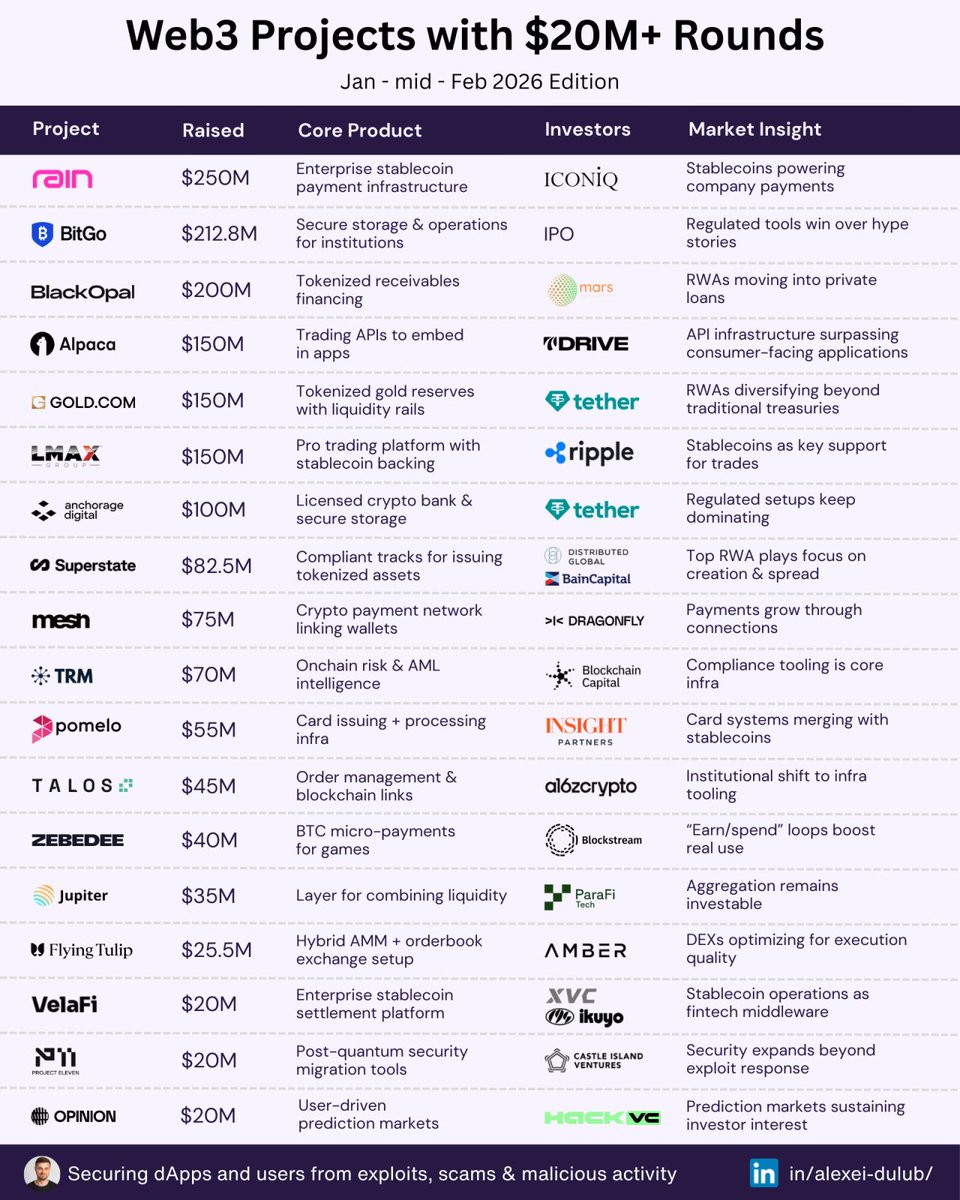
Over $2B of VC funding flowed into crypto in Q1, and almost none of it went where crypto Twitter thinks.
The biggest rounds weren't for L1s, memecoins, or Agential AI integrations.
They went to stablecoin infrastructure, custody solutions, and real-world asset tokenization.
- Rain raised $250M.
- BitGo filed a $212M IPO.
- BlackOpal secured $200M.
The loudest voices in crypto still obsess over token prices and retail focused products.
Meanwhile, institutions are quietly building the pipes that will carry TRILLIONS.
And this capital allocation reveals where the actual value creation is happening.
→ Custody platforms are reaching operational maturity.
→ Stablecoins are becoming enterprise payment infrastructure.
→ Tokenized assets are moving beyond treasury products into private credit and commodities.
Here's everything you missed:
1/ Stablecoin infrastructure pulled in over $495M of VC funding across Rain, LMAX Group, VelaFi, and Mesh.
2/ Institutional custody saw BitGo, Anchorage Digital, and Talos raise a combined $357M.
3/ Real World Assets attracted $432M through BlackOpal, Superstate, and Gold (dot) com
4/ Trading and fintech convergence brought in $205M via Alpaca and Pomelo.
5/ Security and compliance raised $90M through TRM Labs and Project Eleven.
6/ ZBD, Jupiter, Flying Tulip, and Opinion combined for $120M.
So yeah, consumer products remain active - but infrastructure dominates the biggest rounds.
The practical takeaway?
Follow the capital, not the noise.
The institutions writing $100M+ checks are betting on infrastructure that connects crypto to existing financial systems.
Not on speculation. Not on hype cycles.
They’re looking at the pipes, rails, and compliance layers.