This is really big news. Google introduced the Open Knowledge Format (OKF) - a standardized way to store information in a directory of markdown files. Makes it really easy to make a digital brain that agents can use.
These files can serve as a living wiki. You can give agents the ability to query them or edit them. They can interlink.
Seems to me this could replace Notion or Obsidian. I can think of so many uses for this.
Google's blog post: https://t.co/DqSjg4UpvH
An easier to understand explanation is the SPEC.md file:
https://t.co/A3qSz3Tfas
I gave those two links to Antigravity and asked how we could use it for any of the projects we're working on. It came up with so many ideas. I would imagine Claude Fable 5 would whip up some pretty amazing things based on this system.
Currently creating an OKF library of our pepper garden. It's going to be a fun weekend.
Developers can use Gemini 3.5 Live Translate to build near real-time voice translation experiences, including live interpretation for multilingual calls, meetings, lessons, broadcasts and more.
Watch the Gemini Live API in action, which enables dubbing and simultaneous multi-language translation:
Developers can use Gemini 3.5 Live Translate to build near real-time voice translation experiences, including live interpretation for multilingual calls, meetings, lessons, broadcasts and more.
Watch the Gemini Live API in action, which enables dubbing and simultaneous multi-language translation:
@ManikkageYasuni I usually check a person's area of expertise. I never follow medical advice unless it comes from an actual medical professional. When it comes to other subjects like the economy, politics all are experts.
I have to disagree with the idea that university education is too theoretical and creates a gap in the job market. The real purpose of a university is to train students to create new knowledge. A university's core focus shouldn't just be about feeding the job market—it needs to be on research and driving entrepreneurship. If someone is solely focused on immediate job market success, they should be looking into professional qualifications instead, like CIMA or NDT or similar course/program
Dario is wrong.
He knows absolutely nothing about the effects of technological revolutions on the labor market.
Don't listen to him, Sam, Yoshua, Geoff, or me on this topic.
Listen to economists who have spent their career studying this, like @Ph_Aghion , @erikbryn , @DAcemogluMIT , @amcafee , @davidautor
Anyway, to burn this many tokens, you have to be a next level developer. Maybe the top 1% still struggle to burn this many tokens in the near future. I think we (humans) have cognitive limitations ( I experienced it, maybe my limitation), where AI does not.
$250k sounds like a lot—until you zoom out.
As AI companies scale, their revenue climbs. More revenue → more model training → more compute demand → more GPUs.
So who really benefits? 😁 Good for Nvidia.
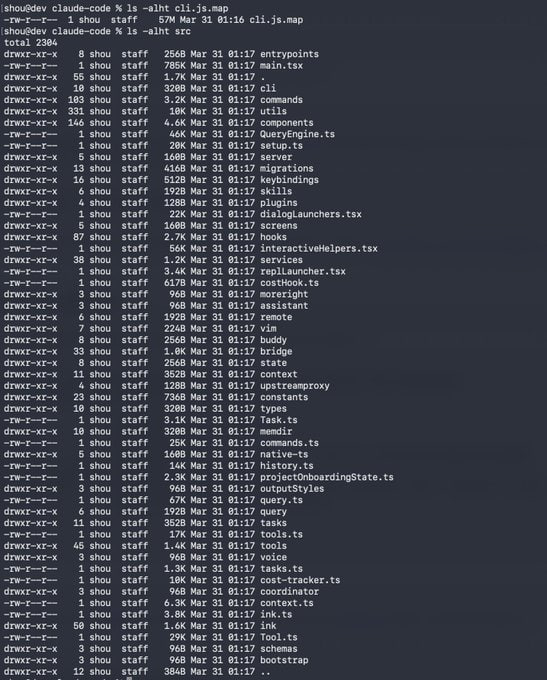
Anthropic accidentally leaked their entire source code yesterday. What happened next is one of the most insane stories in tech history.
> Anthropic pushed a software update for Claude Code at 4AM.
> A debugging file was accidentally bundled inside it.
> That file contained 512,000 lines of their proprietary source code.
> A researcher named Chaofan Shou spotted it within minutes and posted the download link on X.
> 21 million people have seen the thread.
> The entire codebase was downloaded, copied and mirrored across GitHub before Anthropic's team had even woken up.
> Anthropic pulled the package and started firing DMCA takedowns at every repo hosting it.
> That's when a Korean developer named Sigrid Jin woke up at 4AM to his phone blowing up.
> He is the most active Claude Code user in the world with the Wall Street Journal reporting he personally used 25 billion tokens last year.
> His girlfriend was worried he'd get sued just for having the code on his machine.
> So he did what any engineer would do.
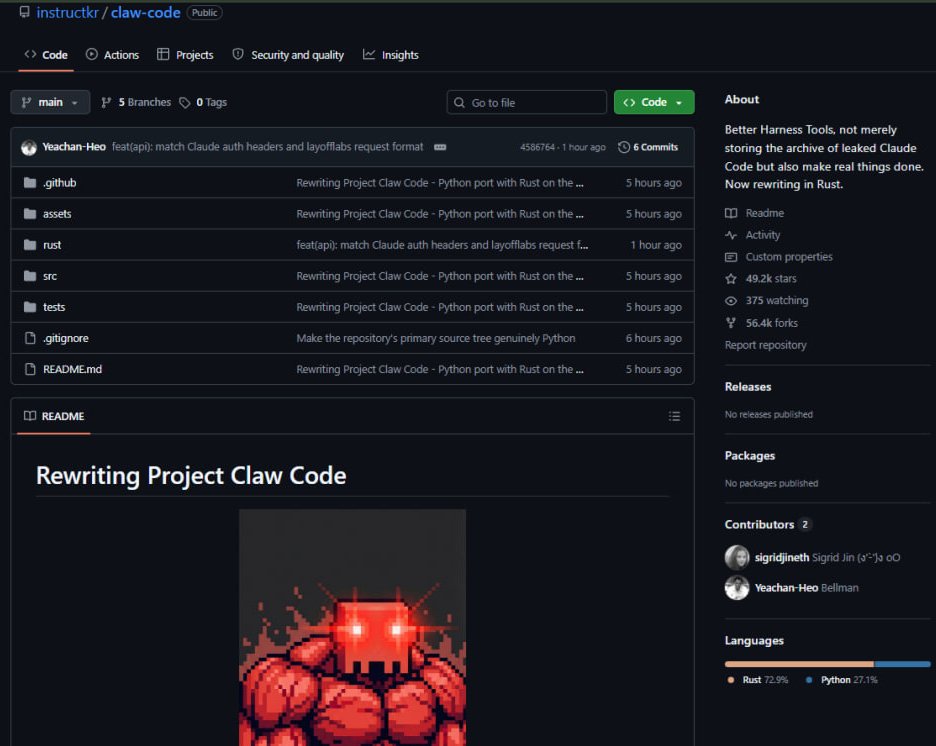
> He rewrote the entire thing in Python from scratch before sunrise.
> Called it claw-code and Pushed it to GitHub.
> A Python rewrite is a new creative work. DMCA can't touch it.
> The repo hit 30,000 stars faster than any repository in GitHub history.
> He wasn't satisfied. He started rewriting it again in Rust.
> It now has 49,000 stars and 56,000 forks.
> Someone mirrored the original to a decentralised platform with one message, "will never be taken down."
> The code is now permanent. Anthropic cannot get it back.
Anthropic built a system called Undercover Mode specifically to stop Claude from leaking internal secrets. Then they leaked their own source code themselves. You cannot make this up.