People often point to The Matrix as the most Baudrillardian movie ever made, but it's Once Upon a Time in Hollywood that nails it. Baudrillard argued that images (any copy or representation of reality, like a map or a film) gradually stop representing reality and start replacing it, as people begin to model their lives after the image, which leads to what he calls the "hyperreal," a copy that feels more real than the thing it copies. Tarantino, intentionally or not, plays with similar ideas and the film ends by replacing history itself.
First, the central pair. Rick Dalton (DiCaprio's character) plays tough Western guys on screen but is portrayed as insecure in real life. Cliff Booth (Brad Pitt) is the tough guy: the war vet who loves to drive, fix stuff, fight, and, when needed, actually kills. Rick is the image, wishing he could live up to the characters he plays, and Cliff is the closest thing to the archetype behind it. This is the least subtle parallel, since Cliff is literally Rick's stuntman, living in a trailer behind a drive-in movie screen.
The 1969 LA around them is hyperreal, built from the era's own images and signs (billboards, ads, TV shows, movie marquees, etc.) so heavily curated that it feels even more real than the LA of the time. The radio that plays throughout the movie for instance is real 1969 KHJ audio that Tarantino edited into his own version of the station, as if he was aware that the original wasn't going to be "accurate" enough to pull off the vibe.
The film itself is made of hyperreal layers. DiCaprio, an actor, plays an actor who made his name as a TV cowboy, is now forced to play villains, wants to play heroes again, and is told to go make Westerns in Italy. In the film's best scene, Rick, playing a villain on a TV western, forgets his line mid-scene and has to call for it. By then, the viewer is fully immersed in the scene within the scene, so when the spell breaks and the fictional set is revealed, the villain Rick was playing feels more real than Rick (also a joke on the industry, as the characters actors play often feel more real than the actors).
In another scene, Sharon Tate (Margot Robbie) goes to watch herself in The Wrecking Crew, a film she appeared in that was released a few months before she was killed. What plays on screen is footage of the real Tate, or rather, her image, i.e., Tate playing a character in a film, watched by an actress playing her. By the end, the copy of the copy is the one who gets to live.
Spahn Ranch, the old Western movie set where the Manson Family actually lived, is also the set where Rick and Cliff used to work on Bounty Law, the show that made Rick famous. The Manson Family, real violent killers, living in a place built to stage pretend violence already blurs the line between fiction and reality, and Tarantino pushes it further by making it the fake frontier town where the film's protagonists are "forged."
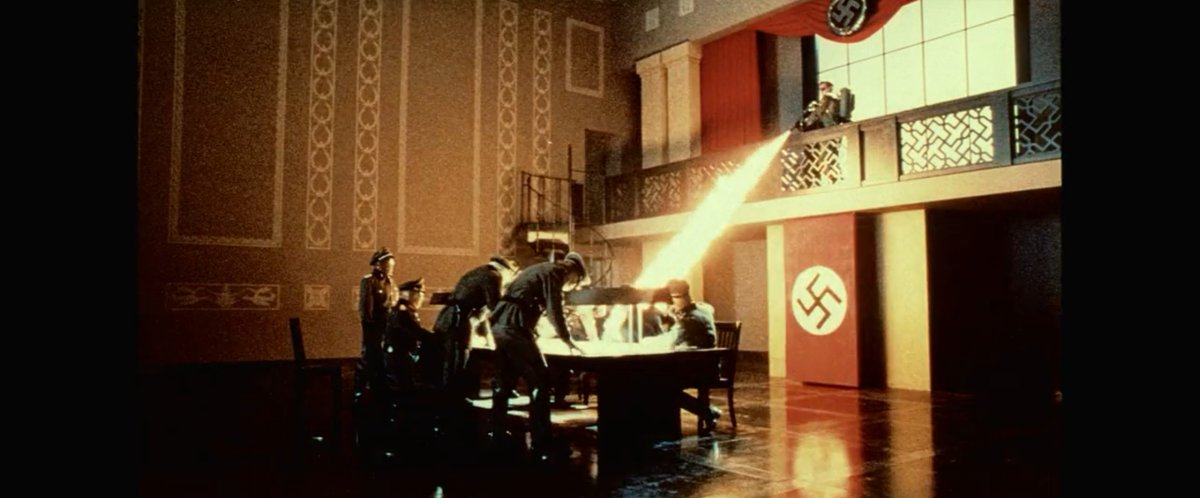
Finally the ending. The Family members, after recognizing Rick from Bounty Law, drop their plan to murder the people at Tate's house because one of them, Sadie (who calls every TV actor in the 50s a fascist), argues that TV taught them to murder, so they should kill the people who taught them instead. The image wants to kill the image. Instead, Cliff and his dog take out two of them, and Rick (who complains about hippies throughout the entire film) finishes off Sadie with a flamethrower he kept from an old movie he starred in as, ironically, a Nazi-killer. The murders that really happened never take place, and the one who blamed TV for teaching them to kill is killed by a prop from a fictional WWII movie (whose scene is a clear reference to Tarantino's own Inglourious Basterds, a WWII revisionist film).
Baudrillard famously called The Matrix the kind of film the matrix would make about itself, and said it confuses his theory of simulation with Plato's old cave allegory, i.e., an illusion you can simply wake up from if you decide to exit it. OUATIH is closer to Baudrillard's theory as nobody "wakes up." Every time the illusion breaks, another illusion underneath feels more real than the last until real history is overwritten by a fake version.
It's also fitting that the film is set at the end of Hollywood's golden age, since today few events are treated as real unless framed within Hollywood's conventional morality tropes, with human history having been reinterpreted accordingly. The official title itself hints at it with the dots: "Once Upon a Time... in Hollywood", as if to say, "History, according to Hollywood."
Algo incontestável deve ser dito sobre Luiz Inácio Lula da Silva: ele não é apenas um político normal numa democracia, porque algo em sua pessoa encarna profundamente um aspecto sombrio do brasileiro que nenhum outro político desde 1988 conseguiu recriar.
Luiz Inácio é sui generis, e só Getúlio o supera historicamente como político brasileiro - isso não é mérito moral nenhum. É como se Luiz Inácio fosse um "tipo ideal platônico" ambulante que serve de espelho quando se pensa no lado ruim do Brasil e do brasileiro.
Como explicar que um confesso mentiroso contumaz consiga cinicamente mentir não uma, nem duas, nem três, nem quatro, nem cinco, mas SEIS vezes em eleições e sair vencedor ininterrupto de quatro, numa era cheia de fact-checking, IAs e internet?
Como explicar que o líder do partido mais corrupto da história brasileira não apenas se safe por aí dizendo que "não sabia de nada", mas ativamente promova a candidatura de corruptos condenados como José Dirceu e Delúbio Soares nas ruas do país sem a menor vergonha e desfaçatez?
Como explicar que o presidente que cedeu a nossa soberania nacional na Amazônia para centenas de ONGs internacionais sem o menor escrúpulo, e que ao mesmo tempo que desviava dinheiro do trabalhador brasileiro para ajudar a sustentar ferozes ditaduras narcoterroristas no continente, se safe com a aura do "Lulinha paz e amor" que luta pela soberania?
Como é possível explicar que um líder tenha a coragem de passar pano publicamente para ladrões, traficantes e criminosos, e ativamente resista a quaisquer tentativas de endurecer as penas para crimes num país com altíssimas taxas de violência, e ao mesmo tempo seja visto como um defensor dos trabalhadores e das minorias que mais sofrem nas mãos dos criminosos?
Como é possível explicar que um líder que governou, junto ao seu partido, por quase duas décadas e deixou um país subdesenvolvido, sem indústrias, sem ferrovias, sem capacidade de manufatura e inovação tecnológica relevantes seja, ao mesmo tepo, visto como promovedor do desenvolvimento?
Como é possível que o líder que mais beneficiou a alta elite banqueira e capitalista brasileira, concedendo-lhes ricos empréstimos públicos e altíssimas taxas de juros para uma vida fácil de rentismo às custas do imposto do trabalhador, seja visto como um inimigo dos ricos e poderosos?
Como é possível que político mais dinheirista e gastador contumaz da história brasileira moderna, cujos déficits públicos e esbórnia financeira desmedida são estrondosos, seja visto como alguém preocupado com a sustentabilidade e a longevidade dos serviços sociais como o SUS e o INSS?
Como é possível que o político que mais se gabou de não apenas não ter concluído o ensino médio, mas de não ter tido qualquer interesse em ampliar sua educação formal e de ter mantido as Universidades numa situação financeira difícil e cheia de cortes, seja visto como o promovedor da "Pátria Educadora", com índices educaionais declinantes e vaxaminosos?
Possivelmente nenhuma ciência consiga explicar a contradição sombria que é Luiz Inácio, mas parte da resposta está no fato que o brasileiro "cordial", o brasileiro do "jeitinho", do malandro de temperamento romântico e emocional que infesta os trópicos e esconde sua falta de espírito, coragem e retitude sob a postiça fachada do espertalhão tenha sido inteiramente encarnado na pessoa de Luiz Inácio.
Quando toda essa ruindade do brasileiro se encarna num pesado ponto único, e ele se torna candidato numa frágil democracia de sufrágio universal, o lado bom, respeitável, inteligente e capaz de levantar o país está fadado a seguir a lei da gravidade: para baixo.
podem até dizer que não, mas pra mim, ESSE foi o momento exato que o lula conseguiu a virada nessas eleições. aqui ele resgatou toda a classe trabalhadora e colocou do lado dele novamente
O que Silvio Santos faria se fosse comunista? Ele mesmo respondeu.
Em tempos de discussões eleitorais e disputas por poder, vale a pena ouvir uma reflexão de um dos maiores empresários da história do Brasil.
De camelô a dono do SBT, Silvio construiu um império empresarial, acumulou uma fortuna bilionária e se tornou um dos brasileiros mais conhecidos do país.
Mas, quando questionado sobre o que faria se o Brasil adotasse o comunismo, surpreendeu com sua resposta.
Para ele, independentemente do regime, o objetivo seria o mesmo: fazer o melhor possível, pela satisfação pessoal, acima do dinheiro e do poder.
Uma lição do mestre.
-
Créditos: SBT e Canal Bizuti
-
Curioso Mercado - Conteúdo para quem tem conteúdo
If Flávio Bolsonaro loses this, he’ll largely have himself to blame. His first-round win bred overconfidence: allies began jockeying for ministries in public, and his campaign seemed to take centrist voters for granted.
Votar no Lula é um ato de fé. Ngm deixa de ser católico ou evangélico pq o padre é pedófilo e o pastor rouba. Lula deixou de ser um político no final do 2o mandato. N houve quem quebrasse o domínio político do PT no nordeste.