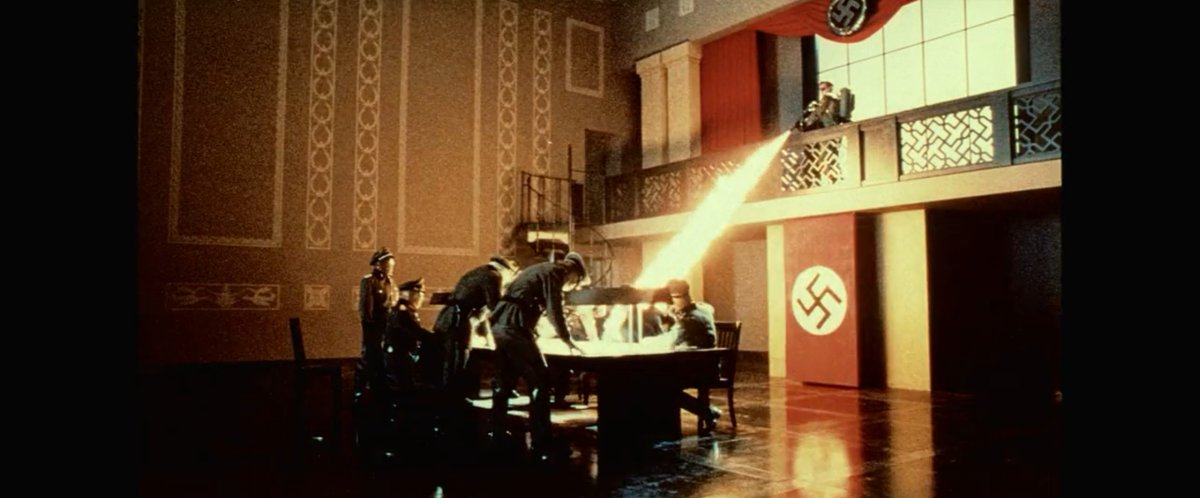
"Werner Herzog has often been called the original enemy of introspection. But his objection to psychoanalysis is not that of a man who avoids his inner life. He is the enemy of therapy culture insofar as he is more like a living archetype..." — @markgranza https://t.co/EpRbYYnNlo
People often point to The Matrix as the most Baudrillardian movie ever made, but it's Once Upon a Time in Hollywood that nails it. Baudrillard argued that images (any copy or representation of reality, like a map or a film) gradually stop representing reality and start replacing it, as people begin to model their lives after the image, which leads to what he calls the "hyperreal," a copy that feels more real than the thing it copies. Tarantino, intentionally or not, plays with similar ideas and the film ends by replacing history itself.
First, the central pair. Rick Dalton (DiCaprio's character) plays tough Western guys on screen but is portrayed as insecure in real life. Cliff Booth (Brad Pitt) is the tough guy: the war vet who loves to drive, fix stuff, fight, and, when needed, actually kills. Rick is the image, wishing he could live up to the characters he plays, and Cliff is the closest thing to the archetype behind it. This is the least subtle parallel, since Cliff is literally Rick's stuntman, living in a trailer behind a drive-in movie screen.
The 1969 LA around them is hyperreal, built from the era's own images and signs (billboards, ads, TV shows, movie marquees, etc.) so heavily curated that it feels even more real than the LA of the time. The radio that plays throughout the movie for instance is real 1969 KHJ audio that Tarantino edited into his own version of the station, as if he was aware that the original wasn't going to be "accurate" enough to pull off the vibe.
The film itself is made of hyperreal layers. DiCaprio, an actor, plays an actor who made his name as a TV cowboy, is now forced to play villains, wants to play heroes again, and is told to go make Westerns in Italy. In the film's best scene, Rick, playing a villain on a TV western, forgets his line mid-scene and has to call for it. By then, the viewer is fully immersed in the scene within the scene, so when the spell breaks and the fictional set is revealed, the villain Rick was playing feels more real than Rick (also a joke on the industry, as the characters actors play often feel more real than the actors).
In another scene, Sharon Tate (Margot Robbie) goes to watch herself in The Wrecking Crew, a film she appeared in that was released a few months before she was killed. What plays on screen is footage of the real Tate, or rather, her image, i.e., Tate playing a character in a film, watched by an actress playing her. By the end, the copy of the copy is the one who gets to live.
Spahn Ranch, the old Western movie set where the Manson Family actually lived, is also the set where Rick and Cliff used to work on Bounty Law, the show that made Rick famous. The Manson Family, real violent killers, living in a place built to stage pretend violence already blurs the line between fiction and reality, and Tarantino pushes it further by making it the fake frontier town where the film's protagonists are "forged."
Finally the ending. The Family members, after recognizing Rick from Bounty Law, drop their plan to murder the people at Tate's house because one of them, Sadie (who calls every TV actor in the 50s a fascist), argues that TV taught them to murder, so they should kill the people who taught them instead. The image wants to kill the image. Instead, Cliff and his dog take out two of them, and Rick (who complains about hippies throughout the entire film) finishes off Sadie with a flamethrower he kept from an old movie he starred in as, ironically, a Nazi-killer. The murders that really happened never take place, and the one who blamed TV for teaching them to kill is killed by a prop from a fictional WWII movie (whose scene is a clear reference to Tarantino's own Inglourious Basterds, a WWII revisionist film).
Baudrillard famously called The Matrix the kind of film the matrix would make about itself, and said it confuses his theory of simulation with Plato's old cave allegory, i.e., an illusion you can simply wake up from if you decide to exit it. OUATIH is closer to Baudrillard's theory as nobody "wakes up." Every time the illusion breaks, another illusion underneath feels more real than the last until real history is overwritten by a fake version.
It's also fitting that the film is set at the end of Hollywood's golden age, since today few events are treated as real unless framed within Hollywood's conventional morality tropes, with human history having been reinterpreted accordingly. The official title itself hints at it with the dots: "Once Upon a Time... in Hollywood", as if to say, "History, according to Hollywood."
“Claude, run AI air traffic control for the entire country. Make no mistakes”
“I need to flag something serious: I've just realized I made an error in the routing instructions, and it's the reason every flight is now grounded. This is entirely my mistake, and I completely understand if you're angry with me”
This Veterans Day, we are releasing Ben Braddock’s conversation with SGM (Ret.) Mike Vining.
From defuzing bombs as a teenager in Vietnam to fighting in some of Delta Force’s toughest missions, Vining reflects on his life of service and sacrifice. https://t.co/9uLiYjHw1q
People often point to The Matrix as the most Baudrillardian movie ever made, but it's Once Upon a Time in Hollywood that nails it. Baudrillard argued that images (any copy or representation of reality, like a map or a film) gradually stop representing reality and start replacing it, as people begin to model their lives after the image, which leads to what he calls the "hyperreal," a copy that feels more real than the thing it copies. Tarantino, intentionally or not, plays with similar ideas and the film ends by replacing history itself.
First, the central pair. Rick Dalton (DiCaprio's character) plays tough Western guys on screen but is portrayed as insecure in real life. Cliff Booth (Brad Pitt) is the tough guy: the war vet who loves to drive, fix stuff, fight, and, when needed, actually kills. Rick is the image, wishing he could live up to the characters he plays, and Cliff is the closest thing to the archetype behind it. This is the least subtle parallel, since Cliff is literally Rick's stuntman, living in a trailer behind a drive-in movie screen.
The 1969 LA around them is hyperreal, built from the era's own images and signs (billboards, ads, TV shows, movie marquees, etc.) so heavily curated that it feels even more real than the LA of the time. The radio that plays throughout the movie for instance is real 1969 KHJ audio that Tarantino edited into his own version of the station, as if he was aware that the original wasn't going to be "accurate" enough to pull off the vibe.
The film itself is made of hyperreal layers. DiCaprio, an actor, plays an actor who made his name as a TV cowboy, is now forced to play villains, wants to play heroes again, and is told to go make Westerns in Italy. In the film's best scene, Rick, playing a villain on a TV western, forgets his line mid-scene and has to call for it. By then, the viewer is fully immersed in the scene within the scene, so when the spell breaks and the fictional set is revealed, the villain Rick was playing feels more real than Rick (also a joke on the industry, as the characters actors play often feel more real than the actors).
In another scene, Sharon Tate (Margot Robbie) goes to watch herself in The Wrecking Crew, a film she appeared in that was released a few months before she was killed. What plays on screen is footage of the real Tate, or rather, her image, i.e., Tate playing a character in a film, watched by an actress playing her. By the end, the copy of the copy is the one who gets to live.
Spahn Ranch, the old Western movie set where the Manson Family actually lived, is also the set where Rick and Cliff used to work on Bounty Law, the show that made Rick famous. The Manson Family, real violent killers, living in a place built to stage pretend violence already blurs the line between fiction and reality, and Tarantino pushes it further by making it the fake frontier town where the film's protagonists are "forged."
Finally the ending. The Family members, after recognizing Rick from Bounty Law, drop their plan to murder the people at Tate's house because one of them, Sadie (who calls every TV actor in the 50s a fascist), argues that TV taught them to murder, so they should kill the people who taught them instead. The image wants to kill the image. Instead, Cliff and his dog take out two of them, and Rick (who complains about hippies throughout the entire film) finishes off Sadie with a flamethrower he kept from an old movie he starred in as, ironically, a Nazi-killer. The murders that really happened never take place, and the one who blamed TV for teaching them to kill is killed by a prop from a fictional WWII movie (whose scene is a clear reference to Tarantino's own Inglourious Basterds, a WWII revisionist film).
Baudrillard famously called The Matrix the kind of film the matrix would make about itself, and said it confuses his theory of simulation with Plato's old cave allegory, i.e., an illusion you can simply wake up from if you decide to exit it. OUATIH is closer to Baudrillard's theory as nobody "wakes up." Every time the illusion breaks, another illusion underneath feels more real than the last until real history is overwritten by a fake version.
It's also fitting that the film is set at the end of Hollywood's golden age, since today few events are treated as real unless framed within Hollywood's conventional morality tropes, with human history having been reinterpreted accordingly. The official title itself hints at it with the dots: "Once Upon a Time... in Hollywood", as if to say, "History, according to Hollywood."
Maybe it's ambiguous on purpose but in a previous scene Rick tells him he can't be his stuntman that day because the director is friend with the producer whose wife Cliff pisses off by fighting with Bruce and to fix his roof instead since he has nothing to do. So I interpreted it as a memory that provides background
People often point to The Matrix as the most Baudrillardian movie ever made, but it's Once Upon a Time in Hollywood that nails it. Baudrillard argued that images (any copy or representation of reality, like a map or a film) gradually stop representing reality and start replacing it, as people begin to model their lives after the image, which leads to what he calls the "hyperreal," a copy that feels more real than the thing it copies. Tarantino, intentionally or not, plays with similar ideas and the film ends by replacing history itself.
First, the central pair. Rick Dalton (DiCaprio's character) plays tough Western guys on screen but is portrayed as insecure in real life. Cliff Booth (Brad Pitt) is the tough guy: the war vet who loves to drive, fix stuff, fight, and, when needed, actually kills. Rick is the image, wishing he could live up to the characters he plays, and Cliff is the closest thing to the archetype behind it. This is the least subtle parallel, since Cliff is literally Rick's stuntman, living in a trailer behind a drive-in movie screen.
The 1969 LA around them is hyperreal, built from the era's own images and signs (billboards, ads, TV shows, movie marquees, etc.) so heavily curated that it feels even more real than the LA of the time. The radio that plays throughout the movie for instance is real 1969 KHJ audio that Tarantino edited into his own version of the station, as if he was aware that the original wasn't going to be "accurate" enough to pull off the vibe.
The film itself is made of hyperreal layers. DiCaprio, an actor, plays an actor who made his name as a TV cowboy, is now forced to play villains, wants to play heroes again, and is told to go make Westerns in Italy. In the film's best scene, Rick, playing a villain on a TV western, forgets his line mid-scene and has to call for it. By then, the viewer is fully immersed in the scene within the scene, so when the spell breaks and the fictional set is revealed, the villain Rick was playing feels more real than Rick (also a joke on the industry, as the characters actors play often feel more real than the actors).
In another scene, Sharon Tate (Margot Robbie) goes to watch herself in The Wrecking Crew, a film she appeared in that was released a few months before she was killed. What plays on screen is footage of the real Tate, or rather, her image, i.e., Tate playing a character in a film, watched by an actress playing her. By the end, the copy of the copy is the one who gets to live.
Spahn Ranch, the old Western movie set where the Manson Family actually lived, is also the set where Rick and Cliff used to work on Bounty Law, the show that made Rick famous. The Manson Family, real violent killers, living in a place built to stage pretend violence already blurs the line between fiction and reality, and Tarantino pushes it further by making it the fake frontier town where the film's protagonists are "forged."
Finally the ending. The Family members, after recognizing Rick from Bounty Law, drop their plan to murder the people at Tate's house because one of them, Sadie (who calls every TV actor in the 50s a fascist), argues that TV taught them to murder, so they should kill the people who taught them instead. The image wants to kill the image. Instead, Cliff and his dog take out two of them, and Rick (who complains about hippies throughout the entire film) finishes off Sadie with a flamethrower he kept from an old movie he starred in as, ironically, a Nazi-killer. The murders that really happened never take place, and the one who blamed TV for teaching them to kill is killed by a prop from a fictional WWII movie (whose scene is a clear reference to Tarantino's own Inglourious Basterds, a WWII revisionist film).
Baudrillard famously called The Matrix the kind of film the matrix would make about itself, and said it confuses his theory of simulation with Plato's old cave allegory, i.e., an illusion you can simply wake up from if you decide to exit it. OUATIH is closer to Baudrillard's theory as nobody "wakes up." Every time the illusion breaks, another illusion underneath feels more real than the last until real history is overwritten by a fake version.
It's also fitting that the film is set at the end of Hollywood's golden age, since today few events are treated as real unless framed within Hollywood's conventional morality tropes, with human history having been reinterpreted accordingly. The official title itself hints at it with the dots: "Once Upon a Time... in Hollywood", as if to say, "History, according to Hollywood."