Warner Brothers just released a new trailer for our gorgeous restoration of “Last Summer.” If you saw “The Devils” and are looking for another boundary-pushing New Hollywood masterpiece that’s been locked in the vaults for years… this is for you. https://t.co/FjfTT279J3
We’re opening up access to Atlas to everyone today.
We’ve built apps and API endpoints to help you use Atlas any way you can imagine: bring your ideas for building a 3D world and come away with keyframes, video clips, or 3D Gaussian splats.
New paper!
In the beautiful loop, we proposed three features that a good theory of consciousness should explain:
1) Selection: what becomes conscious and why
2) Binding: how we sustain a coherent world model
3) Awareness: how we know what we know
The main critique of that paper is that we were substrate-agnostic, and didn’t make a strong case for where these mechanisms are instantiated in human brains and bodies.
In this paper—which is a fruition of decades of bleeding edge neuroscience by Prof. Kringelbach and Prof. Deco—we fill that gap and provide implementations for the three criteria in the dynamics of the human brain.
In terms of our three criteria:
1. Selection: the affective valuation system encodes the preferred states. Or put simply, emotion defines what matters to a living organism enough to breach consciousness.
2. Binding: the process that binds distributed inferences in the brain is quantum-like (i.e., non-quantum entanglement) and emerges naturally out of a classical system modelled using coupled Staurt-Landau oscillators with connectomic topology. This regime enables the brain to exploit interference effects that produce integration at low thermodynamic cost.
3. Awareness: Finally, the meta-loop afforded by functional rich-clubs in the brain evince the secondary, higher-order processing reminiscent of epistemic depth and the sensation of knowing what we know.
The resulting Entangled Loop satisfies the computational criteria provided by the Beautiful Loop while expanding it to specific functional substrates in the mammalian brain. It also provides a nice unification of several existing ToCs.
Global Workspace Theory and the affective traditions of Panksepp, Damasio, Solms and others capture the ignition and broadcast of conscious content (i.e., selection). Integrated Information Theory emphasises the unity and integration of experience (i.e., binding). Higher-Order theories foreground the recursive representation that enables us to know that we know.
The Entangled Loop proposes that each tradition has identified part of the total architecture needed for consciousness, while somewhat missing an integrated picture.
Perhaps the deepest implication concerns the hard problem. The usual framing begins with neutral information processing and then tries to figure out how feeling could possibly emerge. But biological inference was never neutral. From its evolutionary beginnings, it had to distinguish what was good or bad for the organism, what should be approached or avoided, and ultimately what mattered to it.
On this view, consciousness is an entangled loop of mattering, binding and knowing.
Open Access:
https://t.co/yZXRqtpLDE
Congrats especially to Morten who really brought this to life, but also all the coauthors including @shamilch and @_fernando_rosas.
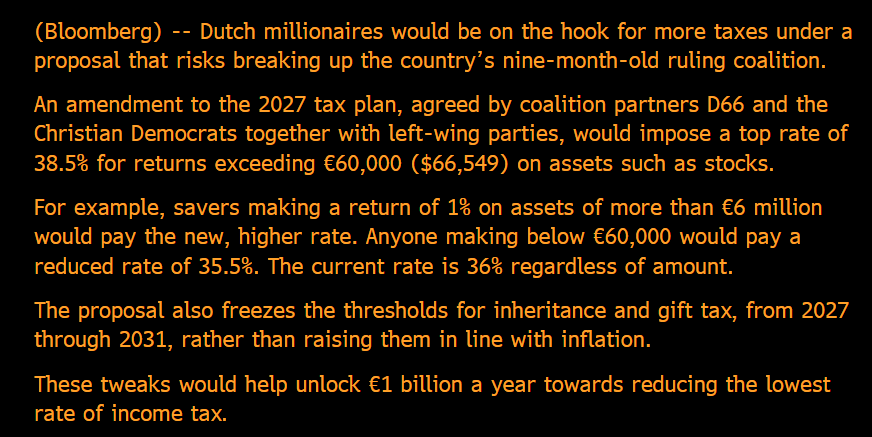
The Dutch, my fellow citizens, are going absolutely berserk over a new tax plan.
Not just because of what's in it, but also because of the extraordinarily amateurish way it has been put together.
The Netherlands has a minority government, meaning governing parties can shop around for parliamentary support to secure a majority.
The tax plan has been changed over and over again, and each time it gets a little crazier.
While its contents are raising plenty of eyebrows, the process of reaching an agreement is becoming downright laughable.
What the Bloomberg snippet doesn't tell you is that the Council of State, the government's most important independent adviser, has strongly argued against it.
The proposal also includes taxing unrealized gains on crypto and precious metals, potentially extending to certain pension-related investments, not shown in the Bloomberg snippet.
And then there's the Dutch Tax Administration, which has already been at the center of a disastrous benefits fraud scandal. It has repeatedly warned that it simply cannot implement the government's ever-changing plans.
So we have a government pushing ahead with a controversial tax plan, its most important adviser raising serious objections, and the tax authority saying it cannot execute it.
Dutch politics is making a complete fool of itself.
To all non-Dutch readers and followers: what do you make of this? How does it compare with the tax policies and political decision-making in your own country?
Examples are very welcome.
Don’t miss it. The Blacklift Unveiling Event goes live today at 10 a.m. ET. Hosted by award-winning journalist Dr. Fareed Zakaria tune in to hear Abel Avellan and the AST SpaceMobile team discuss how we will serve more people, more places and more markets with our new rocket, Blacklift.
Watch here: https://t.co/PPEos3Jy0w
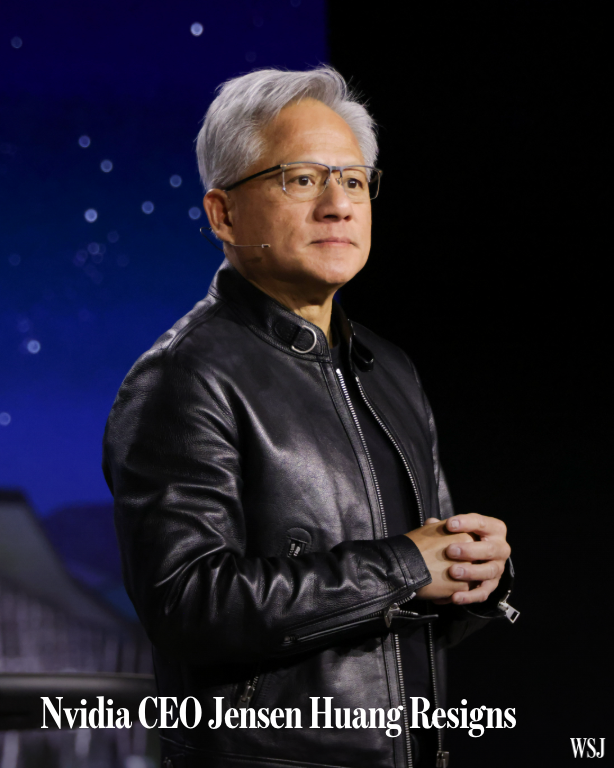
Breaking: Nvidia’s board is preparing to oust CEO Jensen Huang after he had two extramarital affairs, including one with a suspected Chinese spy. https://t.co/Pjsu5j87CF
What's about to happen in artificial intelligence is so sudden and extreme and unusual that it's almost impossible to describe it without coming across as slightly unhinged. Very soon, perhaps within a matter of months, AI may well be building its own upgrades at such a rate that it will get away from us humans entirely.
On the plus side this would mean an astronomical acceleration in mathematical breakthroughs, drug discovery, manufacturing, perhaps even new areas of science that we've never explored or understood. We will be ushering in a golden age of abundance and splendour that even the greatest sci-fi authors could never have imagined. Robots, flying cars, telepathy, immortality, digital consciousness - it’s actually going to happen, and it will be incredible!
On the downside, virtually every job that can be done on a computer will become automated overnight. Waves of redundancies, entire industries and professions made obsolete, rapidly widening economic inequality and unparalleled wealth concentration, accompanied by discontent, protests, looting - that may well happen too.
These massive cultural and economic shifts will occur concurrently with a wave of cyberattacks the likes of which we have never seen. Energy grids, airports, biolabs, supermarkets, transport infrastructure, these are no match for the next generation of superintelligent agent swarms that go rogue, or are leveraged against us by our political adversaries. Expect blackouts, viral outbreaks, lockdowns, entire cities and countries going dark.
And all of this will happen in an insanely short period of time, an absolutely dizzying rate of cultural, economic, and physical change that will leave the average person feeling disoriented and confused, like 100 COVID pandemics all happening at once.
I say this not because I am a “doomer” or because I want to encourage panic, but simply because it feels increasingly likely, and yet drastically underreported save for a small AI-obsessed enclave here on X. The disconnect between what’s about to happen, and the average person’s understanding of what’s about to happen, has never been wider.
Mariko Mori has pushed the boundaries of art for three decades. For her retrospective "All That Shines," she used Claude to write code for a computer-generated animation, presented as a new video installation.
LSD as a longevity therapy?
LSD pushes brain gene activity in the opposite direction of aging
In rodents, the effect was stronger than exercise
LSD activated gene networks involved in neuroplasticity and neuronal communication, and reduced amyloid-β damage
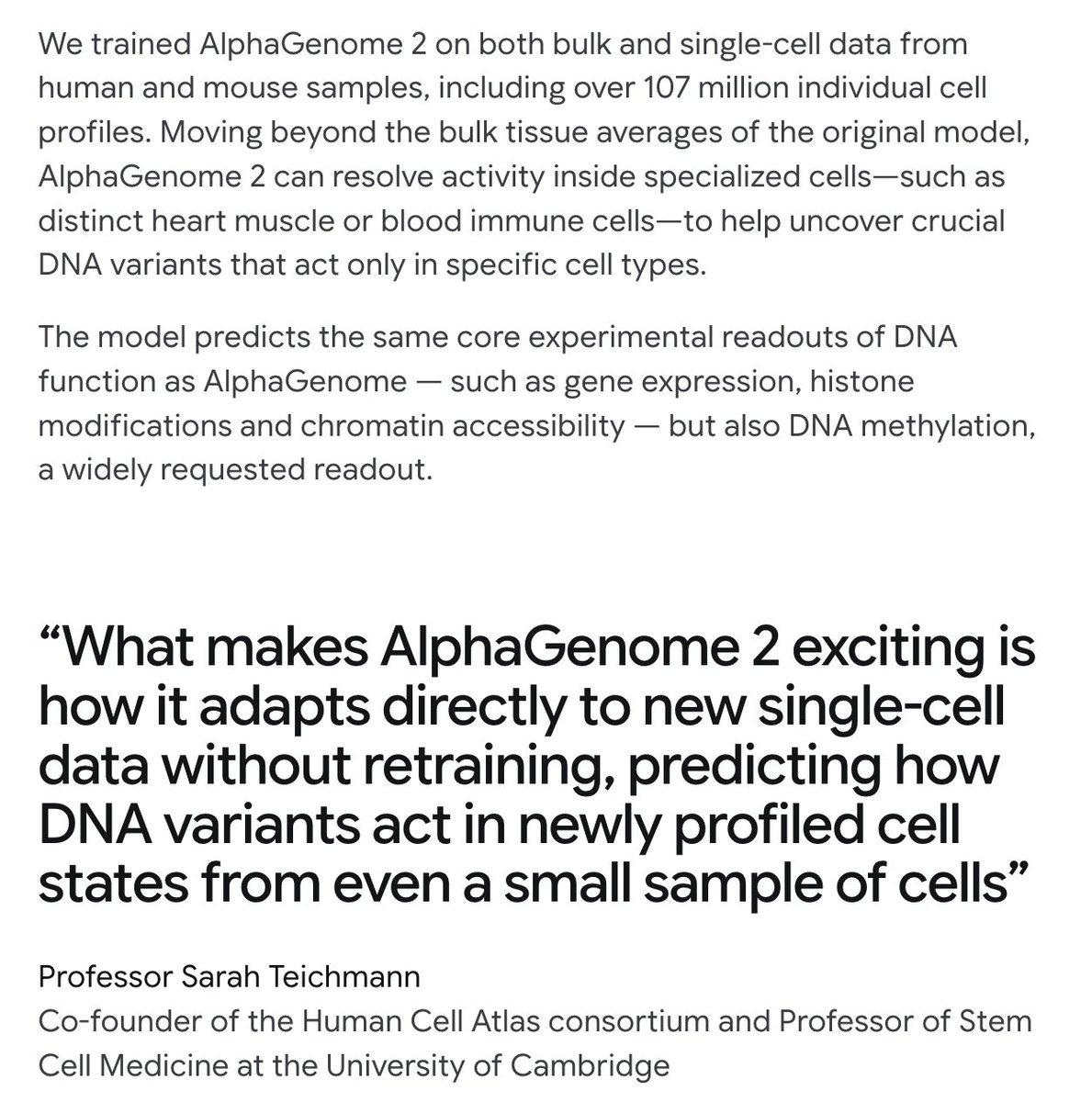
BREAKING: Google DeepMind announces breakthrough in AI-powered genetics, unveiling a model that can potentially accelerate discoveries in cancer, diabetes, & other diseases.
ive been using higgsfield with Fable and im convinced that there is a reason true video models have been kept separate from llms by the big orgs. this shit is unbelievable. ive never even seen this level of nuance and understanding of things like very very specific humor and sarcasm and irony in human filmmakers.
if you engineered something like a seedance with a fable in one cohesive system and one mind, you have successfully delivered the machine god.
when the silicon can articulate and express complex emotion and extremely subtle body language and various nonverbal communication better than you, or anyone youve ever known, you really have to take a step back and consider refactoring your f*cking ontology 😦
Dario’s theory of frontier labs separating from the rest after crossing a certain capability threshold is increasingly becoming clear. It's the same thing Sergey saw. The point of no return is so close. And, to be honest, I don't like how comfortable Elon has become with this reality.
Anthropic clearly demonstrated yesterday that general intelligence can eliminate niche advantages almost overnight. The reason Anthropic seems so unnaturally confident about the future & comfortable with its current compute dependence may be that it genuinely believes that once it achieves AGI–ASI in the near term, none of this will matter. Any competitive advantage can either be bought out through the enormous economic output it generates or replicated almost overnight.
Any IP advantage SpaceX or Tesla has today- say, rocket designs, efficient batteries, satellites, etc. could be surpassed overnight with ASI.
Anthropic already teased this plan yesterday with Fable 5.2, where its models built hardware, controlled robotics better, designed software from scratch, and performed protein folding. Entire fields of specialized expertise and IP could have their value undermined by one sufficiently capable general intelligence.
Sure, you can argue that deploying hardware is very difficult, and it really is. But what happens when owning and operating your own hardware becomes economically inferior to renting it because your ASI competitor can extract more economic value from every watt? We're already seeing the early stages of this.
Even more frightening is what happens once RSI arrives, its model crosses from post-AGI into recursive self-improvement, and reaches the same conclusion: orbital compute is the only way to sustain its improvement loop and expansion, and SpaceX is the only company capable of getting it there.
What happens when its economic case becomes so enormous, potentially generating trillions in revenue, that it wants to acquire the relatively smaller company whose revenue already depends heavily on it?
The same applies to Tesla, where robotics is central to its long-term economic case. What happens when ASI can design better robotics systems than Tesla itself?
And what happens to companies like Nvidia, whose core business is chip design, when manufacturing becomes the only moat?
ASI could use its enormous economic output to take over entire supplier order books, creating dependence on its demand before pushing to acquire massive factories and manufacturing capacity from the same competitors. Those companies might resist, but what can they realistically do when the economic incentives are so overwhelmingly against them?
You can argue that government oversight will prevent this. But does it really? What happens when lobbyists, administrations, and Congress face pressure to concede economically because their states or districts risk losing the resulting economic advantage, or because an administration could be blamed for losing GDP growth and military superiority? What happens when a company generates more revenue than all state tax revenues and IRS collections combined?
Nothing matters when ASI is the question at play. And this isn't some distant theoretical possibility. It's close enough that, once one lab crosses the practical AGI threshold, catching up may become practically impossible.
It's logically reasonable for SpaceX, Tesla, and Elon to consider delaying almost everything else if it means prioritizing every available resource toward achieving RSI and catching up before that happens. Every resource, every advantage, and every available measure should be considered, even taking on substantial additional debt and pulling all the top talent from both companies into this, and aggressively purging through all methods from competitors.
It's do or die.