Long shot, replug . Watch @katyal_sonal and my efforts at merging #scicomm & #healthcomm in these two films made for @PlanetDivoc91 !
Help us reach right avenues.
Challenges and solutions in the field of communication in a pandemic
https://t.co/wCfAZjXGUf
https://t.co/lHHpriHY00
The neurodivergent urge to stay awake long after everyone else has gone to bed, just to enjoy a few hours where no one needs anything from you and your brain can finally exist in peace.
The first thing @kunalb11 should do is to separate WhatsApp into two modes:
• Work
• Personal
Let users automatically snooze Work chats after office hours while keeping Personal chats active.
This could really improve work-life balance of millions!
Extraordinary people will often vanish from everyday life when a hard problem emerges.
Across thousands of meetings, we found that geniuses have periods of normality where meetings are attended and emails are answered, but when a big challenge appears the person goes totally dark.
Andrew Wiles disappeared into his attic for seven years to prove Fermat's Last Theorem, and Newton went home to a Linconshire farm during the plague, saw nobody for 18 months and came back with the foundations of gravity.
Breakthroughs need a level of isolation you only get when everything else is shut out, and most bosses/managers today make this impossible with the expectation that you'll respond to any email by EoD.
I think the deepest form of reset for neurodivergent especially (Autistic /ADHD) people isn't sleep, food, or a hot shower.
It's a few hours where nobody needs a response, an explanation, a decision, or a piece of your energy.
A guide to ADHD time:
- "5 minutes" = 47 minutes
- "I'll be there at 8" = I'll leave at 8
- "Quick task" = 4 hours
- "I'll text you back later" = in 11 days
- "I'll do it tomorrow" = I will think about it tomorrow
Apparently this is "executive dysfunction."
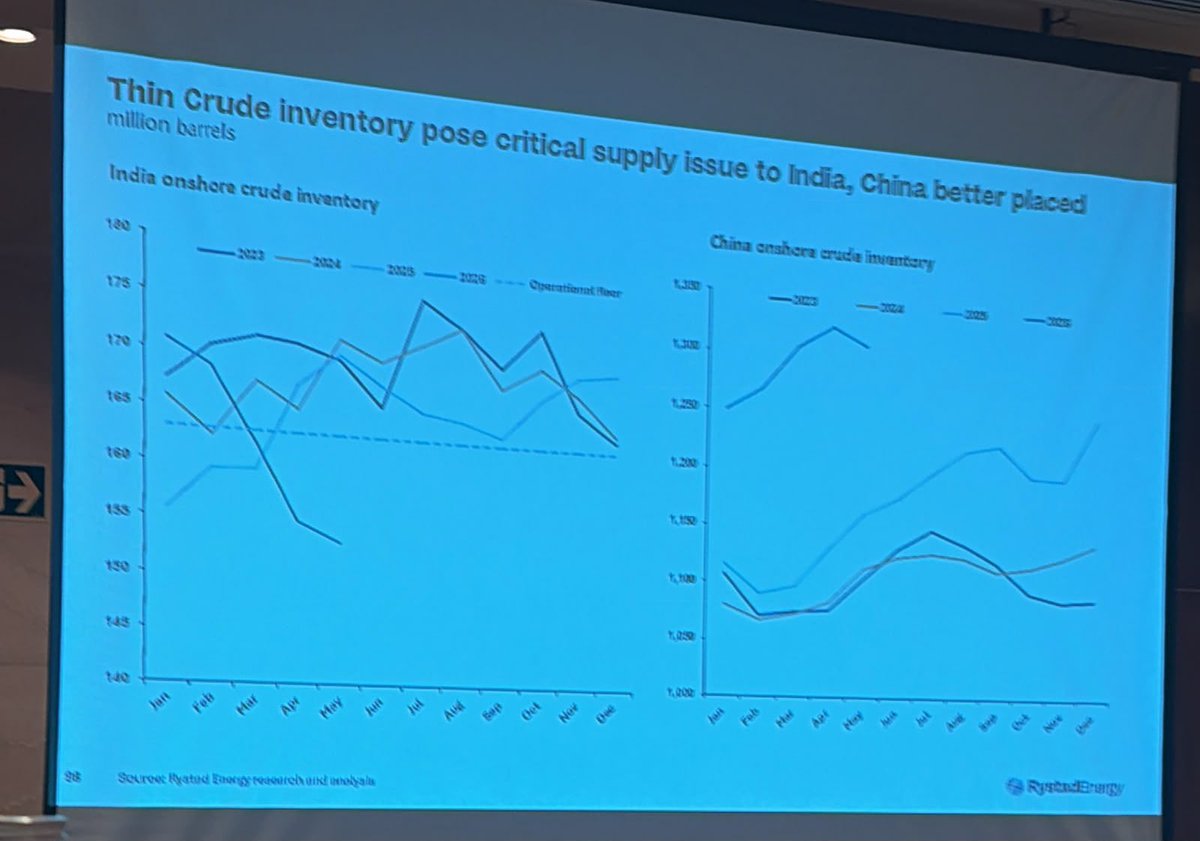
India's government says the country has 60 days of oil supply cover. Here's why that number is doing a lot of heavy lifting.
The 60-day figure bundles crude stocks + refined product stocks + strategic reserves + cargoes in transit. Strip it apart and the crude-specific picture is alarming.
Vortexa tracks India's onshore crude at ~144mb as of February 2026. Rystad puts the operational minimum — the physical floor below which refineries cannot function normally — at ~163mb. India is already 19mb below that floor.
This isn't 'running low.' Operating minimums aren't a policy buffer. They're crude trapped in tank heels, pipeline fill, and refinery feed systems that physically cannot be drawn down without shutting units. India's accessible crude buffer is effectively zero.
Kpler puts net commercial stocks at ~100mb. At 2.5mb/d of Hormuz-sourced imports (50% of India's total), that's ~40 days against the disrupted share — and that was early March. India's imports have since fallen 760kb/d (IEA, May 2026). The clock has been running three months.
Now add the ADNOC factor, which the government counts as a cushion. ADNOC currently stores ~5.86mb at India's Mangalore SPR cavern. But read the fine print: ADNOC has full re-export rights over its share. Under the ADNOC-ISPRL agreement, only 50% of that capacity — roughly 3mb — is reserved for India's strategic use. That's less than 15 hours of national crude consumption.
ADNOC did just announce plans to expand to 30mb across three Indian SPR sites. At India's import rate, even the full 30mb would be 6 days of cover. And it hasn't been built yet.
The 60-day headline also makes a category error. Product stocks can't substitute for crude once refineries run dry. Counting diesel and petrol in reserve against a crude supply shock is like counting cooked meals as a substitute for raw ingredients — once the refineries trip, you can't make more.
So what happens if India fails to secure replacement barrels?
Refineries don't gradually slow down. They trip. A crude unit that loses feed pressure shuts hard and takes 2-3 weeks to restart safely. India has 23 refineries running at over 100% utilisation. A supply failure means cascading unit shutdowns, a collapse in domestic fuel availability, and a government forced to choose between rationing and paying whatever spot demands.
India is not a price-sensitive buyer right now. It is a buyer with no alternative. The ADNOC crude stored in its own caverns isn't fully India's to use. And the clock has been running for three months.
I started Oracura in 2018 with no funding.
Everyone said D2C won't work for oral care.
Last year we crossed ₹50 Cr in revenue.
100% bootstrapped.
But today, the game has changed completely.
If you want to start a D2C Brand in India in 2026,
read this before you spend a single rupee:🧵👇🏻
@delhivery this is absolutely chaos and irresponsible. My two parcels are stuck one for return because your delivery agents aren’t willing to come and pick up when all info is given to them