The speed of light is constant, finite, and no massive body can ever match it
This fact is at the basis of modern physics
And we're really confident in that because it's implications have been tested to astonishing precision.
But not by measuring the speed of light... 🧵1/10
When power lines ice up — like they did in southwestern Manitoba this week — the power company creates a controlled short circuit, the line heats up, and the ice falls off
[📹 Manitoba Hydro]
June 19, 1926, a letter written by Hendrik Antoon Lorentz to Erwin Schrödinger concerning wave quantum mechanics.
In this correspondence, Lorentz, at the age of 73, demonstrates his profound command over the newly established wave mechanics, leaving a significant impression on its originator, Schrödinger.
The magical machinery of mathematics.
Four partial sums (Fourier series) of lengths 1, 2, 3, and 4 terms, showing how the approximation to a Square Wave improves as the number of terms increases. Source: https://t.co/f2QlHfyh9M
Stunning sunset
This happens because of a phenomenon called Rayleigh scattering: cirrus clouds scatter the longer, red wavelengths of light and give the sky an orange or reddish hue
[📹 jiangzhibin24 姜志斌]
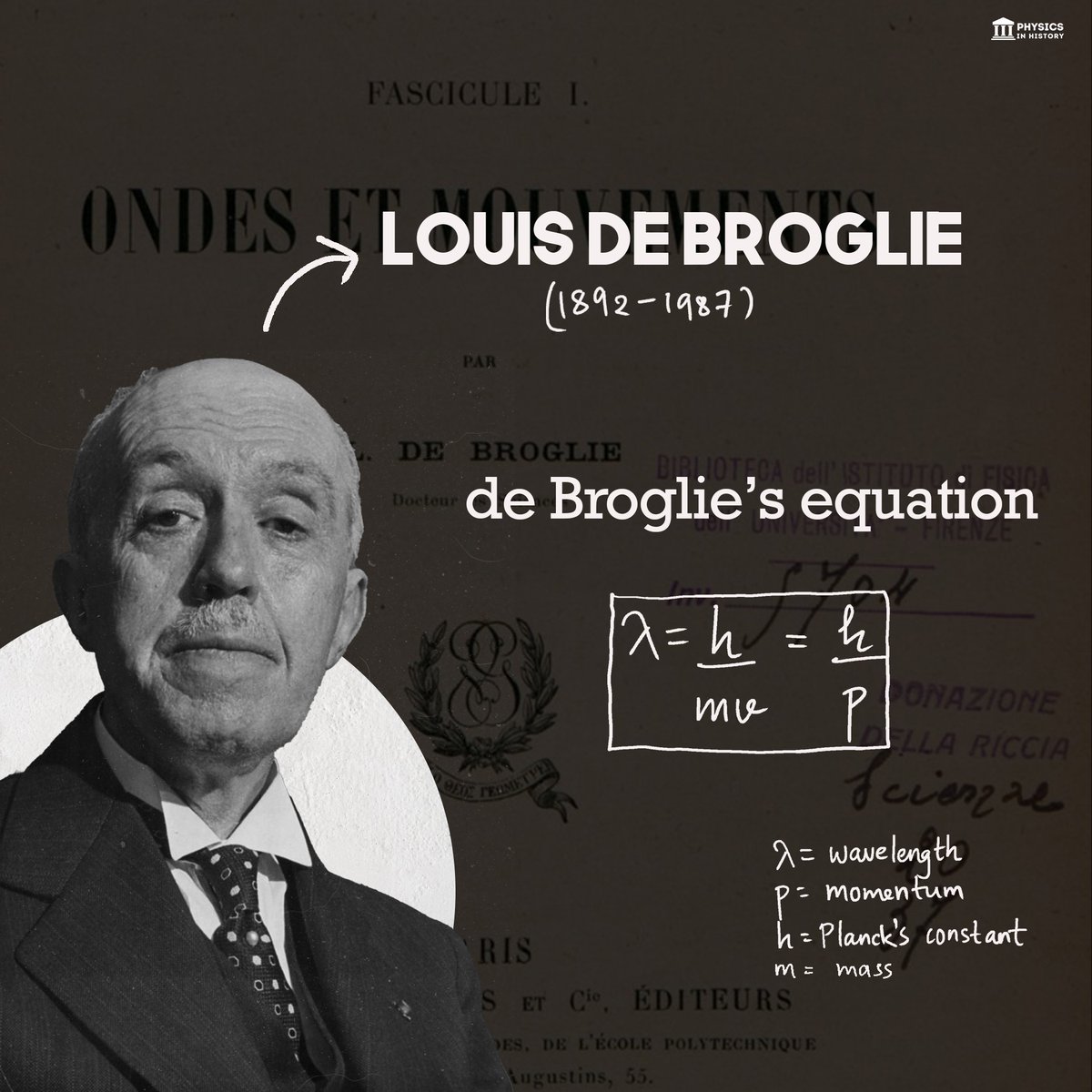
Happy Birthday to one of the pioneers of Quantum Mechanics, Louis de Broglie, born 130 yrs ago today.
L. de Broglie, in his 1924 PhD thesis, postulated the wave nature of electrons and suggested that all matter has wave properties. He predicted that the wavelength of any particle is inversely proportional to its momentum, and that the frequency of any particle is proportional to its energy. This is known as the de Broglie relation, and it can be written as:
λ = h/(mv)
De Broglie’s hypothesis was confirmed experimentally by the observation of electron diffraction by crystals in 1927. This showed that electrons, which are usually considered as particles, can also behave like waves under certain conditions. De Broglie’s idea of wave-particle duality was a fundamental concept in the development of quantum mechanics, and it influenced the work of Erwin Schrödinger, Werner Heisenberg, and others. He also developed a pilot-wave theory, which proposed that particles are guided by a deterministic wave field that determines their trajectories. This theory was later revived and modified by David Bohm, and it offered an alternative interpretation of quantum phenomena.
He received the 1929 Nobel Prize in Physics and was also a member of the French Academy of Sciences and the French Academy of Letters. De Broglie was interested in the philosophical implications of quantum theory, and he advocated for a synthesis of science and humanism.
This photographic comparison shows the Anak Krakatau volcano, before and after the explosion which caused the deadly tsunami on December 22, 2018
[source: https://t.co/HQDyu39UOn]
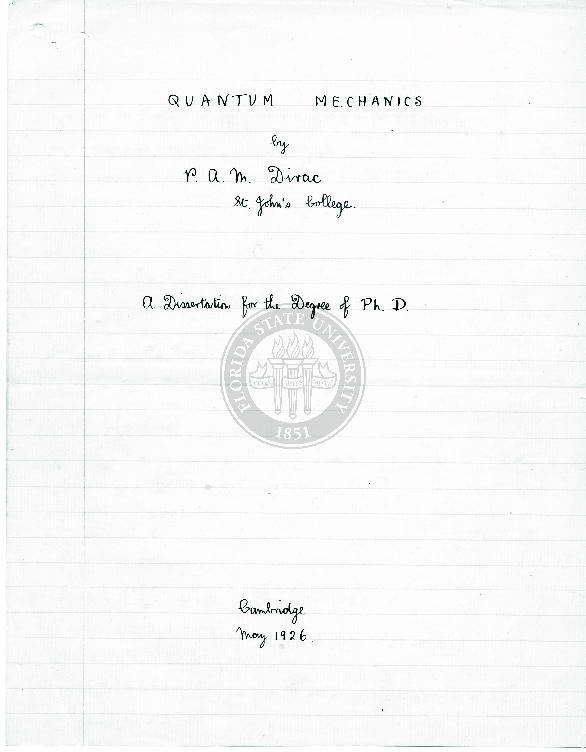
Born 121 years ago #Today, Paul Adrien Maurice Dirac was theoretical physicist and pioneer of quantum mechanics. He is regarded as one of the most significant physicists of the 20th century
[read more: https://t.co/7KHJNmRUao]
Henry Moseley, the inventor of the modern periodic table, was killed at the age of 27 by a sniper in the Gallipoli battle in 1915.
Moseley was a brilliant physicist who worked at the University of Manchester under Ernest Rutherford, the father of nuclear physics. He was interested in the properties of X-rays and how they could be used to study the structure of atoms. He used a device called a spectrometer to measure the wavelengths of X-rays emitted by different elements when they were bombarded by electrons. He found that there was a regular pattern in the X-ray spectra, and that each element had a characteristic set of lines that could be used to identify it. He also found that the frequency of the most intense line in each spectrum was proportional to the square of a number that he assigned to each element. This number, which he called the atomic number, was later found to be equal to the number of protons in the nucleus of an atom.
Moseley’s discovery was very important for chemistry and physics, as it provided a clear and logical way to organize the elements in the periodic table. It also explained why some elements had similar chemical properties, as they had the same number of electrons in their outer shells. Moseley’s work also supported Niels Bohr’s theory of the atom, which proposed that electrons orbit around the nucleus in discrete energy levels. Moseley’s law also predicted the existence of some missing elements that had not been discovered yet, such as technetium, promethium, and rhenium.
Unfortunately, Moseley’s life and career were cut short by World War I. He volunteered for the British Army as a telecommunications officer, and was sent to Gallipoli, Turkey, where he participated in a campaign against the Ottoman Empire. He was killed by a sniper on August 10, 1915, at the age of 27. His death was mourned by many scientists and scholars, who regarded him as one of the most promising physicists of his generation. Some even speculated that he would have won the Nobel Prize in Physics if he had survived.
Niels Bohr once said that,
Rutherford's work "was not taken seriously at all" and that the "great change came from Moseley."
His death also prompted the British government to ban other prominent scientists from serving in front-line roles, as they realized the value and importance of scientific research for society
[Photograph: Balliol-Trinity College Laboratory, 1910]
Oranges are made up of almost 90% water by weight. This should pretty clearly mean that they are not flammable. However, thanks to a special oil called D-Limonene in their peel, they can spray fire
[read more: https://t.co/8abvTWRMGn]
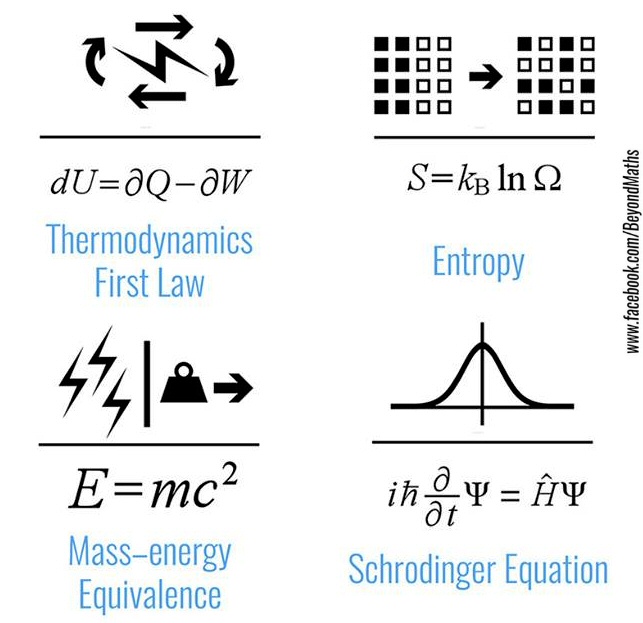
Math, physics.
A wizard says to you: "I can turn you into an instant super-expert on one of these four concepts — giving you a deep, complete, and profound understanding of that topic."
Which one do you choose?
Art by Beyond Maths, https://t.co/CbWPwQiiLG, Used by permission.








![Rainmaker1973's tweet photo. This photographic comparison shows the Anak Krakatau volcano, before and after the explosion which caused the deadly tsunami on December 22, 2018
[source: https://t.co/HQDyu39UOn] https://t.co/zueI81ZCE7](https://pbs.twimg.com/media/F2_Lp4-XgAAj3Wc.jpg)
![Rainmaker1973's tweet photo. Born 121 years ago #Today, Paul Adrien Maurice Dirac was theoretical physicist and pioneer of quantum mechanics. He is regarded as one of the most significant physicists of the 20th century
[read more: https://t.co/7KHJNmRUao] https://t.co/r3Q4d5XSoW](https://pbs.twimg.com/media/F2_CqsTXkAA3-P2.jpg)
![PhysInHistory's tweet photo. Henry Moseley, the inventor of the modern periodic table, was killed at the age of 27 by a sniper in the Gallipoli battle in 1915.
Moseley was a brilliant physicist who worked at the University of Manchester under Ernest Rutherford, the father of nuclear physics. He was interested in the properties of X-rays and how they could be used to study the structure of atoms. He used a device called a spectrometer to measure the wavelengths of X-rays emitted by different elements when they were bombarded by electrons. He found that there was a regular pattern in the X-ray spectra, and that each element had a characteristic set of lines that could be used to identify it. He also found that the frequency of the most intense line in each spectrum was proportional to the square of a number that he assigned to each element. This number, which he called the atomic number, was later found to be equal to the number of protons in the nucleus of an atom.
Moseley’s discovery was very important for chemistry and physics, as it provided a clear and logical way to organize the elements in the periodic table. It also explained why some elements had similar chemical properties, as they had the same number of electrons in their outer shells. Moseley’s work also supported Niels Bohr’s theory of the atom, which proposed that electrons orbit around the nucleus in discrete energy levels. Moseley’s law also predicted the existence of some missing elements that had not been discovered yet, such as technetium, promethium, and rhenium.
Unfortunately, Moseley’s life and career were cut short by World War I. He volunteered for the British Army as a telecommunications officer, and was sent to Gallipoli, Turkey, where he participated in a campaign against the Ottoman Empire. He was killed by a sniper on August 10, 1915, at the age of 27. His death was mourned by many scientists and scholars, who regarded him as one of the most promising physicists of his generation. Some even speculated that he would have won the Nobel Prize in Physics if he had survived.
Niels Bohr once said that,
Rutherford's work "was not taken seriously at all" and that the "great change came from Moseley."
His death also prompted the British government to ban other prominent scientists from serving in front-line roles, as they realized the value and importance of scientific research for society
[Photograph: Balliol-Trinity College Laboratory, 1910]](https://pbs.twimg.com/media/F2dQ5DVagAAo_io.jpg)