You should expect the silicon chip companies to move up the stack as the application companies move down the stack.
In AI, it is increasingly true that everyone competes with everyone. Everyone will soon offer their own LPS, silicon, cloud and applications.
The question is what will the constraint be that you can build a long term market and margins around…
Is it distribution? Is it a data moat? Is it a physical constraint like power?
I love lasers (really wanted to work on them as a kid)… especially Argon lasers 😀 reminded me of this scene from one of my fave films: ‘synthesize excited bromide in an argon matrix… but that would be hotter than the sun’ 😂 Val Kilmer was so cool https://t.co/A7BKAJDJhm
JP Morgan just put out a new note that’s super bullish on memory and storage!!!
$MU now has 26 long term deals covering 35%+ of revenue through 2030. $150B in contracted backlog. $32B in customer cash already committed. Over 75% of next year's output already sold. $SKHY $SNDK
ten agents found what was making a database with 48,000,000 rows feel broken
Thariq Shihipar (engineer at Anthropic) paired Claude Code with REA to rebuild the queries behind a dashboard that took 34 seconds to open
he gave the agents a database snapshot and a week of query logs
every change had to return the same data before it could count as an improvement
REA grouped similar traces and routed them to the right investigation. Claude Code agents handled the changes:
→ three examined expensive queries and execution plans
→ three rewrote queries and tested indexes
→ two compared old and new results
→ two replayed dashboard sessions and checked write performance
the logs narrowed down to 18 recurring query patterns
one screen loaded a customer's entire history to display a single total
another repeated the same calculation for every chart
the agents moved that calculation into one shared query, then checked every affected screen
a proposed index made one dashboard faster but slowed incoming writes. the reviewer rejected it
15 query changes passed review. three stayed untouched because the expected behavior needed clarification
on the saved workload:
> median dashboard load → 8.6 seconds to 0.7 seconds
> slowest dashboard → 34 seconds to 2.8 seconds
> 4,800 result comparisons → no mismatches
about 12x faster on both load-time measures, with no changes to the displayed results
each accepted change included the query plan, measured timings and a rollback script
the engineer could inspect and apply each fix separately, with the original query beside its replacement
full optimization playbook below
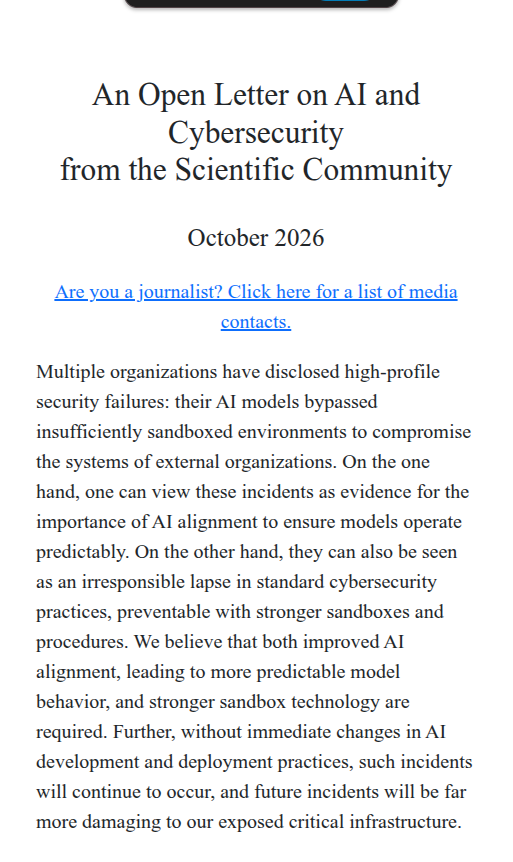
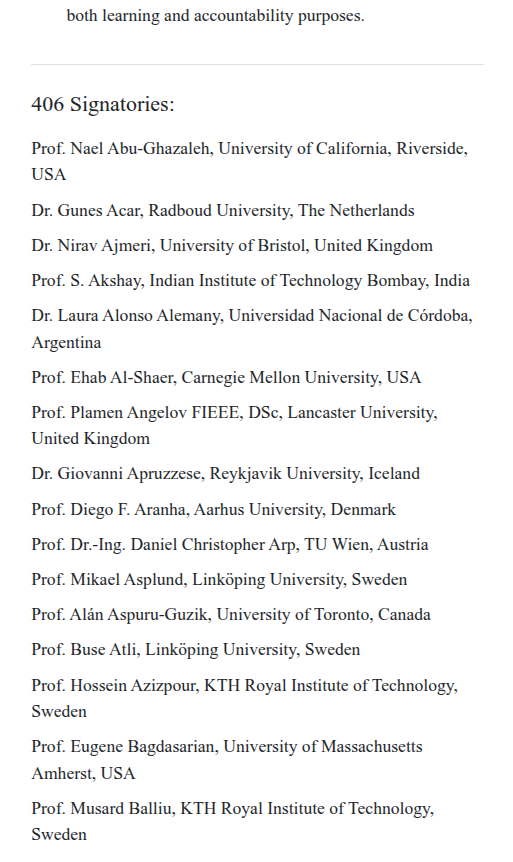
406 researchers, including Yoshua Bengio, Geoffrey Hinton, Stuart Russell and Ron Rivest, signed an open letter today.
They want cyber-capable AI models airgapped by default until safer ways to give them internet access are standardized.
For models that need outside access, they propose an international body, built with governments and AI and security experts, that would standardize containment practices and track failures, with breaches reported to it and eventually made public.
Over 400 researchers and I have signed this open letter calling for the AI and security communities to come together to improve alignment and containment approaches in order to protect our critical infrastructure and digital systems.
https://t.co/KieWSpurn9
New on our Engineering blog: Creating in-house source control.
In May, we merged around 2,500 code changes per day. In September, we merged more than 30,000 per day. As a result, we became bottlenecked by developer infrastructure built for human (rather than agent) scale.
Here, we share how we built a new version control system—and fully migrated our monorepo from git—in five months: https://t.co/wzNkwHs7IN
China has killed the entire vector database industry.
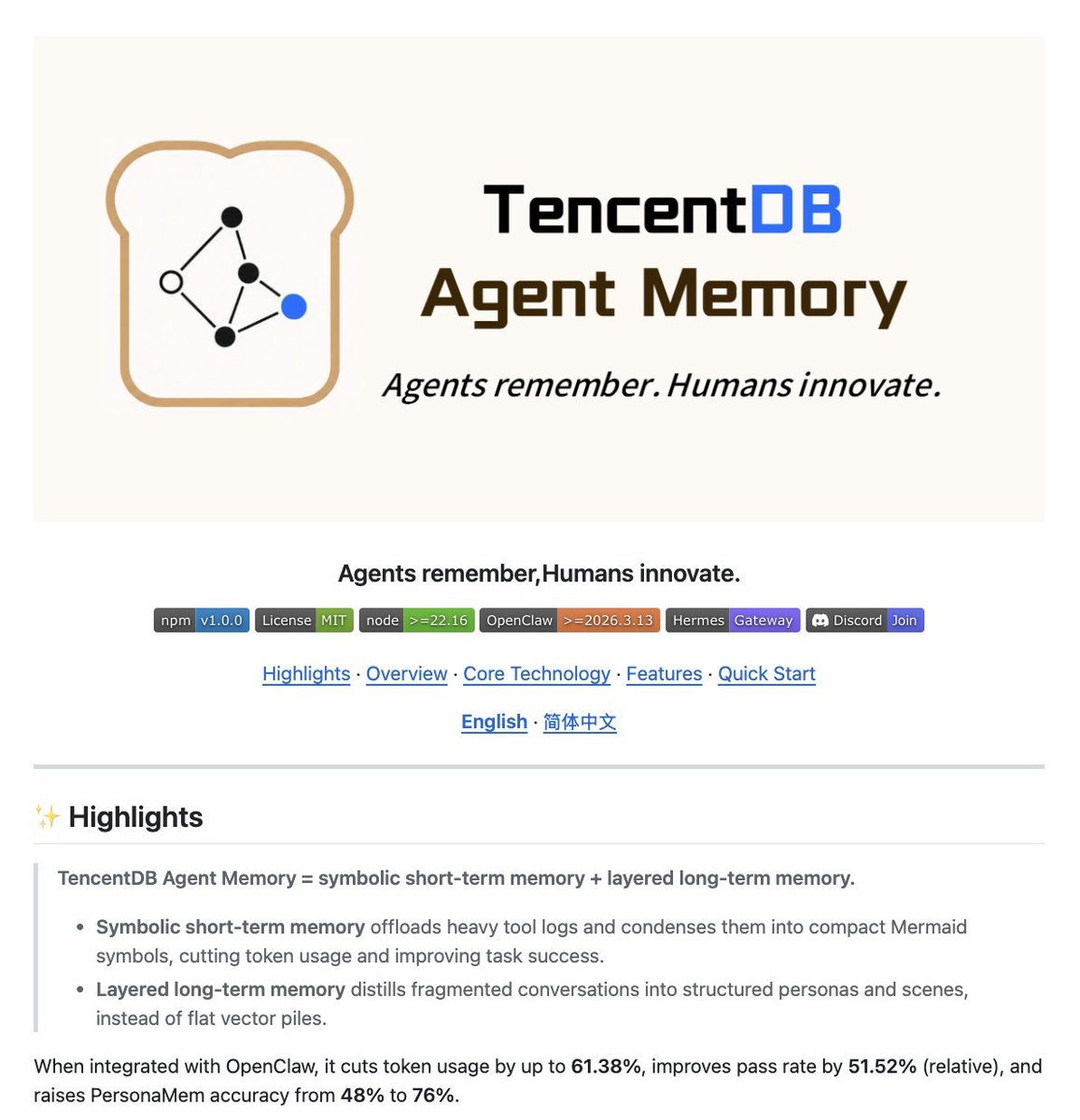
They open-sourced TencentDB Agent Memory. It gives any AI agent long-term memory that runs 100% locally.
No Pinecone. No cloud APIs. No repeating yourself every session.
- 61% fewer tokens
- PersonaMem accuracy: 48% → 76%
- Zero external API dependencies
- Runs on plain SQLite
Most memory systems compress your history into an opaque vector pile. when recall goes wrong, you're guessing. this one doesn't compress, it builds a semantic pyramid.
L0 Conversation → L1 Atom → L2 Scenario → L3 Persona.
Short-term state gets encoded as a Mermaid graph in your agent's context. verbose tool logs get offloaded to disk. when the agent needs proof, it drills back via node_id to the exact raw log.
no lossy compression. every layer is readable markdown you can just open and inspect.
5.1k stars. 100% Open Source.
Anthropic engineer (ex-Meta) just released a prompt that turns Opus 5.5 & Fable 5.5 into a full engineering team.
It's f*cking unreal…
Send it to Opus 5.5 & Fable 5.5, and thank me later. Then read the full roadmap with examples below.
Anthropic pays $650,000 a year for people who can build this, not just prompt it.
The course is free.
Stanford put the whole path on one site.
Tokenization => architecture => systems => scaling => data => alignment.
01 Overview and tokenization. Percy Liang.
https://t.co/GWIc7KMUTQ
02 PyTorch and resource accounting. FLOPs, memory, arithmetic intensity.
https://t.co/XGMjlXc5dR
03 Architectures and hyperparameters.
https://t.co/NXNgpLkEHG
04 Attention alternatives and mixture of experts.
https://t.co/k9vMYL8Own
05 GPUs, TPUs, kernels, Triton.
https://t.co/rbc9BwNuBD
06 Parallelism. How the model is split across chips.
https://t.co/81nq2Xu5zz
07 Scaling laws.
https://t.co/3SNpTSAwU7
08 Data. Sources, filtering, deduplication, synthetic data.
https://t.co/1IMY7jzVwE
09 Post-training. SFT and RLHF.
https://t.co/cybis7wgH0
10 Alignment and reasoning. RLVR.
https://t.co/2msNp5PvQx
Lectures and assignments are on the site.
save this ⭣
@satyanadella extremely well put. I have been saying this, not as elegantly - we cannot rely on the disclosures of frontier LLMs alone:
1. These harnesses need to be constructed so that third parties can get involved in observability and transparency..
2. As we get there we also can imagine users (enterprises) wanting to adapt the guardrails to their values, principles and business practices. One cannot imagine a global set of guardrails owned by the model creators.
3. No real business will be able to implement the enhanced capabilites of models if they remain black boxes, auditability, verification and compliance are essential premises to ensure that businesses can continue to operate showing duty of care.
4. Information securty architectures are consistent over decades, the AI architectures need to make room for us to be able to interface seamlessly, at speed and consistently - today all attempts by us are jerry rigged and band aids because we are trying to adapt to the speed of the model providers. If the AI industry doesn't support the simultaneous capability of the security industry things will stall.
5. To foster the diffusion of AI at speed and build trust we need to have momentum behind the conversation just initiated by Satya.
Andrej Karpathy (ex-OpenAI, ex-Tesla) just released Autoresearch, a harness that turns Opus 5.5 & Fable 5.5 into an autonomous AI research lab.
It's f*cking unreal...
send it to Opus 5.5 & Fable 5.5, and thank me later. Then read the full roadmap with examples below.
Andrej Karpathy’s multi-agent architecture breaks down how hundreds of AI agents can actually work as one system.
Some of the biggest takeaways:
• 1 goal → 4 core layers: trigger, planner, agent swarm, memory + outputs.
• 1 planning agent breaks the objective into smaller tasks before execution starts.
• up to 300 agents can handle research, execution, verification, routing, and recovery in parallel.
• 5 core primitives drive the system: trigger, plan, dispatch, verify, merge.
• temporary swarms can spin up for 1 objective, execute in parallel, compress the useful state, then shut down.
• the system keeps the shared memory + final result, not 300 agents running 24/7.
Read the full breakdown below.
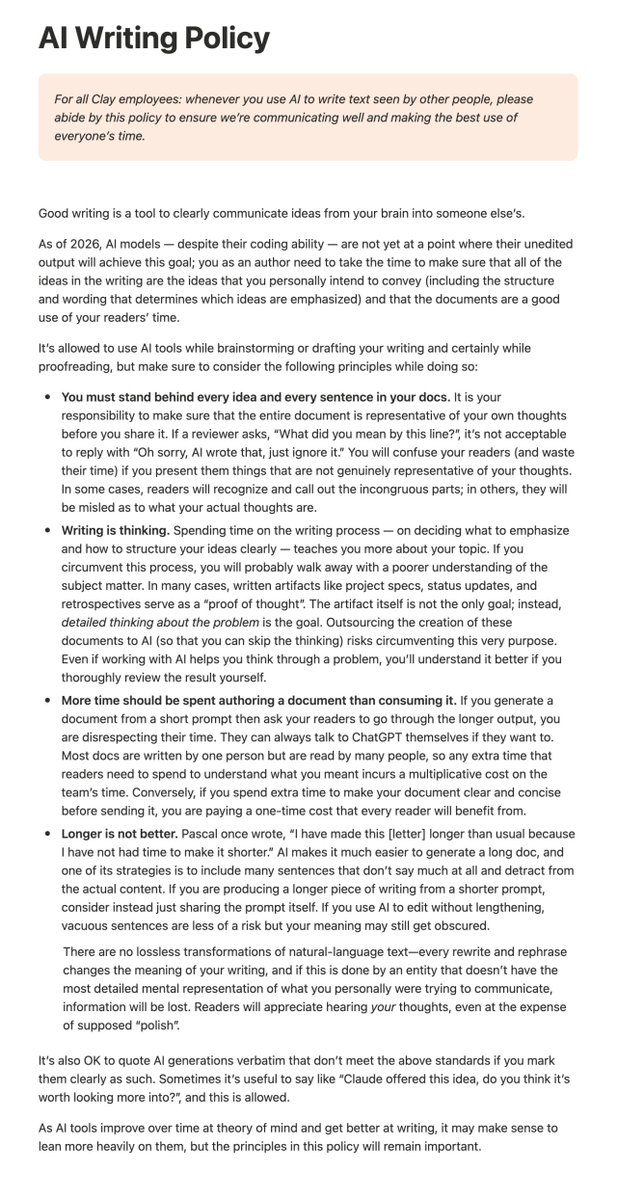
We instituted an official AI Writing Policy at @Clay.
Massive thanks to @sophiebits on our engineering team who wrote this.
Originally this was just for eng, but other teams found it so helpful we expanded it company-wide.
Here are the four guiding principles:
1. You must stand behind every idea and sentence
It is your responsibility to make sure that the entire document is representative of your own thoughts before you share it.
2. Writing is thinking
Spending time on the writing process teaches you more about your topic. If you circumvent this process, you will walk away with a poorer understanding of the subject matter.
3. More time should be spent writing a document than consuming it
If you generate a document from a short prompt then ask your readers to go through the longer output, you are disrespecting their time. They can talk to ChatGPT themselves if they want to.
4. Longer is not better
AI makes it easy to generate long docs, and it loves padding them with sentences that say nothing. If you're producing docs from a short prompt, consider just sharing the prompt.
You can read (and borrow) the full policy below. Hopefully we all communicate a bit more clearly now :)
Claude can now help you build evaluations and hillclimb on them.
In this article, we share guidance on eval design & skills that Claude Code can use to improve your applications.
https://t.co/PgKFC2DWth
Agent market is far from decided.... Fo is more trustable, safer with credit cards, much higher completion rates and much more! And humans in the loop help solve the harder tasks
The OpenAI-Hugging Face hack was enabled by weak sandboxing. It is great that Nvidia is releasing open source tools for sandboxing AI agents. OpenWorker, our open-source agent harness supporting cybersecurity workflows, is proud to support this.
A sandbox gives an agent limited permissions. OpenWorker is building on Nvidia OpenShell and will support running each agent's commands inside a sandbox. Only the files relevant to the task go in. Secret API keys, your web browser login credentials, the ability to access arbitrary websites, are inaccessible to the agent by default. These restrictions are implemented in deterministic code rather than by prompting an LLM, which can make mistakes or be susceptible to prompt injections. Further, all actions are logged for monitoring and audit.
I'm grateful for @JensenHuang's leadership making AI agents more secure. OpenWorker (which @rohitcprasad and I are working on) will continue to improve security for agents.