EUR/USD's rally: is the U-turn coming? ↩️
Rich Excell explores fundamental and technical indicators, suggesting a potential reversal or downside for the EUR/USD pair. https://t.co/8zih4C9nDu
8️⃣ ⏳ In summary: Global markets face a perfect storm of geopolitics, energy shocks, and policy pivot risks. Stay nimble. Stay informed. #Macro#Investing#MiddleEastCrisis
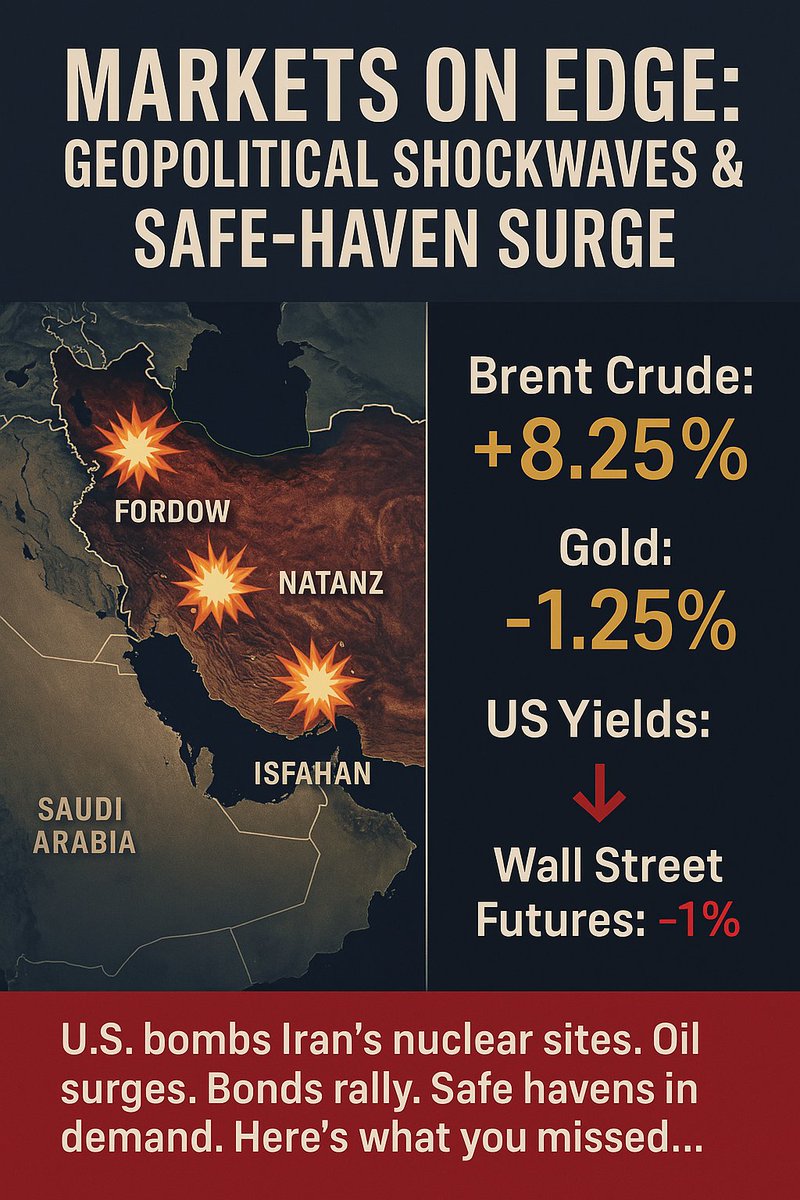
🧵Thread: Middle East on Edge | Markets in Turmoil
1️⃣ On Sunday, June 22, the U.S. bombed 3 key Iranian nuclear facilities—Fordow, Natanz & Isfahan. This marks a major escalation in the Iran-Israel conflict. Here’s how the markets reacted & what lies ahead 👇 #Geopolitics #Markets
1/8
7️⃣ 🗣️ Dovish Fed speakers added fuel to the fire: Markets began pricing in a deeper rate cut cycle for FY25. Monetary easing could be on the table sooner than expected. #FederalReserve#InterestRates
Global Macro Snapshot
1. Geopolitical Tensions & Safe-Haven Demand The escalation of the Israel-Iran conflict has intensified global risk aversion, prompting a surge in safe-haven flows into U.S. Treasuries. This has led to a softening of long-end yields, despite inflationary concerns. The rally in global bonds reflects investor anxiety over potential disruptions to oil supply and broader geopolitical instability.
2. Monetary Policy Outlook – Fed & SNB While the Federal Reserve held rates steady at 4.25%–4.50%, the dot plot suggests a modest 50 bps rate cut by year-end. However, the Fed remains cautious, citing elevated inflation risks and geopolitical uncertainty. Meanwhile, the Swiss National Bank (SNB) cut its policy rate by 25 bps to 0%, citing deflationary pressures and a strong franc. This dovish move contributed to a compression in European bond spreads, with the Bund-BTP spread narrowing from 99 bps to 96 bps.
3. Yield Curve Dynamics – Bond Markets are witnessing a bear-steepening of the U.S. yield curve, with long-end yields rising faster than short-end. This reflects a recalibration of inflation expectations and reduced conviction in near-term Fed cuts. However, this trend may reverse if geopolitical risks deepen, potentially triggering renewed safe-haven buying and curve flattening. A dovish comment the Fed Governer Christopher Waller has lead to buying in the front end of the yield curve leading to a further steepening of yield curve.
4. Inflation & Stagflation Risks The FOMC revised its FY25 PCE inflation forecast to 3.0%, up 30 bps from March. Coupled with slower GDP growth (1.4%) and higher unemployment (4.5%), this points to stagflation-lite conditions. While core inflation has eased in the near term, markets remain wary of second-round effects from energy and supply chain disruptions.
5. Credit Risk Outlook Credit markets remain stable for now, but the Fed’s projections—higher inflation, slower growth, and rising unemployment—could reignite credit risk, particularly in high-yield and leveraged loan segments. Investors should monitor for signs of spread widening as macro headwinds persist.
6. Equity Market Sentiment & Portfolio RepositioningThe sell-off in global equities and futures reflects a broader risk-off sentiment. Investors are actively rebalancing portfolios, rotating into defensives, gold, and sovereign debt. Hedge funds have reportedly liquidated equity positions at a record pace, underscoring the shift in institutional risk appetite.
(2/2)
5. Trader Positioning and Sentiment Are Capped
Into CPI and PPI this week, many funds were already long the dollar expecting a deflationary print and risk off move. When war headlines hit, the positioning was already crowded. Instead of chasing the dollar higher, markets faded the move. The rally was already priced in.
—
6. The Dollar May Be Being Deliberately Suppressed
This is the hardest but most important layer to consider. In a multipolar escalation, a runaway dollar can trigger EM crises, global demand destruction, and chaos in U.S. debt markets. It’s plausible that the current Trump administration, working through the Fed and Treasury, is managing dollar volatility behind the scenes through swaps, liquidity lines, or coordinated interventions not to defend allies, but to maintain funding stability for U.S. debt itself. In this view, the muted dollar is not weakness. It’s policy.
—
7. Reverse It: Where This Could Be Wrong
If the war spreads to Saudi oil fields or the Strait of Hormuz, dollar demand may surge regardless of central bank intent. If foreign capital begins to panic and dump emerging market exposure, we could get a disorderly USD spike.
But that would come with consequences. It would mean risk assets collapse, margin calls ripple through credit, and the Fed is pulled back into intervention faster than the market expects.
—
High-Conviction View
The dollar’s failure to rally today is not an anomaly. It is a sign of how fragile and strategically managed this system has become. The U.S. dollar is no longer a clean safe haven asset. It is now a tool of containment, deployed cautiously to avoid triggering systemic fracture.
We are no longer in a world where volatility equals dollar strength. We are in a world where volatility equals fragility, and the dollar’s moves are part of a broader liquidity chessboard.
—
For Now, Watch These Signals Closely
•Long-end U.S. yields vs foreign bond bids
•Oil settlement currencies and shipping choke points
•Treasury auctions and SOMA activity
•Swap line announcements and reverse repo drawdowns
•FX interventions from Japan, China, and GCC states
This is no longer a market story. It’s a geopolitical currency regime transition playing out live.
(1/2) $10 Billion Bought Back Quietly: What the Largest Treasury Buyback in History Really Signals
⸻
Executive Summary
On June 3, 2025, the U.S. Treasury executed the largest debt buyback in American history, absorbing $10 billion in short- and medium-term bonds prior to maturity. At first glance, it resembles a routine technical operation. But a deeper analysis reveals something more coordinated and far-reaching: a discreet attempt to reinforce the sovereign debt market under mounting structural stress.
This wasn’t merely a matter of curve management or liquidity smoothing. It was a strategic signal to institutional participants that the Treasury is willing to intervene quietly behind the scenes when rollover risk begins to threaten core funding stability.
⸻
What Happened
According to official data released June 3:
•Total Buyback Size: $10 billion (largest ever)
•Total Par Value Offered: $22.87 billion
•Maturity Range: July 15, 2025 to May 31, 2027
•Issues Accepted: 22 out of 40 eligible
•Settlement Date: June 4, 2025
The market offered over twice as much debt as the Treasury was willing to accept. That scale of excess demand to liquidate is itself a warning sign.
⸻
Signals Hidden in Plain Sight
1. Quiet Acknowledgment of Stress at the Short End. The buyback zeroed in on maturities that coincide with a heavy rollover window over $9 trillion of U.S. debt comes due in the next 12 months. This operation functioned as a circuit breaker without announcing one.
2. It’s Not QE, But It Functions Like It
This is not an expansion of the Fed balance sheet. But by retiring debt ahead of schedule often below par and reducing float without issuing new supply, it mimics QE’s liquidity effects without its political baggage.
3. Institutional Sellers Are Under Strain
The overwhelming volume of offers $22.87 billion suggests that banks, funds, or foreign reserve holders are facing constraints. Treasury effectively chose which counterparties to relieve, creating a selective outlet for stress.
⸻
Strategic Intent Simulation
This was not a confidence exercise. It was triage. The Treasury is managing two critical fronts:
•Maturity Wall Management: The 2025–2026 issuance calendar is dense with short-duration paper. A failed auction or oversupply-induced yield spike would damage perceptions of sovereign funding credibility.
•Market Function Under Constraint: Rather than flooding markets with issuance and risking yield curve destabilization, Treasury opted to surgically absorb select maturities through a controlled buyback window.
The move contains the signal of stress while allowing policymakers to avoid triggering broader alarm.
⸻
Historical Echoes
•Operation Twist (1961): A coordinated maturity swap to reshape the curve without explicit QE.
•BoE Gilt Crisis (2022): A rapid and targeted intervention in long-end bonds to prevent systemic damage to pension funds.
•Belgium Backdoor QE (2014): Used as an intermediary channel to discreetly absorb U.S. debt during periods of geopolitical tension.
Each example featured intentional obfuscation to maintain market confidence while stabilizing beneath the surface. The June 2025 buyback fits this lineage precisely.
Simple Yen Carry Trade (YCT) 101 (it's
just a version of a margin call)
Because Japan has a massive NIIP it invests heavily in foreign assets. That number is roughly 3.5TN of which most is real stuff not financial assets. BUT some is
Some is domestics buying Global risky assets. Some is loans to foreigners investing in global assets with leverage.
The latter is the heart of the Yen Carry trade but the big deal is neither the source of the leverage nor the interest rate on that leverage
The big deal about all levered investment is when the asset owned on leverage falls in price. Just like any margin call or bankruptcy or default when the asset falls in price the levered investor must either come up with more cash or sell the asset
The Yen carry trade is primarily driven by the performance of the levered asset whether it's Mexican Cetes (Tbills) or alt coins or anything in between when the asset falls the yen carry trade unwinds. Just like all other leveraged trades the Yen carry trade investor has been seeing a year worth of a bull run in most assets and that has driven chasing and increasing of the size of the Yen carry trade and all other asset margin trades. However the YCT has another leg that other leveraged trades don't have. That is loan is denominated in Yen while the asset is in a foreign currency. That means that the YCT has really done particularly well for the last few years as the yen has plunged from 110 to 160 in a virtual straight line. That has also awakened people and caused piling into the trade
But here we are. The MOF succeeded in abating the Yen depreciation by intervening heavily while Americans were celebrating the 4th of July. Not a huge problem tbh but it did seem to hold and perhaps those who thought they could make money on both legs of their YCT may have begun to get nervous.
By July 16th the equity markets and many other risky asset markets peaked. For whatever reason these asset markets began to sell off. As the sell off continued recent entrants into the YCT saw their asset falling and to be clear that is almost always the driver of unwinds. BUT worse the Yen began rallying slowly. That began the unwind. The unwind of the trade results in inelastic price moving flow to buy Yen and sell risky asset. The sale of the risky asset also impacts the much bigger set of levered investors who don't have any yen exposure at all and they get margin called as well. The combination of levered unwinds and YCT unwinds strengthens the Yen and further hits assets. A vicious cycle ensues.
Then last week the BOJ increased short term interest rates. On face the cost of the loan moved higher but as these loans are overnight the actual impact of the hike was nonexistent on the YCT but the macro impact paired with the NFP in the U.S. may have dulled enthusiasm for risky assets and the domestic impact on the NKY may have led to repatriation flows back to Japan which strengthened the yen further and squeezed the YCT further.
So 1. Risky asset selloffs cause a vicious cycle of deleveraging which 2. If leverage is denominated in Yen causes a yen squeeze which 3 may result in repatriation which further influences the cycle
It ends when risky assets become attractive to leveraged investors. NOT to unlevered investors as the quantities are not equal. When that happens and the Yen becomes unattractive the cycle ends.
Up to you to decide where we are today
The Yen Carry Trade.
Since everyone is talking about it, let’s explain how it’s impacting stock markets worldwide. 🧵
Hedge trade --> https://t.co/9uprvaSTP6
What caused the yen carry trade to explode now? (Timeline)
In recent years, Japan’s interest rates have been almost zero, so the yen carry trade continued. But now, several factors are making the yen carry trade fail:
-July 3, 2024: The yen hit a 38-year low of 161.96 against the dollar, prompting concerns and speculation about possible intervention.
-July 31, 2024: Japanese authorities spent 5.53 trillion yen ($36.8 billion) to shore up the yen, reducing its supply and increasing its value
-July 31, 2024: The BOJ raised its key interest rate to 0.25%, the highest since 2008, making borrowing yen more expensive
-August 2, 2024: Analysts from Citi, JPMorgan, and Barclays predicted a 50 basis point cut by the Federal Open Market Committee (FOMC) in September, influencing market expectations and creating uncertainty
As the yen appreciates, the carry trade becomes less profitable. Investors are selling their investments and pulling money out of stock markets, causing them to drop.
What is the yen carry trade?
Let's go back over 30 years. In the late 1980s, Japan had a huge boom in real estate and stock markets. The Bank of Japan (BOJ) popped this bubble by raising interest rates.
After the crash, the BOJ cut interest rates to almost 0%. This meant saving money in Japan didn’t earn much. So, people looked for better returns outside Japan.
Some housewives, called Mrs. Watanabes, started borrowing money in yen at low rates, converting it to foreign currencies, and investing it in places with higher returns. At their peak, they were a big part of the Tokyo forex market.
This strategy was called the yen carry trade. Big financial institutions soon adopted it. A lot of money came to America during the dotcom boom through the yen carry trade.
The yen carry trade has worked for the last 30 years because Japan’s rates stayed very low.
How It Works: Mrs. Watanabe has two choices to make money
Safe Choice:
- Borrow yen at low interest rates.
- Convert it to US dollars.
- Invest in US bonds, earning higher interest rates.
- Make money from the interest rate difference (arbitrage) and the yen losing value (currency exchange gain).
Risky Choice:
- Instead of bonds, invest in US stocks like SPY (S&P 500 ETF).
- SPY has seen about a 77% return from 2020 to now.
- This can make more money but is riskier.
Example:
- In 2020 during COVID, Mrs. Watanabe borrowed 1 million yen at a 0% interest rate.
- She converted this yen to $10,000 (1 USD = 100 yen).
- She invested $10,000 in US bonds at 5% interest.
- Four years later in 2024, her $10,000 became $10,500.
- She converted the $10,500 back to yen. If 1 USD = 160 yen, she got 1.68 million yen.
- She made a 68% profit because the yen lost value against the dollar and she earned 5% interest.
If she chose SPY stocks instead, she could make an extra 77% return in stocks, making her $10,000 grow to $17,700. Plus, a 68% profit in currency exchange gain. Converting this back to yen at 1 USD = 160 yen, she would get 2.83 million yen, making an even larger profit compared to 1.68 million yen with bonds.
Why Is the Yen Carry Trade Risky Now??
The yen carry trade is a complex arbitrage trade. It’s like hype beasts buying up limited sneakers to resell at a higher price. It works until there are too many sneakers on the market, and then prices crash. Similarly, the yen carry trade works until the yen starts to appreciate or interest rates change, making it unprofitable.
Impact on US Stocks:
If many investors are doing the yen carry trade, we could see a massive sell-off in the US stock market as they rush to lock in their profits. But it’s hard to predict exactly what will happen since we don't have details on how much money is involved in these risky bets.
As Warren Buffett said: "A pin lies in wait for every bubble and when the two eventually meet, a new wave of investors learns some very old lessons."
What Should the US Do?
Hold Rates Steady: Avoid cutting rates to prevent further instability.
Enhance Liquidity Programs: Provide targeted support to sectors most affected by the slowdown.
What Should We Do as Investors?
Hedge for market crash --> Check my notions
Summary:The yen carry trade is a strategy where investors borrow yen at low rates to invest in higher-yielding foreign assets. It has worked for 30 years because of Japan's low interest rates. But now, with recent rate hikes by the BOJ and predictions of US rate cuts, it's becoming risky. With the yen going up 📈, profits are shrinking, causing investors to sell off assets and impacting global stock markets, including the US 📉. Understanding the yen carry trade helps explain why markets are reacting the way they are now. To navigate these uncertain times, diversifying investments remains key to reducing risks and finding opportunities across different markets and asset classes.
1/9
An update on the yen carry trade (explained in link)
tl:dr - a lot of it has been unwound. But the attractiveness of the trade remains, so carry traders should be "rewounding" right back into it.
More chapters in this story are coming.
https://t.co/QntwwqaVZA