Trained ....
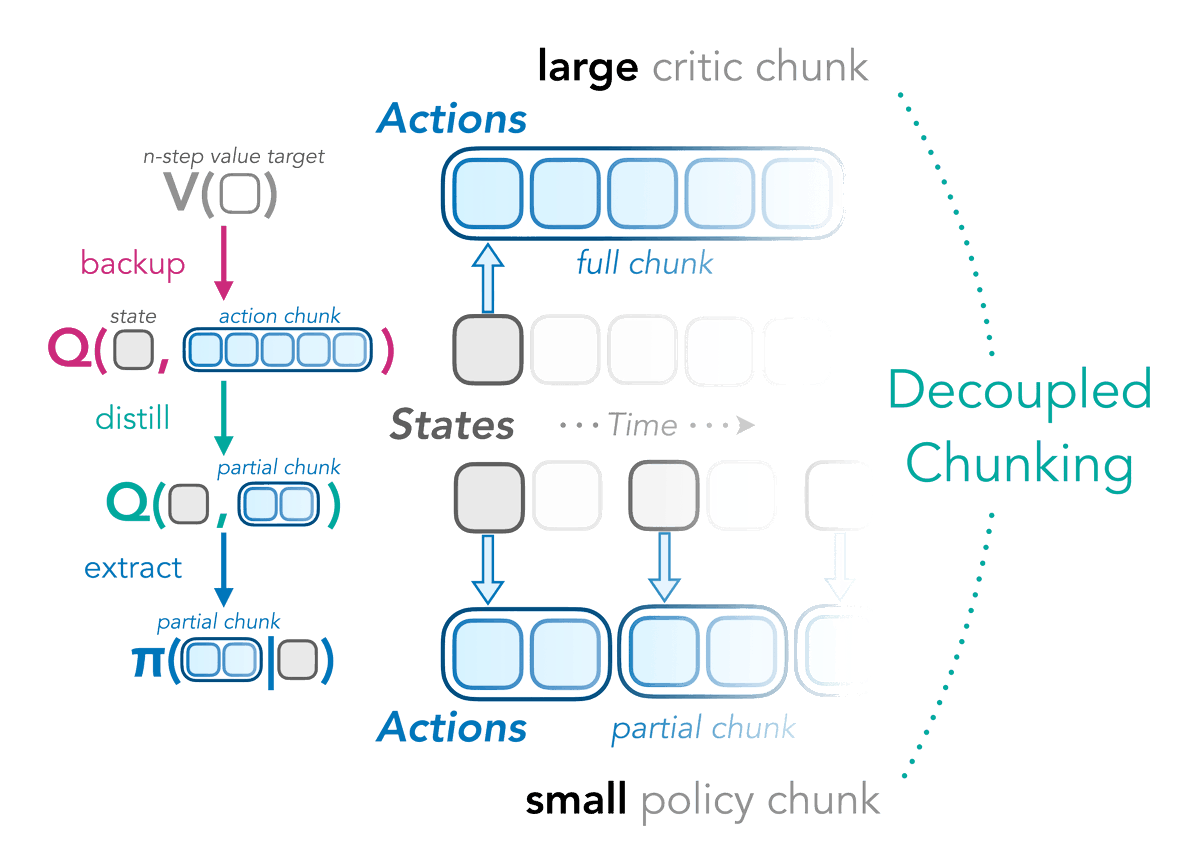
ATC - Action Chunking with Transformers, a robot imitation learning method that predicts sequences of actions instead of one action at a time.
Humanoid-GPT treats humanoid control like foundation model training.
The team scaled from curated motion datasets to a 2B-frame corpus, clustered motions with a Harmonic Motion Embedding, trained hundreds of RL motion experts, then distilled them into a single Transformer tracker. The result is a zero-shot humanoid controller that tracks diverse human motions without finetuning.
REFINE-DP tackles a key humanoid robotics problem: diffusion policies trained offline often fail when real execution drifts from demonstrations. The paper jointly fine-tunes a diffusion-based planner and a reinforcement learning loco-manipulation controller, allowing both planning and execution to adapt together. The result is over 90% success in complex humanoid tasks like door traversal and object transport with far less demonstration data.
DIAL is a clever rethink of robot learning: instead of forcing a model to jump straight from “see + read” to “act,” it inserts a latent imagination step. The model first predicts what the future should look like, then figures out actions to get there. Think “visualizing success” before moving.
Implemented Guided Polynomial Diffusion inside EDMP on an RTX 4090.
Key idea: replace 50 waypoint trajectories with 8 Bernstein control points and shorten diffusion from T=256 to T=64. This reduces dimensionality and stabilizes gradient guidance via a polynomial basis.
Dexterous robot hands have been stuck for years.
Too expensive to train.
Too hard to generalize.
Too many DoFs to control.
UniDex changes that—by learning hand control from human videos.
Vision made robots smart, but touch will make them competent.
This Robots Digest blog argues vision fails at contact, and shows how low cost 3D printable eFlesh finally gives robots force, slip, and feel at scale.
Physical intelligence starts with touch.
Vision Language Action models are the backbone of Physical AI.
This guide maps how we got from early VLAs to VLA+ models like Microsoft’s Rho-alpha, covering Gemini Robotics, π0, SmolVLA, Helix, and more.
A clear snapshot of where robot intelligence stands today.
Humanoid robots go mainstream.
Unitree just debuted the world’s first humanoid robot App Store.
A real marketplace where robot skills and behaviors can be shared just like mobile apps.
This is how humanoids scale beyond demos.
CLASH combines a reactive small model with a reflective vision-language large model using an uncertainty-aware collaboration mechanism. Point-goal and waypoint prediction enable robust navigation in both simulation and real-world deployment.
First Principles breakdown of BFM-Zero
A humanoid robot that learns what to do before being told why.
No task labels. No hand-designed rewards. One foundation policy.
Testing robots on "Out-of-Distribution" (OOD) scenarios, things they’ve never seen before, is the "final boss" of robotics. Usually, this means building complex 3D sims or risking hardware. Gemini Robotics by @GoogleDeepMind is using generative video to solve this.
Humanoid robots can walk or manipulate. Doing both together in large spaces is still rare.
Meet WholeBodyVLA, a system that finally brings true whole-body loco-manipulation to life.