A little bit about Andy Burnham...
He has repeatedly ignored Rochdale and Oldham rape gangs.
He wasted £100m+ on failed Clean Air Zone before U-turning.
He oversaw Greater Manchester Police collapse amid a crime surge.
He was Health Secretary during the Mid-Staffordshire NHS deaths scandal and cover-up between 2005-2008.
He claimed £17k expenses for a London flat within walking distance of Parliament.
He's just as bad as the rest of them, perhaps even worse...
I guess that’s why the pound tumbled upon news of his leadership bid.
For anyone who still hasn't had the memo:
- Oatmeal = sugar
- Quinoa = sugar with a marketing degree
- Brown rice = sugar wearing a tiny bran cardigan
- Wholewheat bread = sugar that went to a wholesome photoshoot
- Sweet potato = sugar the wellness influencers agreed to forgive
"Complex carbohydrate" is one of the great triumphs of food branding. It sounds like something that takes effort to break down. Something virtuous. Something earned.
It's a chain of glucose molecules holding hands. The chain breaks in your gut within minutes. By the time it crosses into your blood, it's the same glucose as a spoon of table sugar.
Your pancreas has never once read a label. It doesn't care that the oats were steel-cut, organic, and recommended by a man in running shoes. It sees the glucose. It pumps the insulin. Same response. Every time.
The packaging is for you. The bloodstream isn't fooled.
The British high street in 1978 had a butcher, a fishmonger, and a queue of women buying ingredients for meals that delivered more usable nutrition in a single plate than most British adults now manage in a week.
Liver and onions. The highest concentration of bioavailable vitamin A on earth, more B12 than any supplement, haem iron a plant cannot match. Tuesday tea, eight pence a serving in 1962.
Devilled kidneys on toast. The Victorian breakfast classic, sizzling on a silver chafing dish in every country house in the land. CoQ10, selenium, B12, iron. Now eaten by approximately nobody under fifty.
Brawn. A whole pig's head simmered for six hours and set into a collagen-rich terrine, sliced cold for sandwiches all week. The entire connective-tissue nutrient profile the supplement industry now sells back at £25 a tub.
Bone marrow on toast. Sixpence at the butcher, twenty-five minutes in the oven. Alkylglycerols, the entire fat-soluble vitamin suite, conjugated linoleic acid. St John's now charges £16 for the same plate.
Kippers. Split smoked herring with a knob of butter. Roughly 150 IU of vitamin D per fish, complete omega-3, B12 in concentrations no supplement matches. Three a week kept the British vertical through six months of inadequate sun.
Kedgeree. Smoked haddock, rice, eggs, butter, a hint of cayenne. The Edwardian breakfast that opens the first episode of Downton Abbey. Complete protein, omega-3, choline, iodine, in a single plate.
Sheep's heart, roasted with sage and onion stuffing. The most exercised muscle on the animal, dense with CoQ10 and taurine, fed a family of four for under a pound in 1978.
Tripe and onions. Boiled honeycomb stomach with white sauce. Wigan was once full of tripe shops; George Orwell lodged above one on Darlington Street in 1936. There is now one stall left in the whole town.
Jellied eels. East End working-class protein for a century. Heme iron, vitamin D, omega-3. London's pie-and-mash shops have gone from a hundred to thirty in living memory.
Mutton broth with barley. A three-hour simmer of cull-ewe bones and root vegetables. Collagen, bone minerals, the slow-cooked foundation that fed Northumbrian shepherds for six hundred years.
Suet pudding. Beef suet, flour, water, three hours of steam. Vitamin K2, CLA, the stable saturated fat that kept a bricklayer working through the afternoon.
Bread and dripping with salt. Sunday's leftover beef fat on a slice of bread on a Thursday. Free, complete, and built the British skeleton for three hundred years.
Your grandmother ate eight of these in a normal week without thinking about it. A modern nutritionist would call the same week "nutrient-dense" and charge £180 a session to help you replicate it.
The butcher will still sell you every ingredient, often for less than the supermarket charges for a vacuum-packed chicken breast.
The grandmother is the part that has gone missing. The rest is still on the high street.
A short history of the great British improvement.
They came for beef dripping. We got margarine, then seed oils, then a cardiac ward in every hospital.
They came for butter. They told your grandmother it would kill her husband. The replacement was a tub of palm oil emulsified with rapeseed and a yellow dye, and her husband died of a heart attack in 1989 anyway.
They came for full-fat milk. We got skimmed milk, a vitamin D deficiency epidemic in children, and a cereal aisle fortified to plug the gap.
They came for mutton, the meat that fed every shepherd, miner, and mill worker for six hundred years. We got a chicken breast injected with water and a turkey twizzler.
They came for the kipper. We got a Findus boil-in-the-bag, dyed orange, and a fish oil capsule sold at the chemist to make up for the omega-3 nobody is eating.
They came for wool. We got polyester fleece, and microplastics in human placentas. Every one tested. Sixty-two out of sixty-two.
They came for leather. We got synthetic shoes that delaminate in eighteen months, and a high street with no cobbler.
They came for the cotton nappy. We got the disposable, and a landfill that will outlast the child wearing it.
They came for the cast iron pan handed down three generations. We got Teflon, and a forever chemical now found in 98% of British rivers.
They came for the wooden bowl your grandmother kneaded dough in. We got Tupperware, then BPA, then "BPA-free" plastic containing compounds we have not yet bothered to measure.
Now they are coming for the cow herself. The replacement is a textured pea isolate, extruded in a factory in the American Midwest, packaged in plastic, and marketed as the ethical option by a company called Cargill, who happen to be the third-largest meat processor in the United States.
Every traditional material we have been told to give up was working perfectly, for free, for centuries. Every industrial replacement has been worse for the body, worse for the land, and considerably better for the shareholders of the company that sold it.
The pattern is not subtle, and the people running it are not embarrassed.
Your great-grandmother is no longer here to call it.
You are.
INTEGRITY MATTERS
Two men. Both elected to Parliament on the same promise. To fight for the British people against a system that has failed them.
One of them means it.
Let me show you the difference.
Nigel Farage has been an MP for 22 months. In that time he has earned nearly £970,000 from second jobs. £394,900 from GB News. £280,500 as a gold bullion brand ambassador. £135,000 from filming personalised birthday videos. Over 1,100 hours, equivalent to 140 working days, spent on outside work while Parliament sat for approximately 260 days.
In those same 22 months he gave 45 parliamentary speeches. Filed approximately 20 written questions. Introduced zero bills. Sat on zero committees. Secured one urgent question.
He missed a vote on the smoking ban. He was filming his television show.
Rupert Lowe was also elected in July 2024. He donates his entire parliamentary salary to local charities. Every single month. He keeps nothing.
In the same period he filed hundreds of written questions systematically covering every government department. He secured a seat on the Public Accounts Committee. He introduced legislation. He gave 27 Home Office debate contributions alone. He raised the rape gang inquiry on the floor of the House. He built a 600,000 pound crowdfunded independent inquiry into child sexual exploitation. He did it while simultaneously building a political movement from scratch.
He did all of that for free.
Now ask yourself an honest question. Which of these two men is in it for Britain? And which is in it for himself?
I have heard people say that Reform is different. That it is not part of the establishment. That it is fighting the uniparty system that has broken this country.
But look at what the uniparty does. It uses the language of the people while serving itself. It talks about change while accumulating power and money. It tells you it is different while doing exactly what it always did.
Nearly a million pounds in outside earnings. Zero bills. Zero committees. Ninety times more birthday videos than parliamentary speeches.
Now look at who is joining the top table at Reform: failed ministers and career politicians from the very governments that broke Britain.
And look at who is flooding out. Ordinary people who believed the promise. Who gave their time, their money and their votes. Who wanted something real and are now realising what they are actually looking at.
That tells you everything about what Reform has become.
If you are genuinely trying to change this country for the better you live and breathe integrity. You do not film birthday videos for £71 a time while the country burns. You do not spend 140 working days on second jobs while a failing government goes unchallenged.
This is not change. This is a uniparty respray.
The British people deserve a movement that puts them first at every single opportunity. Not occasionally. Not when the cameras are on. Every single day, in every division lobby, in every written question, in every committee room, whether anyone is watching or not.
That movement exists. It is growing. And it is coming to a town near you.
Watch this space.
Chris Littlewood
@chrislittlewoo8
---
SOURCES 👇
Let's talk about how long it takes the medical establishment to admit it was catastrophically wrong.
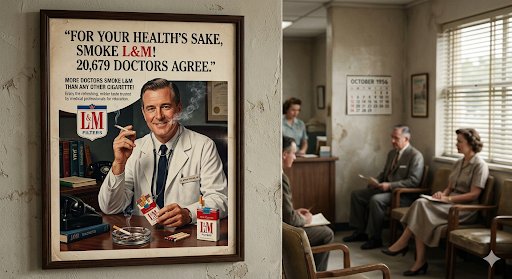
1950s: Doctors recommend smoking to pregnant women. "Calms the nerves." Magazine adverts featured obstetricians lighting up patients in waiting rooms.
Time until reversed: 25 years.
1960s: Thalidomide prescribed for morning sickness. Ten thousand children born with malformed limbs across forty-six countries. The drug was on the market for five years. The United States narrowly avoided approval thanks to one FDA reviewer, Frances Kelsey, who was harassed by the manufacturer for refusing to rubber-stamp it. She received a Presidential Medal afterwards. The men who pressured her did not lose their jobs.
Time until reversed: 5 years. 10,000 affected children.
1970s: DES prescribed to prevent miscarriage. Causes a rare vaginal cancer in the daughters of women who took it, sometimes appearing twenty years later.
Time until reversed: 30 years.
1980s: Margarine officially recommended over butter. Trans fats turn out to cause the exact heart disease they were marketed as preventing. Harvard researchers later estimated up to 250,000 excess American deaths from industrial trans fats before the FDA finally moved against them in 2018.
Time until banned: 30 years after the harm was published.
2000s: Vioxx approved for arthritis. The internal Merck documents showing cardiac risk existed before approval. They hid them.
Time until withdrawn: 5 years. 60,000 dead.
2010s: Opioids prescribed like sweets. "Less than 1% addictive when properly prescribed," cited endlessly from a 1980 letter to the editor of the New England Journal of Medicine. The letter was 101 words long, observed hospitalised patients on short-term doses, and was not a study. It was cited over six hundred times to justify giving OxyContin to people with back pain for the rest of their lives.
Time until reversed: 20 years and counting. Half a million dead.
The pattern is mechanical.
The establishment recommends something. The evidence of harm emerges. The establishment ignores it. Years pass. The harm becomes undeniable. The guidance is quietly updated "based on emerging data." Nobody is held responsible. Nobody apologises. The next mistake is already in development in an adjacent department.
So when modern doctors tell you, with the full confidence of the institution behind them:
"Seed oils are heart healthy."
"Statins for everyone over fifty."
"Saturated fat causes heart disease."
"Cholesterol is the enemy."
Remember that they have been catastrophically, generationally, lethally wrong before. While charging consultation fees the entire way through.
The question worth asking isn't whether they're right this time.
The question is what their track record predicts.
History gives you a fairly clear answer.
A wool jumper, made in 1985, washed in cold water once a month, worn through three decades of British winters, would currently be sitting in someone's wardrobe doing fine.
A polyester fleece, made in 2026, machine-washed weekly, will start to lose its structural integrity within three to five years, shed an estimated 700,000 microfibres per wash into the water system, and end its life in landfill where it will persist for approximately 200 years.
The wool jumper:
- Came from a sheep
- Required grass and rain
- Will biodegrade entirely within three years of being buried
- Will keep you warm when wet
- Will not melt if exposed to a flame
- Will probably outlive you
- Cost £80 in 1985, which is £230 today, and represents the entire jumper budget for the next forty years
The polyester fleece:
- Came from an oil refinery in Texas
- Required hexane extraction, polymerisation and dyeing in three different factories on three different continents
- Will not biodegrade in any human timeframe
- Will get cold and clammy when wet
- Will melt against your skin if exposed to a flame
- Will be in landfill within five years
- Cost £40 in 2026, which means you'll buy ten of them across the next forty years for a total of £400, and the planet will still be eating the residue in the year 2226
But yes. The sheep is the problem.
The sheep, standing in a field in mid-Wales, growing a renewable fibre from grass and rain.
The sheep is the problem.