Dear friends, as promised, the citizens funded generics vs. branded drugs project is now published after 4 months in peer review. It was hardwork, but worth the effort because all of you helped us realize this important work.
You can read the full detaild paper here: https://t.co/jZhm8ZcPCq
Here is a simplified summary:
Do cheaper generic medicines work as well as expensive branded ones? It's a question that worries patients and even many doctors, who often quietly assume that a low price must mean lower quality. This doubt has real consequences in India, where medicines make up nearly two-thirds of what families spend out of their own pockets on healthcare — a burden that pushes millions into poverty and forces people to split doses or stop treatment altogether.
To put the question to a fair, independent test, our team at the Mission for Ethics and Science in Healthcare (MESH) carried out a fully citizen-funded study, paid for entirely by donations from ordinary members of the public, with no money or influence from any drug company.
We bought 131 samples of 22 commonly used medicines — covering heart disease, diabetes, infections, pain, acidity, and more — from seven different kinds of outlets across Kerala, including government stores like Jan Aushadhi, private generic chains, and premium branded pharmacies. Every sample was then coded, blinded, and sent to a top accredited laboratory for rigorous testing against the Indian Pharmacopoeia 2022 standards. What makes this study unusual is that very few before it have tested branded and generic versions from the same market side by side, included government-supplied medicines, and combined strict quality testing with a hard look at price — all at the same time.
The result was striking in its simplicity: every single one of the 131 medicines passed every quality test. 100%. It made no difference whether a pill was generic or branded, cheap or expensive — they were all equally good in their active ingredient content, their purity, and how they dissolve in the body.
Yet the prices told a completely different story. Generic medicines were, on average, 48.6% cheaper than their branded twins, and the most expensive brand cost up to 13.9 times more than the cheapest generic of the very same drug. Government Jan Aushadhi stores were the cheapest source for 18 of the 22 medicines tested, with potential savings running into thousands of rupees a year per medicine — for instance, over ₹16,000 a year on a single liver drug.
For doctors, this is reassuring, hard evidence that prescribing a quality-assured generic is not a compromise on care; it is the same medicine at a fraction of the cost. For patients, it means you can stay on your treatment without it draining your savings, which is exactly what keeps people healthier over the long run.
And this is precisely why independent, publicly funded projects like this matter so much for the future of healthcare in India: they answer the questions ordinary people actually have, free from commercial pressure, and they build the trust that programmes like Jan Aushadhi need to truly succeed. Affordable and high-quality are not opposites — in a well-regulated market, they go hand in hand.
More here: https://t.co/jZhm8ZcPCq
Ok. But how is it fair that openers and other batters are judged by the same metrics. Openers get an order of magnitude more balls to play than a number 5 or 6.
Wouldn’t it be a good idea to give away the Orange and Purple Cap after the League Phase?
How’s it fair to have a competition where some players get 17 innings and others 14 innings?
Team doing well is rewarding…and the team must benefit and it does. Bigger pie of the prize-pool. But why individuals have an unfair advantage?
"If freedom of press is under threat in India how do you exist?" is the genius who'd ask
"If murder rates are increasing in xyz how are you still alive?"
"If the air is polluted to toxic levels why don't you have lung cancer?" & some such geniuses are minsters or journalists😏
NAILED IT: Jeff Bezos: “A nurse in Queens who makes $75K a year pays more than $12K a year in taxes. Does that really make sense?”
“So people talk about making the tax system more progressive. How about we start by having the nurse in Queens NOT pay taxes? At all!”
“Why is a nurse in Queens who makes $75K a year paying more than $1K a month in taxes?”
“That’s $1K a month that could help with rent or groceries or anything.”
“And by the way, do you know what that all adds up to? The bottom half of income earners in this country pay only 3% of the taxes. It’s only 3%.”
“We can find 3%. So we don’t have... it’s a small amount of money for the government. You know that. And the more I thought about it, to me, it’s kind of absurd that we’re doing this.”
“We shouldn’t be asking this nurse in Queens to send money to Washington — they should be sending her an apology. It really makes no sense.”
Exactly!
@PhonePeSupport I am not able to see Care Insurance in your list of insurers for premium payment. Please confirm if this deliberate (You don't have the integration) or an error? Every other upi and BBPS app is showing Care Insurance except yours.
You don't have a problem when the flight goes through and mmt shows the cheapest options and makes the whole experience seamless. Don't blame indigo's problems on others.
The biggest winner in the ongoing #Indigo crisis is @makemytrip
It first made us book indigo flights.. charged "convenience fee". Then retained their fee when tickets were cancelled by Indigo. 700 rupees made on every ticket! Indigo cancelled some 900 crore worth ticket and MMT ciphoned 80 crore plus in this scheme.
Is @DGCAIndia
And @jagograhakjago
Noticing this giant scam on already rattled customers?
Comment if you have experienced this from
@makemytripcare too. We need to take action against them.
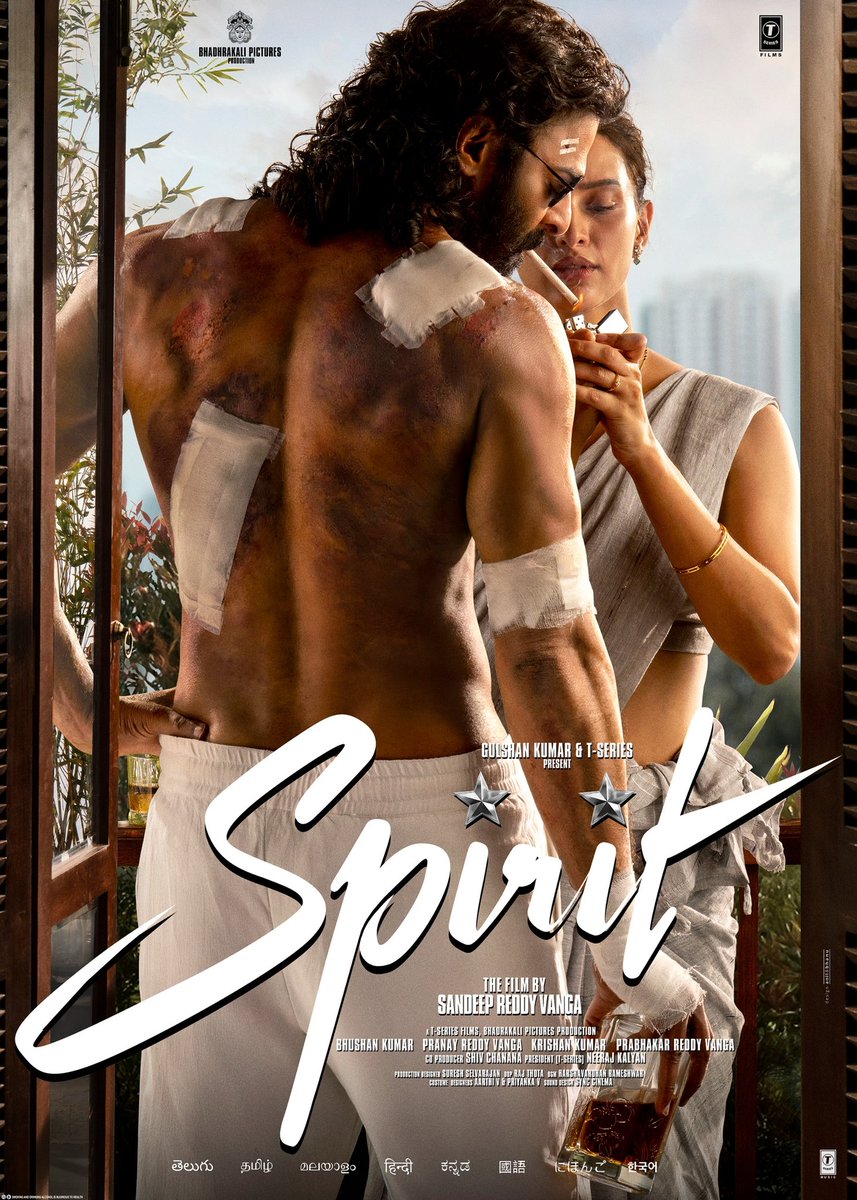
Happy Birthday Prabhas anna 🍾🤗😘 Presenting a 'SOUND-STORY' in five Indian languages straight from the heart, for every fan who’s felt his 🔥
Telugu - https://t.co/oWUchadAcx
Hindi - https://t.co/n7Mwd2jPZ0
Tamil - https://t.co/60UqrdRhWl
Kannada - https://t.co/Uir1ekwkEA
Malayalam - https://t.co/JUDlwppicY
#OneBadHabit
@InSpiritMode
#HappyBirthdayPrabhas
@TSeries@VangaPictures
Bro chill out. Let him think about what is good for him. He is paying crores in taxes to the gov, which can be put to good use (offset losses in tax collection by banning pan masala, etc).
You do your own bit. Stop judging everyone.
If BJP falls in 2029, it won’t return for three decades, because once people taste freedom from a party that tried to script their culture, money, and lifestyle, its own template will be used to erase it, and history rarely offers sequels to control freaks
I have a hypothesis about why Indian CEOs are being selected in such large numbers by international boards.
Indian CEOs are, of course, smart, talented, and capable leaders. But plenty of Americans, Brits, Israelis, Europeans, Chinese, Japanese, and Koreans are too.
And it's not just about speaking English either, as some think, given immigrant Indians are chosen as being better than American or five eyes born native English speakers who are equal, or more in numbers in the western talent pool.
My theory is that they're chosen because they tend to be docile and servile along with all the great qualifications and qualities of a leader.
An Anglo-Saxon white, Chinese, or Israeli CEO might let their community's or birth country's interests creep in and interfere at some point. Or they will just be more brave and open about voicing their opinions and taking decisions which may affect shareholder value.
For example, in the recent H1B visa fee hike case, I saw so many Whites (including Elon), Jewish and Chinese Americans (including CEOs) openly come out against it and support hi-tech immigration, even directly support Indian immigrants.
Indian origin leaders, on the other hand, are a safe bet for keeping their mouths shut in silence. For instance, they haven't yet posted a single line condemning racial targeting, attacks, or killings of Indians, or speak out against H-1B visa policy changes that hurt their own community - or even their own company.
Indians, especially India born ones, can just be trusted to play it safe, focusing solely on their personal and company interests. In fact, they'll bend over backwards to serve their boards, companies, and the deep state, if any, dictating.
My hypothesis can be further proven by seeing that India born Indian origin leaders are picked for CEO jobs in US companies, and not many US born Indian Americans (not even close) who are as qualified with all the great credentials and just as good - if it is really the race or culture that makes good CEOs.
Because, even though they are Indians with similar achievements, qualifications from top schools, and capabilities, being born and brought up in the US, they tend to have a bit more of the independent American spirit and much less of the docility and spineless, servile attitude.
Tell me if I am wrong, but shouldn't our best option be to treat it with respect and not give it flying kicks .
Shuddering to think what happens when it wakes up.
Overall the acting is top notch. Cinematography, coloring and the sets, everything shows meticulous planning and craft. Production value is brilliant. Screenplay is a bit slow. Worth a watch!
go watch #TheBengalFiles. Politics aside, its a good history lesson. Yours truly didn't know anything about this historical event before watching. Now after the movie, I haven't been able to find one thing that was factually wrong with the film.
Ignore the pacing issues tho.