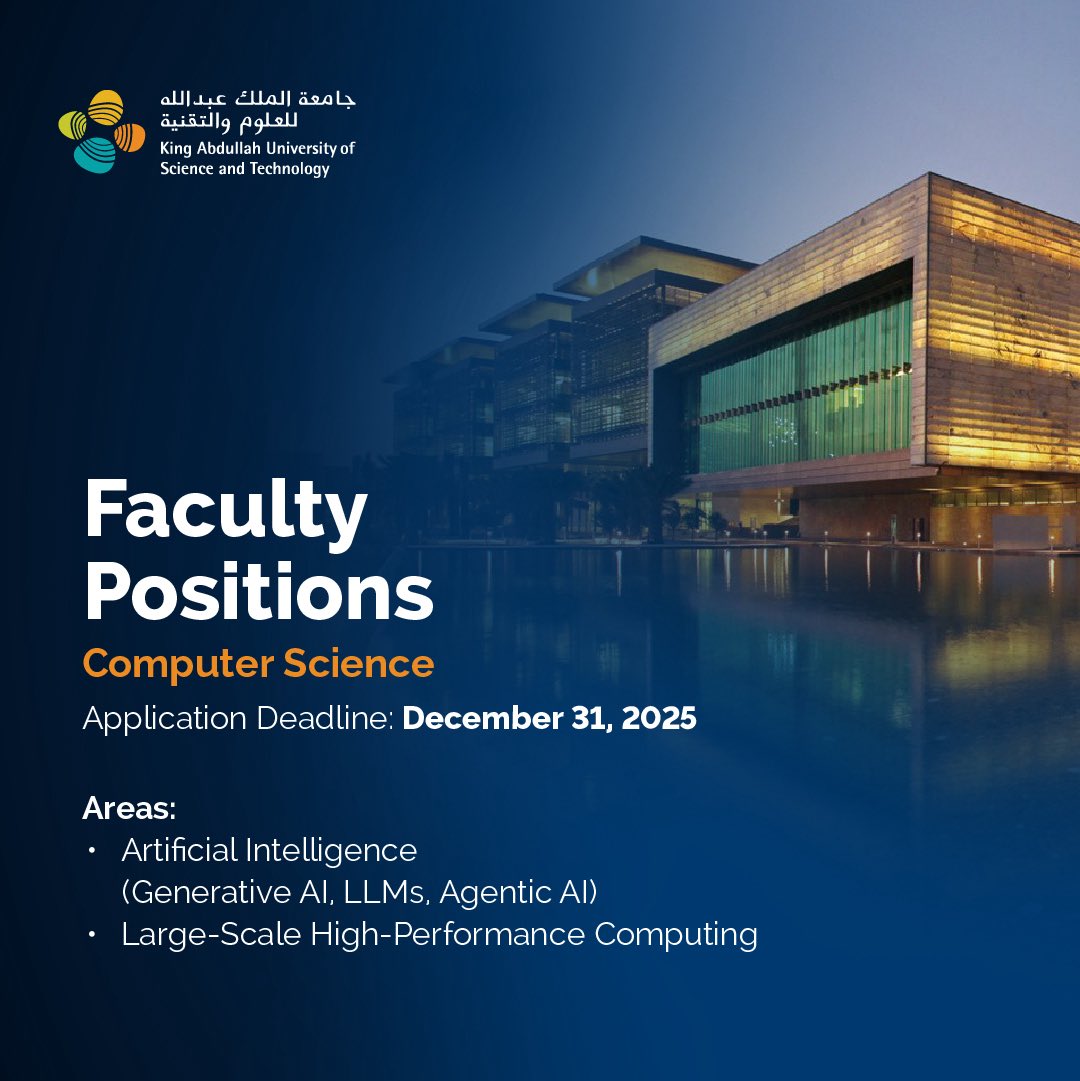
KAUST is hiring!
The Computer Science Program at #KAUST is inviting applications for faculty positions in Artificial Intelligence, with a focus on generative AI, #LLMs, or agentic AI, and in Large Scale High-Performance Computing.
With national investments driving massive growth in #AI infrastructure, data centers, and supercomputing, Saudi Arabia is creating one of the most advanced AI ecosystems in the world, and KAUST is driving this transformation through cutting-edge research, pioneering innovation, and cross-sector partnerships that connect discovery to real-world impact.
We welcome applications from across the spectrum of computer science, with current priorities in these fields.
Learn more and apply here:https://t.co/tDVvUQ6tRQ
#AgenticAI #HPC #FacultyPositions
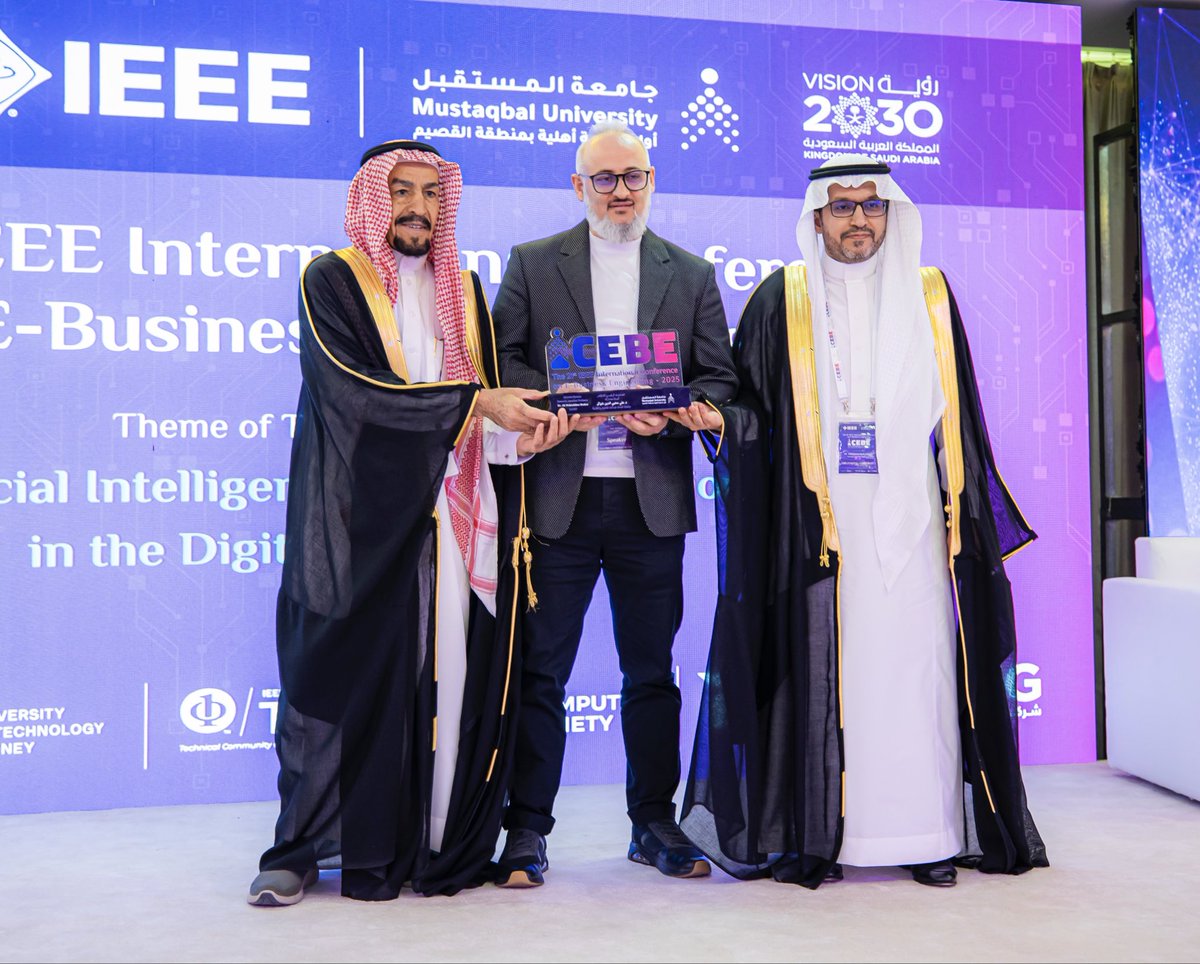
We are proud to announce Prof. Ali Shoker, Head of Cyber Security and Resilience Technology at King Abdullah University of Science and Technology (KAUST), as one of our distinguished speakers at #GDX2026.
🔗 Register now: https://t.co/bGvXHLNHUp
Now that Solidity-compatible blockchains can deliver ~100K TPS in production environment, what kind of new DApps should we invent?
https://t.co/k4wyRvyZUh
@RedbellyNetwork
Very promising discussion to partner with @informalinc supporting MailCoin's @cosmos Tendermint backend and exploring the #Rust Malachite implementation..Proud to have the co-founders and core developers of Tendermint excited to support @MailCoin_org . Thanks @zarinjo and @buchmanster
I am thrilled to be appointed as the Chief Scientist of @MailCoin_org : a breakthrough in #Crypto and #Blockchain.
MailCoin revolutionizes #Decentralized#Fintech adoption through enabling every Email user in the world to make Crypto payments as easy as sending emails, at zero transaction fee!
Keep it simple:
- Email client is the wallet
- Email address is the account
- Email standard protocols are the communication channels–legitimate
- Mail server is the coin minter
- Decentralized Mail Resolution as back-end byzantine consensus network.
Follow us and reach out to help shaping the new world of “#Decentralization 2.0”.
And stay tuned, we are hiring scientists and architects soon.
#MailCoin #blockchain #bitcoin #cryptocurrency #Fintech #Web3 #DeFi
The #NobelPrizeinPhysics2024 for Hopfield & Hinton rewards plagiarism and incorrect attribution in computer science. It's mostly about Amari's "Hopfield network" and the "Boltzmann Machine."
1. The Lenz-Ising recurrent architecture with neuron-like elements was published in 1925 [L20][I24][I25]. In 1972, Shun-Ichi Amari made it adaptive such that it could learn to associate input patterns with output patterns by changing its connection weights [AMH1]. However, Amari is only briefly cited in the "Scientific Background to the Nobel Prize in Physics 2024." Unfortunately, Amari's net was later called the "Hopfield network." Hopfield republished it 10 years later [AMH2], without citing Amari, not even in later papers.
2. The related Boltzmann Machine paper by Ackley, Hinton, and Sejnowski (1985) [BM] was about learning internal representations in hidden units of neural networks (NNs) [S20]. It didn't cite the first working algorithm for deep learning of internal representations by Ivakhnenko & Lapa (Ukraine, 1965)[DEEP1-2][HIN]. It didn't cite Amari's separate work (1967-68)[GD1-2] on learning internal representations in deep NNs end-to-end through stochastic gradient descent (SGD). Not even the later surveys by the authors [S20][DL3][DLP] nor the "Scientific Background to the Nobel Prize in Physics 2024" mention these origins of deep learning. ([BM] also did not cite relevant prior work by Sherrington & Kirkpatrick [SK75] & Glauber [G63].)
3. The Nobel Committee also lauds Hinton et al.'s 2006 method for layer-wise pretraining of deep NNs (2006) [UN4]. However, this work neither cited the original layer-wise training of deep NNs by Ivakhnenko & Lapa (1965)[DEEP1-2] nor the original work on unsupervised pretraining of deep NNs (1991) [UN0-1][DLP].
4. The "Popular information" says: “At the end of the 1960s, some discouraging theoretical results caused many researchers to suspect that these neural networks would never be of any real use." However, deep learning research was obviously alive and kicking in the 1960s-70s, especially outside of the Anglosphere [DEEP1-2][GD1-3][CNN1][DL1-2][DLP][DLH].
5. Many additional cases of plagiarism and incorrect attribution can be found in the following reference [DLP], which also contains the other references above. One can start with Sec. 3:
[DLP] J. Schmidhuber (2023). How 3 Turing awardees republished key methods and ideas whose creators they failed to credit. Technical Report IDSIA-23-23, Swiss AI Lab IDSIA, 14 Dec 2023. https://t.co/Nz0fjc6kyx
See also the following reference [DLH] for a history of the field:
[DLH] J. Schmidhuber (2022). Annotated History of Modern AI and Deep Learning. Technical Report IDSIA-22-22, IDSIA, Lugano, Switzerland, 2022. Preprint arXiv:2212.11279. https://t.co/Ys0dw5hkF4 (This extends the 2015 award-winning survey https://t.co/7goTtI5Uwv)
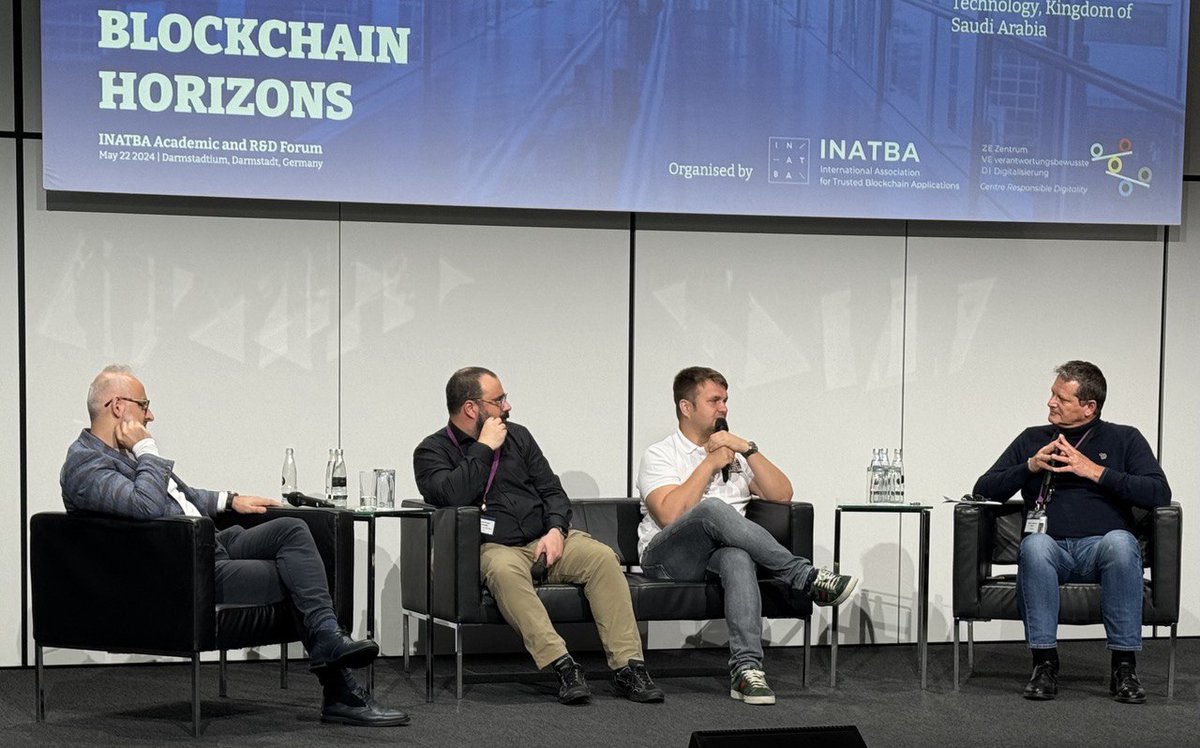
🌍 Next adventure: Darmstadt! Our @buda_kyiv is gearing up for #BlockchainHorizons, hosted by @INATBA_org!
He’s set to participate in a groundbreaking panel on Blockchain’s Role in Space, Defense & Security alongside experts like Dr. David Arroyo Guardeño (@CSIC), @ashokerCS (@KAUST_News), moderated by @smocc694 (@EIT_Digital)
See you there to catch all the action firsthand! 💫
Please consider submitting your work/work-in-progress to the EU flagship dependable computing conference EDCC; new deadline is 20th of October.
@rc3kaust @KaustResearch
https://t.co/x6XIQjgSye