This is absolutely not true. A good friend of mine recently moved back in with her shitty baby daddy. Everyone but her knows it’s a bad idea. Another coworker is writing apologetic love letters to her ex in prison
Correct. Women do not have “one-itis”. When a relationship or marriage ends, after an intense period of mourning, it’s as if that former partner never existed. Even if women have children w/them, women can be in the same room w/exes and have no sexual tension/desire whatsoever. It’s as if they’re siblings or strangers
VEVO was the only reason YouTube didn't get sued out of existence in 2009.
Universal and Sony were ready to pull every music video off the platform. The labels argued YouTube was generating billions on their content while paying back almost nothing. Eric Schmidt's solution: let the labels build a parallel platform where they controlled the ad sales, the curation, and the branding. They called it Video Evolution. VEVO.
The deal was simple. Every "official" music video would route through a VEVO-branded channel. The labels owned the inventory. They sold premium ad slots that regular YouTube videos couldn't access, charging advertisers top dollar to run alongside Beyoncé instead of a random gaming clip.
The leverage was real. In 2010 when https://t.co/dqNjjTgbQ2 tried to renegotiate licensing, UMG pulled every Universal video off the site. MTV's online platform collapsed. The labels had figured out something the platforms hadn't priced in. The platforms needed the labels far more than the labels needed any one platform.
JustinBieberVEVO had 33.6 million subscribers. His personal YouTube channel had 4.2 million. TaylorSwiftVEVO had 27.3 million. Her personal channel had 2 million. The VEVO suffix marked the most valuable real estate on the platform.
Then YouTube counter-punched with Content ID. Every fan upload using a licensed song could now be monetized directly for the labels. By 2016, YouTube had paid labels over $2 billion through Content ID alone. The labels stopped needing a parallel platform to get paid. YouTube was already paying.
In 2018, YouTube started "consolidating" VEVO channels into Official Artist Channels. Artists could not opt out. The 33.6 million Bieber subscribers got auto-merged into a single channel without VEVO branding. https://t.co/sDEAF89gM6 shut down the same year, despite generating 25 billion monthly views.
The VEVO logo still sits in the corner of every official music video. That's the only thing left of the last time a record label cartel had real leverage over a tech platform.
fascinating how quickly he goes from realizing he can’t provoke his desired response from her (to humiliate her), to immediately jumping to sexual harassment (to, again, humiliate her.)
genuinely world record pace fragile masculinity speedrun: hack comic edition.
This is the worst crowd work I’ve seen in a minute, and clip farming it like it’s a highlight is an own goal. This girl is under his skin way more than the other way around.
Let me explain exactly why your phone seems to read your thoughts, because the real answer is more invasive than telepathy.
Every time you open a website or app, a real-time bidding auction fires in under 100 milliseconds. Your GPS coordinates, browsing history, device fingerprint, age, gender, income bracket, and hundreds of inferred interest categories get packaged into a “bid request” and broadcast to hundreds of companies simultaneously. One company wins the ad slot. All of them keep the data.
This happens thousands of times per day per person. A 2018 New York Times investigation found 75 companies pulling precise location data from apps, with some users tracked up to 14,000 times in 24 hours.
In 2012, a Target statistician identified 25 products that, purchased in combination, could predict a customer was pregnant and estimate her due date. A teenager’s father discovered she was pregnant because Target sent baby coupons to the house before she told anyone. That was one retailer. Store receipts only. Fourteen years ago.
Now scale that. Your phone pings GPS while you sleep. Data brokers link your phone, laptop, and tablet through probabilistic matching of IP addresses, WiFi networks, and behavioral patterns without you ever logging in. The FTC caught two brokers in 2024 categorizing people by visits to reproductive health clinics, political protests, and religious services, then selling those profiles to law enforcement.
The algorithm doesn’t hear your thoughts. It compares your behavioral fingerprint against millions of similar profiles and predicts your next interest before you’re consciously aware of it. It makes hundreds of predictions per day. You ignore the misses. The five hits feel like telepathy.
You paid for the phone. You pay for the data plan. You generate the signal. And every time a page loads, your identity gets auctioned to the highest bidder before the content even renders.
They called it “personalized advertising” because “real-time mass surveillance funded by the people being surveilled” doesn’t fit on a consent banner.
Lykke Li seemed set to become a bigger artist than she became and I'm not sure how much of that was her not quite hitting her potential vs. her deciding to let up on the throttle a bit
At some point in the 2020s, perhaps before, what was known as “dating” came to mean “pre-engaged” so we had to start using the horrendous five syllable “situationship” to describe what dating used to refer to
it’s so fucked up when an artist’s like most popular song is also genuinely like one of the top 5 greatest songs ever written like what do you mean the masses are correct
This is one of the most heart-breaking & important articles I have ever read - from someone whose voices are so rarely heard, a teenaged girl.
If you want to understand online misogyny in all its devastating impact, please read this shattering piece.
Here’s one appalling extract:
"A few days ago I saw an Instagram reel of a young woman talking about how she had been raped six years ago, struggled with thoughts of suicide afterwards, but managed to rebuild her life again. Among the comments – the majority of which were from men – were things like “Well at least you had some”, “No way, she’s unrapeable”, “Hope you didn’t talk this much when it happened”, “Bro could have picked a better option.” Reading those comments, which had thousands of likes and many boys agreeing with them, made me feel sick.”
And here’s the impact on this teenager’s self-esteem:
"Using social media has ruined my self-esteem & my relation to being a girl in this world, & nearly every day I feel hatred towards my gender, my appearance, or even teenage girls as a category. The misogyny I see from boys my age online, which is echoed in real life too, has made me grow resentful and bitter towards them, as much as I try to avoid it. As wrong as it is, I persistently find myself considering if there are truly any boys out there who are not misogynistic to some extent, & have even questioned whether I can find love in the future because of this.”
Our daughters do not have to grow up in a world that teaches them they're "community pussy" while still children. Teen boys aren't born misoygnistic - they learn these attitudes from adults. This is on every one of us, male and female alike, to fix. Banning kids from social media won't come close to addressing the fundamental misogyny that's alive, well and thriving in contemporary society. If all of us refused to accept it, called it out for what it is, culture would change.
What a brave young woman this author is.
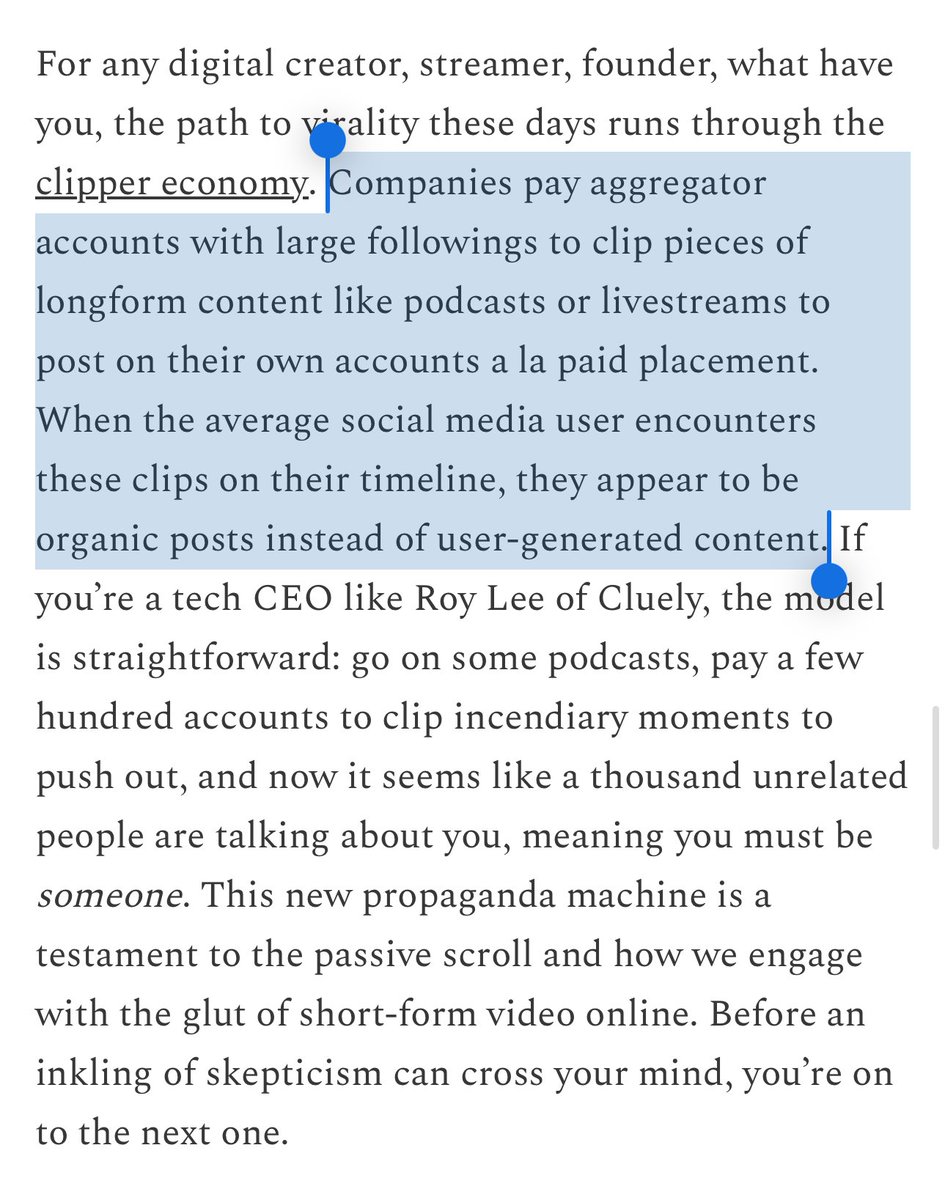
Yes yes yes! I feel like the interesting thing about Clavicular is not really “him” but how this new clipper ecosystem successfully hijacked millennial office worker attention via paid posts on X