Sol is our new flagship and a step function better than GPT-5.5.
Terra delivers performance competitive to GPT-5.5 at 2x lower cost.
Luna is our most cost-efficient model, delivering strong capability at our lowest cost.
Together, the GPT-5.6 family gives people and developers more choice in how they balance intelligence, speed, and cost.
@charlieholtz@betocmn Yeah the popup is useless so why have it. I could literally do the 2-3 things it does on the new workspace's first prompt anyway. But I cannot do the 10 other things I usually want to.
Anthropic dropping Opus 4.8 1M into Claude Code feels incredibly premature. Once you cross the 100k context limit, the agent completely loses the plot. It confidently claims it’s making progress, but it's basically just spinning its wheels.
Maybe just keep 200k context length and invest in better compaction while you figure out scaling laws with respect to context window.
Deep work and deep thinking will be increasingly valuable in a world where AI agents automate a lot of knowledge work. Spawning tens of agents in parallel and context switching between them feels productive, but it's mostly dopamine.
Despite all the excitement, AI adoption still dramatically lags AI capabilities. Our organizations should already be much more automated than they are.
I'm excited to see what this team can do!
The gap holding back AI agents from delivering real economic value isn't model capability. It's the harness: safety, security, governance, orchestration.
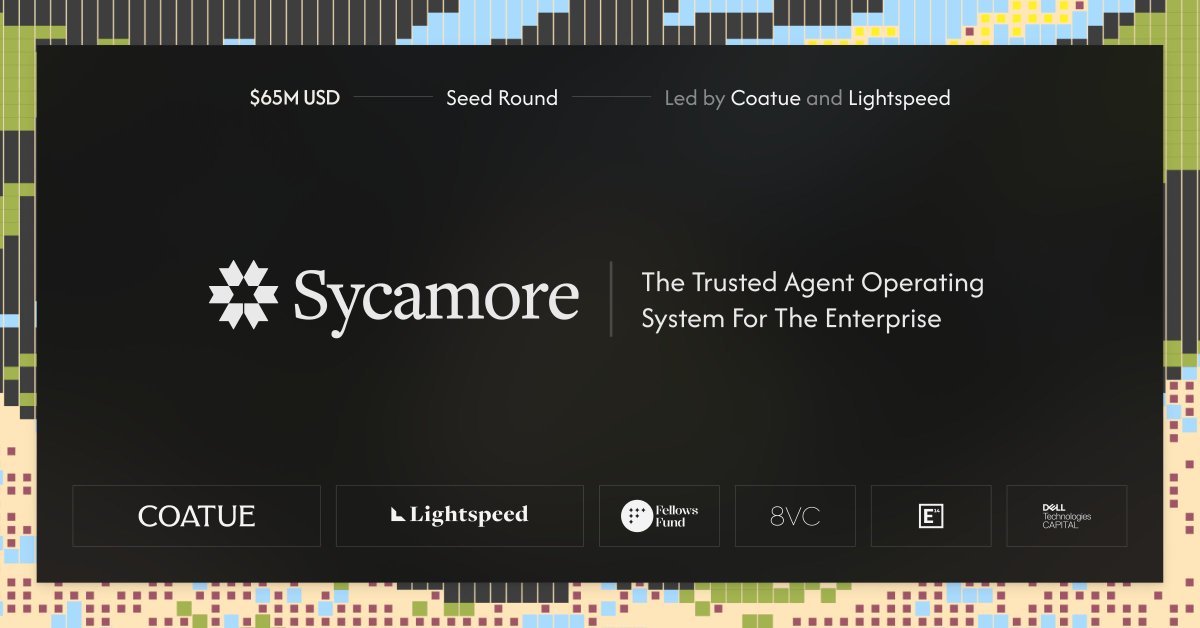
Left Microsoft in January to work on exactly this. Today @SycamoreLabs comes out of stealth with a $65M seed led by Coatue and Lightspeed.
We're hiring. Check us out on https://t.co/Q5eTZXdawJ
@rronak_ Spec != code.
A code harness scales because it lives outside the LLM's context. An NL harness has to be crammed into the system prompt, and strict enforcement is impossible. English is ambiguous by design -- you can't reliably or literally compile an SOP.
If AI scientists are writing millions of papers, many of which are slop, and some of which are incremental progress, how would we identify the one or two which come up with an extremely productive new idea?
In 1948, Shannon was one of hundreds of engineers at Bell Labs working on how to cleanly send voice signals over noisy copper wires. His paper sat in the same technical journal as reports on reducing static and building better filters.
How would you recognize that he has come up with this very general framework for thinking about information and communication channels, which over the coming decades would have enormous use from domains as far apart as cryptography to genetics to quantum mechanics?
It seems like it can take fields multiple decades to recognize the significance of unifying new concepts. Because it is on that time scale that the fruits of such general concepts lead to new discoveries across many different fields.
We’ve managed to solve this peer review problem for human scientists (at least somewhat). Now we’ll need to do it at a much greater scale for the mass of AI science that will be thrown at us.
@mntruell Curious -- what was Cursor's role in this? I guess the semantic/symbolic retrieval tools only, right?
Also, was GPT-5.2 specifically trained to optimize the usage of these tools?
This isn't "basic economics." Gig platforms like Zomato aren't just two-sided markets with supply and demand balancing—they're three- or four-sided (customers, restaurants, delivery partners, platform). The platform extracts growing margins as it scales (e.g., commissions rising from 10% to 25%+ over time) while shifting costs to the other sides.
How? Platforms pass early customer acquisition costs onward through platform fees on restaurants, 25%+ cuts on menu items, and "advanced" algorithms that dynamically set gig worker payouts (often varying with demand surges). This scales the business and pushes out smaller competitors, but it feels uneven.
Of course, jobs are created in the process, and that's good. But greater transparency (e.g., clear algorithm/payout rules and fee breakdowns) could be a better path forward than wage hikes or permanent gigs. It's still a free-market approach but builds trust, reduces friction, and enables sustainable platform growth.