@elonmusk The Honest Reaction thank you for uniting all the Indians and make many aware what type of Protests are happening tomorrow.
Why don’t you enter as a Joint Venture with JIO? What is stopping you?
It's not surprising to see our colonial sepoy @rahulgandhi supporting @elonmusk in undermining our business ventures. After all, in ensuring the integrity of our country be it economic or territorial, the Nehru-Gandhi family has been acting against India for over 4 generations. From giving away PoK and Akshai Chin to distributing 2g spectrum license at decade old rates, the stories of anti-Indian activities of Nehru-Gandhi family are of course many
Russians have started integrating R-60 air-to-air missile onto Shahed drone kamikaze drones (a move that could open an entirely new can of worms.)
This blurs the line between UAVs and air-to-air combat platforms, potentially complicating air defence doctrines and engagement rules.
Rajya Sabha MP Raghav Chadha tweets, "Telecom companies offer Recharge Plans with ‘Daily Data Limits’ like 1.5GB, 2GB, or 3GB per day, resetting every 24 hours. Any Unused Data EXPIRES at midnight, despite being fully paid for. You are billed for 2GB. You use 1.5GB. The remaining 0.5GB disappears as day ends. No refund. No rollover. Just gone. This is not an accident. This is policy. Use it unnecessarily, or lose it by midnight. That’s how mobile data works today. I raised this issue in Parliament - Why should data that we have paid for be FORFEITED? Unused data should carry forward into the next cycle, so consumers can use what they have already paid for..."
From April to July, Bangkok is a paradise for luxury lovers. You can explore 15,000 authentic pre-loved luxury items at up to 90% off.
https://t.co/kEgsSxEzty
₹19,000 crore.
That is what Banks collected in last 3 years just for not maintaining ‘Minimum Account Balance.’
Not from the rich. Not from big borrowers.
From the poorest accounts in the system.
Their crime? They didn’t have enough money.
A farmer misses the minimum balance - Penalty.
A pensioner withdraws money for medicine - Penalty.
A daily wage worker falls short by a few hundred rupees - Penalty.
The poor keep money in banks for safety. Not to be quietly fined for being poor.
Financial inclusion should protect small savings, not punish small balances.
In Parliament today I proposed ending minimum balance penalties so the banking system stops charging people for their poverty.
REVIEW UPI Autopay Mandates 🔔
Login to https://t.co/x0I76tb81k
Review all Mandates (Mainly Subscriptions). Remove unnecessary ones.
Do it Now. Share this Post Widely.
Invest Surplus Mandate Money in a SIP. In 15 years you will Thank Me ❤️
#FI
In the high-stakes theatre of international diplomacy, silence is rarely just silence. When U.S. Commerce Secretary Howard Lutnick announced this January that a landmark trade deal with India had stalled because Prime Minister Narendra Modi "did not call" President Trump to finalize the terms, the explanation was as convenient as it was implausible.
To the casual observer, it painted a picture of bureaucratic hesitation. But to those watching the flow of global capital, the silence on the phone line masked a thunderous shift in the global economic order. While Washington focused on tariffs and trade deficits, New Delhi quietly engineered a financial mechanism that the United States has historically treated as a red line: the ability to buy oil without the dollar.
A rigorous analysis of regulatory filings, central bank data, and geopolitical signalling reveals that the trade impasse of early 2026 is not about almonds or steel. It is the first major casualty of the "Petro-Rupee," a strategy that has placed the world’s oldest democracy and its largest democracy on a collision course over the future of financial sovereignty.
The "Red Line" and the Greenback
To understand the gravity of the rift, one must look past the current headlines to the foundation of American power. Since 1974, when the Nixon administration struck a pact with Saudi Arabia, the global oil trade has been denominated effectively exclusively in U.S. dollars. This "Petrodollar" system forces nations to hold vast dollar reserves, which are recycled back into U.S. Treasury bonds, financing American deficits and cementing the dollar's global supremacy. History has been unkind to those who challenge this arrangement. When Saddam Hussein switched Iraqi oil sales to the Euro in 2000, or when Muammar Gaddafi proposed a gold-backed African currency in 2011, the geopolitical consequences were severe. As former Federal Reserve Chairman Alan Greenspan candidly noted in his memoirs, the Iraq war was "largely about oil"—a resource inseparable from the currency used to buy it. So is the case with Venenzula and Iran today, which are pricing their oil outside the US dollar system.
For decades, this was a line no ally would cross. But in the shifting landscape of 2026, India has done just that.
The Smoking Gun: August 2025
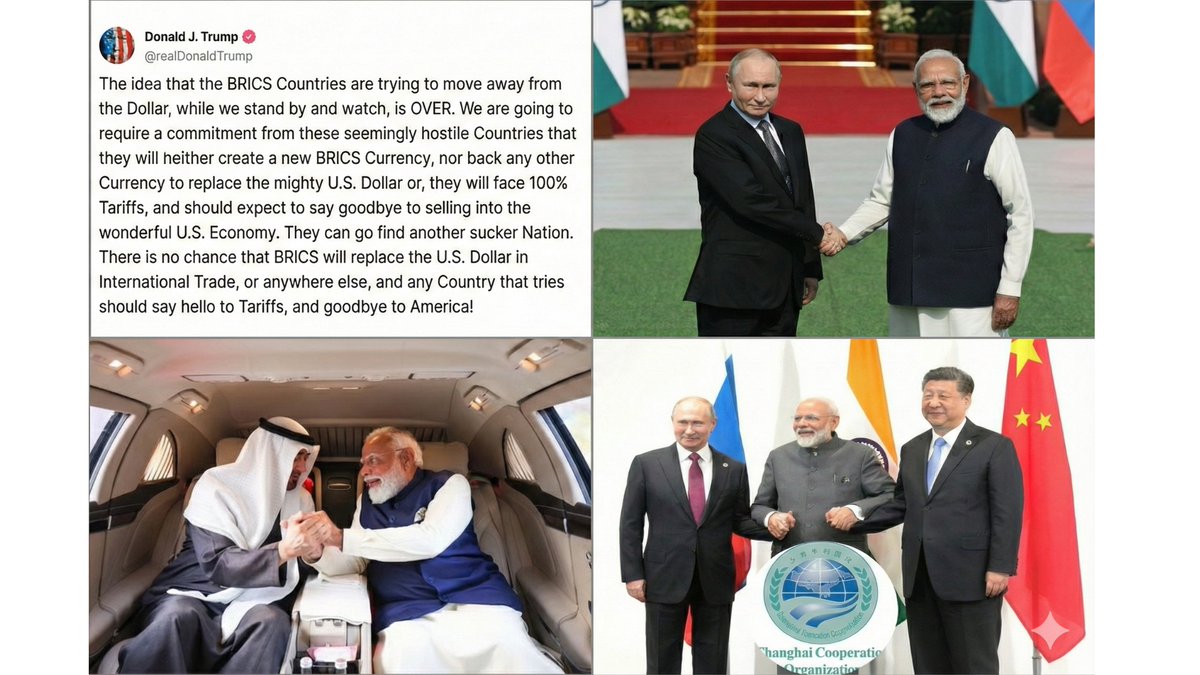
Picture tells thousand words. The deterioration of economic relations can be traced precisely to mid-2025. While public attention was fixed on diplomatic pleasantries, the Reserve Bank of India (RBI) was dismantling the "Rupee Trap" that had hindered its trade with Russia in Rupee.
For months, Moscow had been accumulating billions in Indian Rupees from oil sales that it couldn't spend. Then, on August 12, 2025, the RBI issued a quiet but revolutionary circular. It authorized foreign holders of "Special Rupee Vostro Accounts" (SRVAs) to invest their surplus balances into Indian Government Securities and Treasury Bills. In a move that alarmed U.S. strategists even more, India and the UAE—two key American partners—began operationalizing a Local Currency Settlement system. The Indian Oil Corporation paid for a million barrels of Abu Dhabi crude in rupees, proving the concept worked. By 2025, this corridor had deepened, with the UAE pumping $22.84 billion in foreign direct investment into India to balance the currency flows, and the Abu Dhabi Investment Authority setting up shop in Gujarat's GIFT City.
This was the smoking gun. By allowing Russia to recycle its oil revenue directly into Indian sovereign debt, New Delhi created a closed-loop financial system. Russian oil profits were no longer chasing U.S. Treasuries; they were funding Indian infrastructure. The reaction from Washington was swift. Within weeks, the U.S. imposed tariffs of up to 50 percent on select Indian goods—a punitive strike that signal the partnership was in jeopardy.
By late 2025, this alternative financial architecture had expanded far beyond a wartime necessity for Russian oil. The RBI had permitted 123 correspondent banks from 30 countries—including the United Kingdom, Germany, Israel, and Singapore—to open 156 Special Rupee accounts.
The Last Straw: India Takes the Wheel at BRICS
While the "Petro-Rupee" laid the kindling, the spark that finally burned the bridge was India’s bold assumption of leadership within the BRICS currency project. As the host of the 2026 BRICS Summit, New Delhi has moved beyond passive participation to active architecture. The Reserve Bank of India has formally proposed linking the Central Bank Digital Currencies (CBDCs) of member nations—a project dubbed the "BRICS Bridge."
Building on the 2025 Rio de Janeiro declaration, India is pushing for a proprietary, interoperable payment rail that would allow Russia, China, India, other BRICS members to settle trade instantly in digital local currencies, completely bypassing the U.S. banking system. This is not merely a theoretical exercise; with the RBI actively pilot-testing the e-Rupee’s cross-border capabilities, India is effectively building a "digital SWIFT" immune to Western sanctions. For the Trump administration, this was the final provocation. It wasn't just evasion; it was replacement.
Conclusion: A Monetary Mutiny
This aggressive push for a parallel financial system became the veritable last straw on the camel's back for the stalled trade deal. In December 2024, President-elect Trump issued a blunt ultimatum: any move by BRICS nations to create a new currency or back an alternative to the dollar would be met with 100 percent tariffs.
Washington views India’s 2026 agenda not as economic modernization, but as a "monetary mutiny." The sages who studied the rise and fall of kingdoms would chuckle today, for the lesson is ancient: money is the hard-earned fruit of labor, while currency is merely the paper promise that it still tastes good. Money—like gold and silver—is the crystallized effort of real work. Currency, however, is its excitable younger cousin: useful for trade, but spoiled the moment rulers discover the printing press.
India has chosen to bear the cost of tariffs rather than surrender the sovereignty of its "crystallized effort." The trade deal may be officially "stalled" due to a missed phone call, but in reality, it lies buried under the foundation of the new BRICS financial architecture—a foundation India is now actively pouring concrete for better future.
Manish Bhandari, CIIA, founder of Vallum Capital Advisors, a Portfolio Management firm managing equity investments Based in Mumbai.
Full Article & Research Document Available Below
https://t.co/OsPJLHJ1Db
#Geopolitics #Macroeconomics #USIndiaTrade #BRICS2026 #GlobalEconomy #ForeignPolicy #TradeWar #DeDollarization #InternationalRelations
Why no ADAS on the 2026 Skoda Kushaq facelift? Why rear seat massage instead of ventilation?
Skoda India brand director Ashish Gupta takes on questions from @MrAhmedSays.
🛣️ In Maharashtra, NHAI is set to open the Left-Hand Side tube of the New Khambataki Ghat Tunnel on the Pune-Satara National Highway on a trial basis from 17 January 2026. The project will reduce travel time through the ghat from around 45 minutes to just 7 minutes.
The package includes a 1.3 km tunnel and a 1.2 km viaduct. The Right-Hand Side tube is targeted for completion and opening by June 2026.
#PragatiKaHighway #GatiShakti
VIDEO | On Wednesday, a Hyderabad-based defence tech company unveiled what it claims to be India’s first Anti-Drone Patrol Vehicle (ADPV), the Indrajaal Ranger, a fully mobile, AI-enabled system capable of detecting, tracking, and neutralising hostile drones even while in motion.
Unlike traditional vehicle-mounted anti-drone systems that function only when stationary, the Indrajaal Ranger operates in real time on the move, offering autonomous threat assessment, instant interception, and continuous patrolling.
(Full video available on PTI Videos – https://t.co/9uKz9ypjA9)