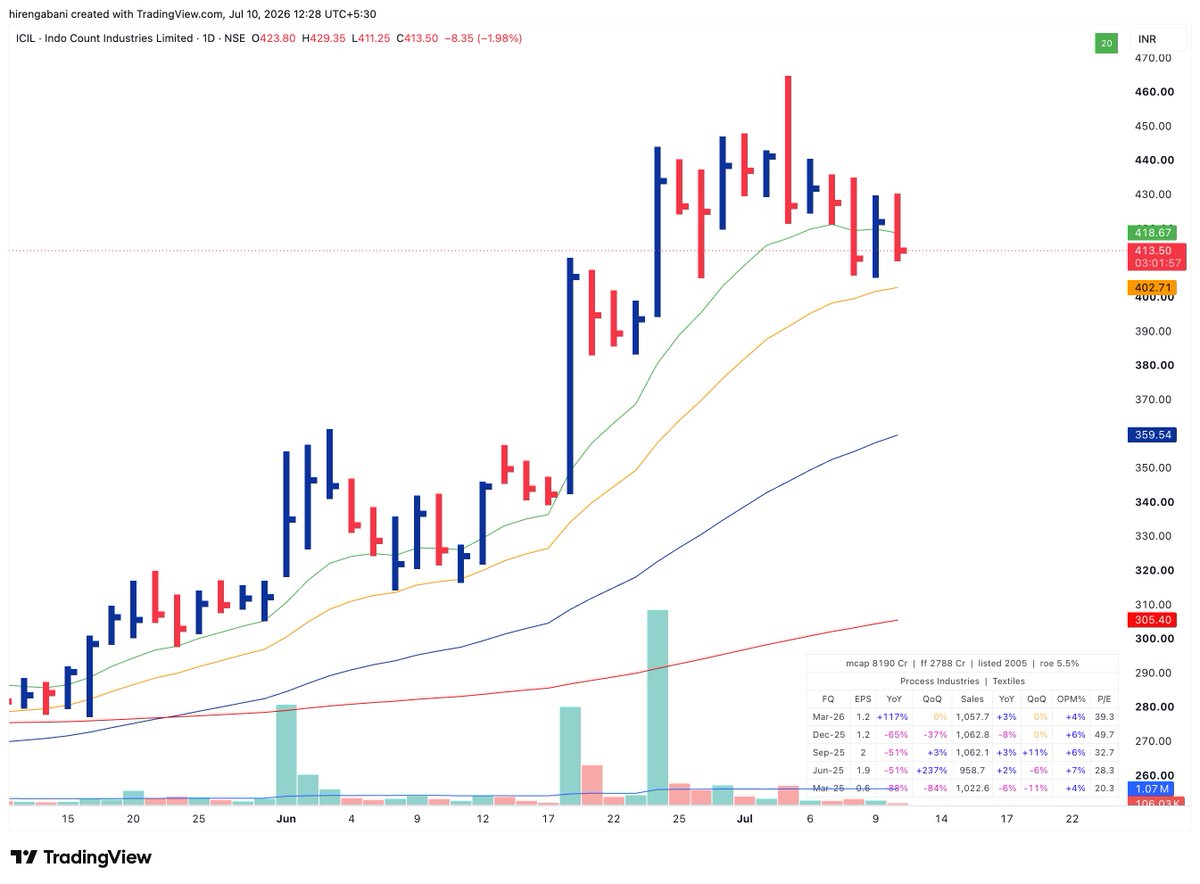
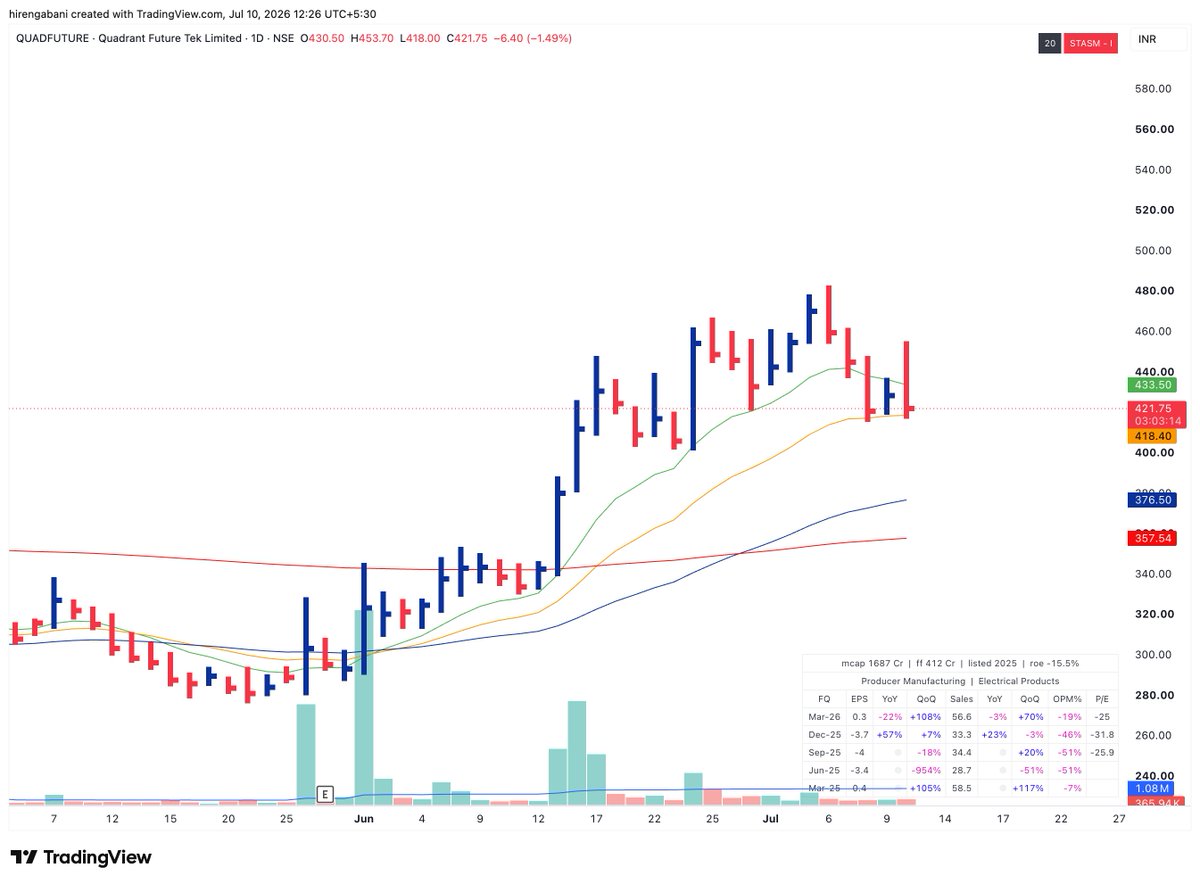
Yes, you can find them on an extremely secret tool called Google. Try searching for "stockbee market breadth," And don't tell anybody about that secret tool.
Manas Arora just caught one lucky bull run.
His edge falls apart the second the market turns.
That's what traders who never learned from him keep telling themselves.
I learned from him directly. Here are 8 ideas that quietly rebuilt how I trade:
I would do: Momentum Burst.
The idea: stocks move in 3-5 day bursts of 5-15%.
trade only the burst. In & out in 3 to 5 days.
Sized properly: 150 trades, 40% win rate, +10% winners vs -3% stop = ~66% in a year. Rough math
The process:
1. Scan daily for tight range candles in range
2. Prior 5-10 days should be low-volatility & sideways
3. Enter on breakout day. Stop below candle low
4. Exit in 3-5 days or at 7-12% - whichever comes first.
5. Capital comes back, rotates into the next burst
You need very strong upmove for this ste up
Small gains, high frequency, compounded
Study Pradeep Bonde (Stockbee) - he built the framework.
I studied him and created a very detailed notes
Relative Strength (RS) in Real Trade Scenarios
Zanger, Minervini, Qullamaggie, Darvas, William O'Neil
All different systems. All different eras.
One thing they all obsess over - Relative Strength.
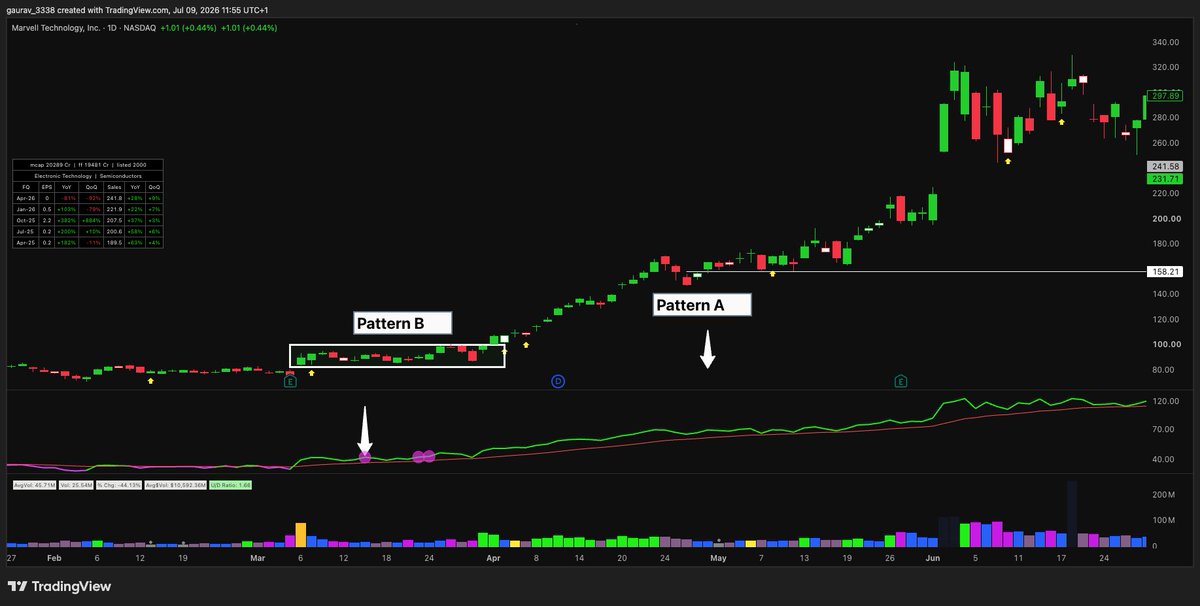
Pattern A - Quiet Accumulation Tell
Price flat, RS rising - coiled spring
This is the most obvious one.
Price is going nowhere. Stock is in a tight range, maybe even slightly drifting down.
But RS line is climbing meaning the stock is outperforming the index while appearing to do nothing.
>What to watch for:
1-RS line making new highs before price breaks out - this is the tell
2-Base is tight: IB/NR7 days, inside bars, volume contracting
Trade application:
1-Highest-conviction Anticipation setup candidate
Stop: low of the base/candle
Pattern B - Early Stage Leader in New Bull Cycle
Follow-through day, first movers
Market is in a long term downtrend say Stage 4.
But somewhere in that phase, few stocks quietly stop falling. Stage 1 accumulation begins. Bases start forming. Right side volume starts appearing. RS lines start rising while everything else is still bleeding.
These stocks are telling you something before the market confirms anything. whose RS lines are already near 52-week highs despite the downtrend - are your cycle leaders.
What to watch for:
1-RS line was rising during market correction (stock held while index fell)
2-RS line at or near new highs at exact moment when stage turning
3-Stock breaking out of a base that formed during bear phase - not after it
3-Stock above 11WEMA
Trade application:
1-Filter for stocks with RS > 80 or Use RS Line Turning up after massive downtrend
2-First buys of new cycle ,small size initially, add as market confirms
3-Hold with patience ,early leaders in new bull run often become 200-500% stocks over next 12 months
💫Sharing a few clean, liquid, and fast-moving stocks that can offer potential entry in the next few days.
✅Note:
-I have not included slow, choppy, or illiquid stocks.
-I also avoided extended stocks that have already made a move (they will need time to form a proper base).
✅I'll add more stocks to my list after this weekend's scanning.
𝗤 𝘀𝗵𝗼𝘄𝗶𝗻𝗴 𝗮 𝗳𝗶𝘃𝗲 𝘀𝘁𝗮𝗿 𝘀𝗲𝘁𝘂𝗽 ⭐ ⭐ ⭐ ⭐ ⭐
So everyone except one person was asleep. At what time, well about the same time it broke out intraday. It’s the most textbook breakout I’ve seen in a while. The right sector, big volume, and just a perfect flag pattern intraday.
I got stopped out the first time around, I took a $13,000 loss on it on this weird red candle. So I had a 5.20 average. I had about half size and then it just shook me out and I got stopped out low 5s. And then I started building back, 5.20 and 5.32, I think, were my entries. My only regret is I didn’t buy 200,000 shares instead of 100,000 shares and then it went just straight up. It is the most textbook flag ever. Higher lows intraday at the range. It’s a hot sector, the hottest sector we’ve seen in probably year plus. Record volume, ultra liquid.
Memorize this, memorize. Trades like that, they don’t grow on trees. Except for the past two weeks they’ve literally been growing on trees, but generally you don’t get them too often. I have to say, I’m a little bit disappointed. Guys, how are you not monitoring these coronavirus stocks? It’s the hottest sector. Only one person saw it. And that person didn't even buy it.
Okay guys, I'm going to teach you something. If you have a hot sector like this, you have to monitor, you have to create a watchlist and monitor all of the stocks. Just scroll through them during the day. This is unacceptable guys. I’m a little bit disappointed. I’m super disappointed. Just scroll; I have 40 coronavirus stocks in my watchlist and I just scroll through them, the most liquid ones. I sort them by dollar volume. Most of them are too illiquid for me to trade. But every day, pre-market and during the day, I just scroll through this list.
INO is obviously the most liquid one today, GILD—this is a slow moving one, it's not a pump stock. MRNA, APT, CODX, AIM, NVAX. All of these. Just scroll through them, look for setups. Look for news. OMI, they had earnings—oh, good thing I sold it yesterday. Whew! What a piece of shit. ARCT, another one that is getting pumped today.
Guys, you have to do these things. You really have to. There's really no excuse. And if you think there's too many, just focus on the most liquid ones. Markets like these are when you can make your whole year in a few weeks. Like a whole year happens in a few weeks. That’s the market environment we are in right now. And you just have to do this over and over and over again.
1 piece of advice I hear all the time is, "Study the greats."
I couldn't agree more...but I also think MOST people misunderstand what that actually means.
When I say I've studied traders like William O'Neil, @markminervini, @OliverKell_, @Qullamaggie, Paul Tudor Jones, Stan Weinstein, and more recent greats who I align with like @RealSimpleAriel + @ShakePryzby1 & so many others, I don't mean I watched a couple of YouTube videos or skimmed a book over the weekend.
I mean I've spent months + years reading thousands of pages, highlighting books, listening to interviews multiple times, revisiting old notes, comparing methodologies, and trying to understand "WHY" they thought the way they did. I wasn't looking for a magical setup or a profitability hack... I was trying to understand the principles that shaped their everyday execution + psychology.
I realized pretty quickly that none of these traders trade exactly the same. In fact, many of them don't think like each other, and at first, that confused me. Then it became 1 of the biggest lessons of my entire journey. The goal isn't to copy someone else's system word for word. The goal is to borrow the pieces that fit your personality, your psychology, and the way "YOU" naturally see the market.
So... that's exactly what I did!
I took Oliver's obsession with relative strength. I took O'Neil's emphasis on leadership and fundamentals. I took Stan Weinstein's focus on Stage 2 breakouts and drawdown control. I took Qullamaggie's patience + emphasis on tightness. Then I spent years testing those ideas, throwing away what didn't fit me, and keeping the pieces that consistently made sense within my own process.
Your edge isn't found by copying 1 person. It's built by understanding many people and slowly becoming yourself.
I also think 1 of the most underrated reasons to study great traders has nothing to do with finding new strategies.
It's learning from their MISTAKES.
Every great trader has already paid tuition to the market. They've blown up accounts, held losers 2 long, overtraded, chased breakouts, ignored risk, and made almost every mistake you and I are capable of making. If I can learn those lessons through their experiences instead of my own, why wouldn't I?
When I read a book now, I'm constantly asking myself questions...
> Why did this work for them?
> Would this fit my personality?
> What assumptions are they making that I might disagree with?
> What mistake are they warning me about that I haven't experienced yet?
Those questions have become far more valuable than simply memorizing "someone's rules."
The longer I've traded, the more I've realized that becoming proficient at anything isn't about finding one life-changing idea. It's about collecting hundreds of small lessons over years, connecting them together, and slowly building something that's uniquely yours.
That's why I still read. I still take notes. I still revisit books I've already finished. Every time I come back, I notice something I completely missed the first time because I've grown as both a trader and a person.
Experience teaches you what works. Studying others often teaches you why it works.
& I think you need both.
If I could leave you with 1 piece of advice, it would be this: don't just study people's wins... Study their routines + study their habits + study how they think under pressure + study how they manage risk + study how they responded after devastating losses. Because truthfully, those are the lessons that tend to stick with you long after the chart patterns are forgotten.
At the end of the day, my goal has never been to become the next KQ or Oliver Kell.
It's to become the best version of myself as an individual + trader.
And studying the greats has been 1 of the biggest reasons I've been able to do exactly that.
Don't take my words as truth, go study them yourself.
Happy 4th, family!
One habit that has completely changed the way I discover stocks is volume-first screening.
Every evening after the market closes, I run just one volume-based scanner—a process I learnt from @iManasArora. Over time, I've realised that many meaningful moves begin with unusual volume, long before the story becomes obvious.
Today, that scanner highlighted Digitide Solutions.
That was just the starting point.
The next step is to combine TechnoFunda—a framework I learnt from @MashraniVivek . Instead of chasing price alone, I study the business, management commentary, growth drivers, and financial quality.
The initial findings were interesting:
✅ Highest volume since listing
✅ Strong breakout above ₹100
✅ AI-first digital transformation theme
✅ Positive management commentary post demerger
✅ Improving business focus with a standalone identity
At this stage, I'm not calling it a winner.
It has simply earned a place on my active watchlist, and I'll now track how the next few quarters validate (or invalidate) the emerging investment thesis.
A good reminder that:
Price gets attention. Volume tells you where to look. Fundamentals tell you whether to stay.
Learning never stops.
#StockMarket #Investing #TechnoFunda #VolumeAnalysis #SwingTrading #Digitide #IndianStocks #LearningEveryDay #thewealthsarthi
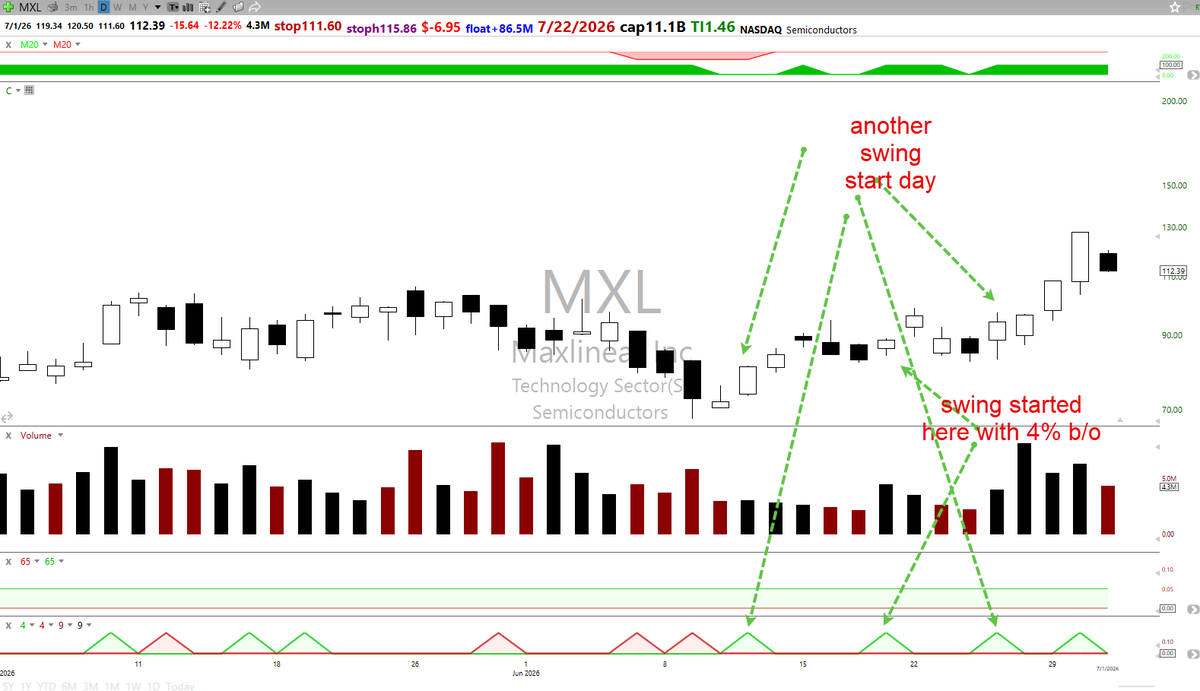
You have a different definition of the start of a swing than I do. For me, swings start with a 4% b/o signal, which was a day earlier, not Monday.
Different ways of trading. If buying on the second day of swing works for you, continue to do what works for you.
𝘿𝙤𝙣'𝙩 𝙗𝙪𝙮 𝙗𝙧𝙚𝙖𝙠𝙤𝙪𝙩𝙨 𝙞𝙣 𝙘𝙤𝙧𝙧𝙚𝙘𝙩𝙞𝙫𝙚 𝙢𝙖𝙧𝙠𝙚𝙩𝙨.
So I'm down 120k on my longs. I should have just not bought any breakouts. Don't buy breakouts in corrective markets. Just remember that mantra. I just get so tempted sometimes. I get so tempted, man. I really get tempted. No bueno.
Delayed Reactions EP9 million scan.
When using momentum to find stocks like these, use a one-month offset. Meaning, find stocks that were momentum leaders a month ago. Rank by 3 months gainers a month ago
In the High Priority list...
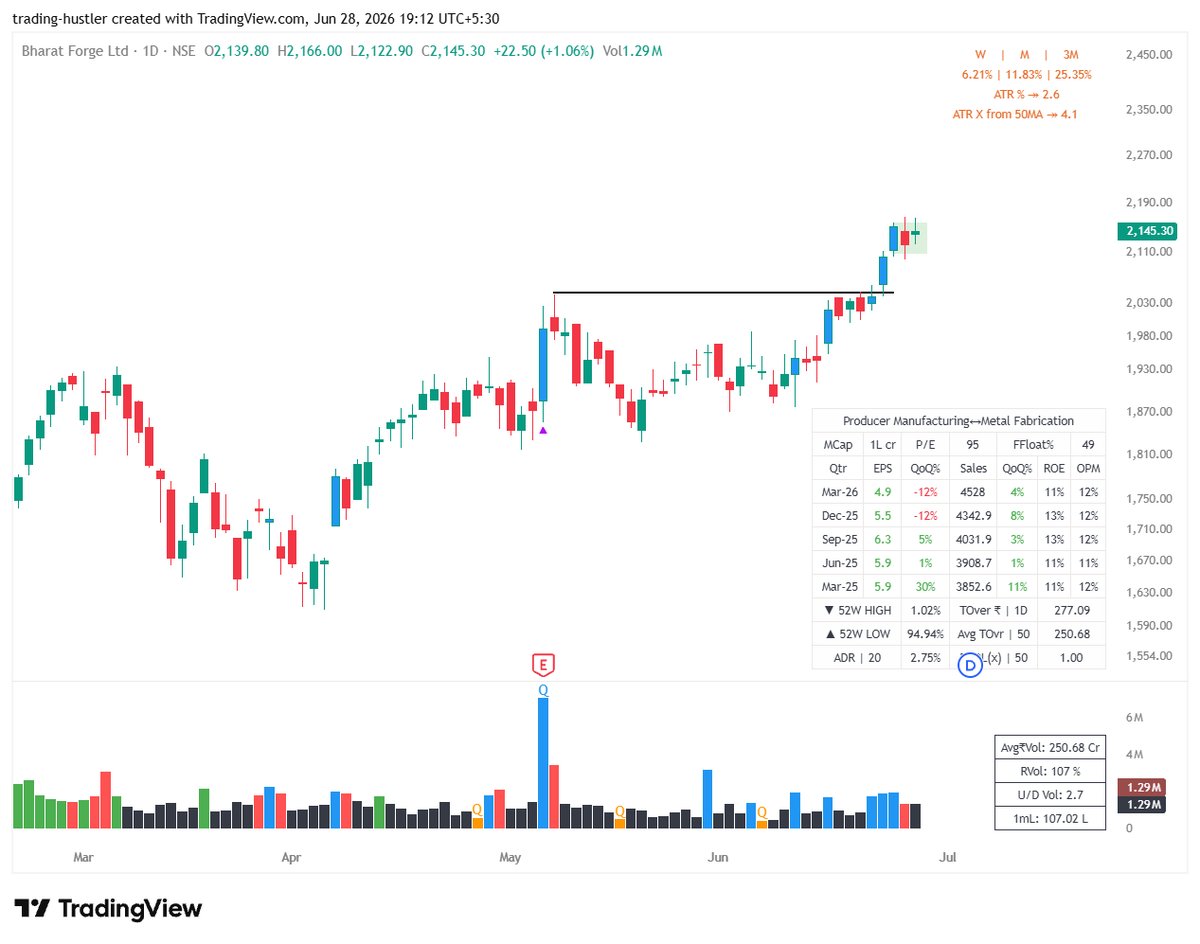
•#Bharatforge: Tightness after Breakout
•#Thangamayil: Avery tight range above 10EMA
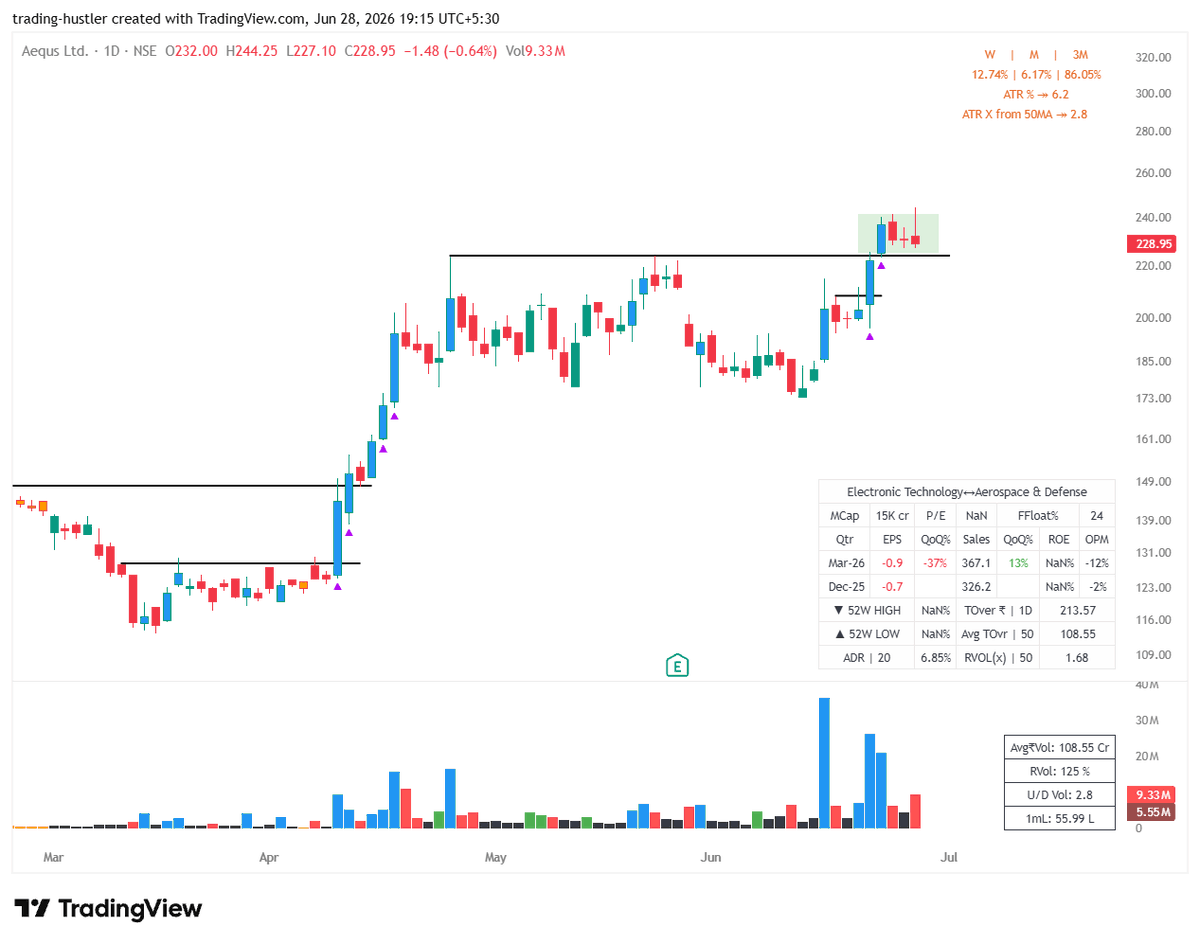
•#Aequs: 4D TR just after Breakout, IPO name
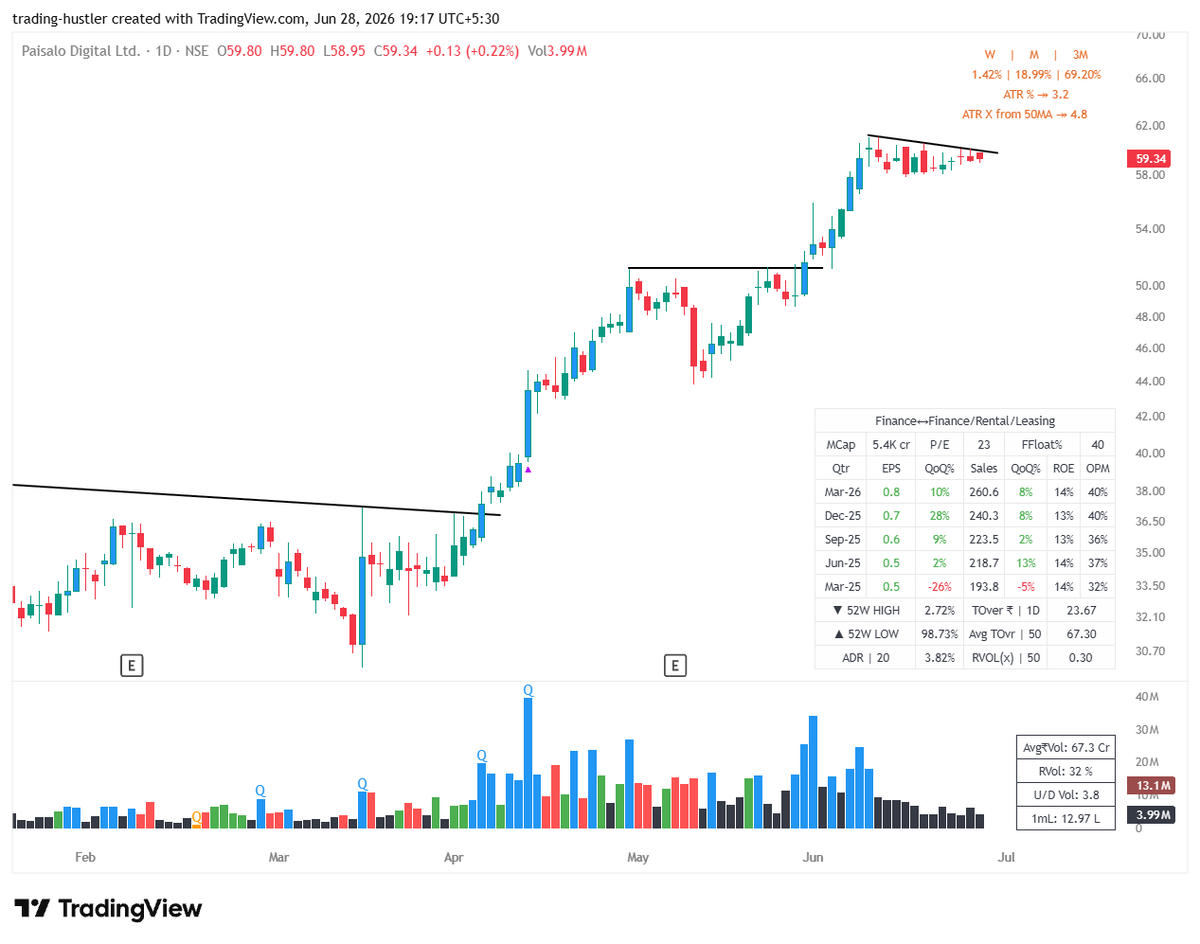
•#Paisalo: Prior uptrend followed by a tight flag
No recos, DYOR!!