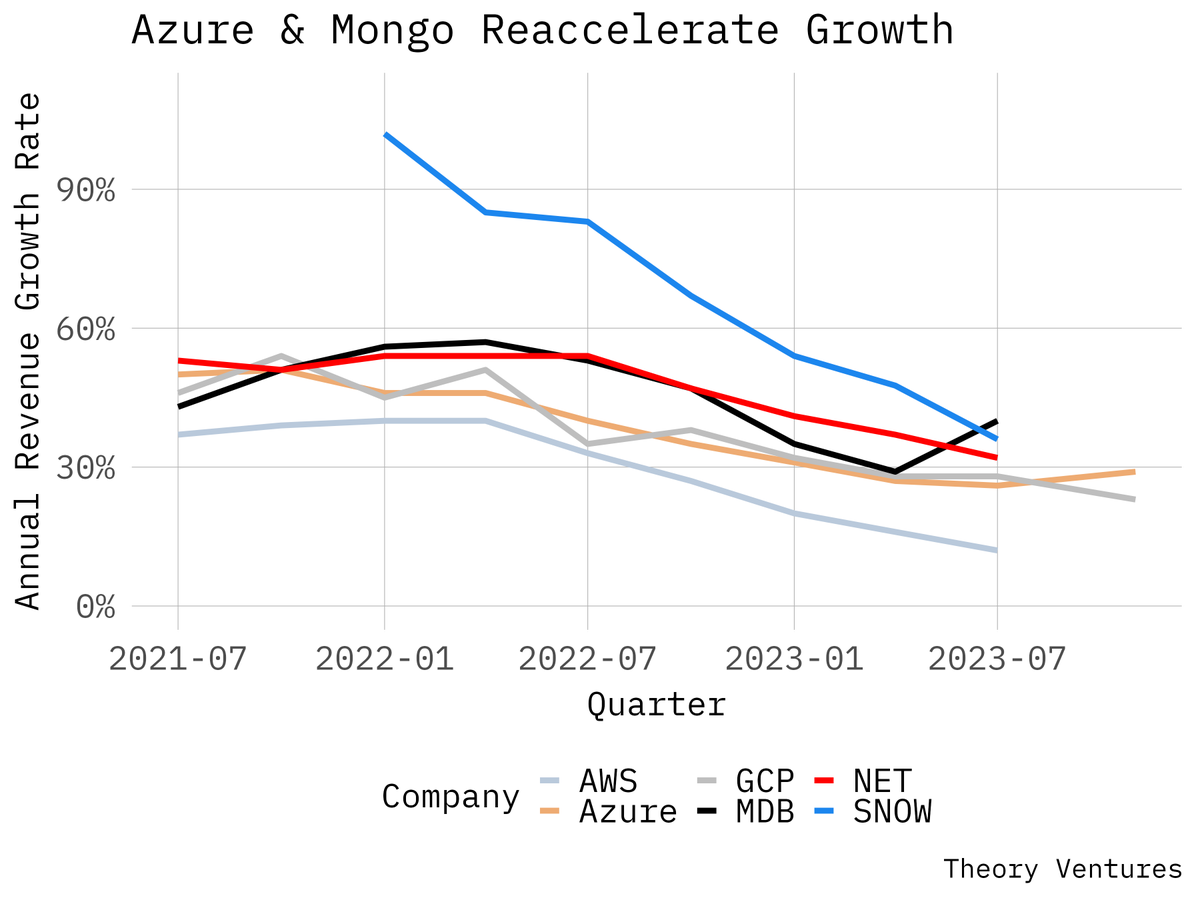
Yesterday, both Google and Microsoft announced their earnings for their cloud businesses. I’ve been tracking the growth rates of these companies and product lines for the last 18 months to develop a broad gauge of enterprise buying patterns after the downturn.
In the chart, it’s immediately evident that Mongo has seen dramatic increase in growth rate last quarter. We await the earnings from everyone aside from Google and Microsoft in the next few weeks.
Notably, Microsoft has also re-accelerated - like Mongo, although to a lesser extent. This growth is fueled by AI workloads.
Google, on the other hand, declined after having plateaued last quarter.
Listening to the Microsoft earnings call, There are some interesting insights to be gleaned.
First, Microsoft is diversifying its algorithms portfolio from primarily OpenAI to open source models.
“Azure AI provides access to best-in-class frontier models from OpenAI and open-source models, including our own as well as from Meta and HuggingFace”
Second, the adoption of Azure OpenAI has grown from 11,000 last quarter to 18,000, a 67% growth, demonstrating the broad wave of adoption that has & likely will continue to Azure revenue growth.
“Because of our overall differentiation, more than 18,000 organizations now use Azure OpenAI service, including new-to-Azure customers.” “Higher-than-expected AI consumption contributed to revenue growth in Azure.”
Also, the growth rate should sustain next quarter, indicating some durability in the growth rate.
“In Azure, we expect revenue growth to be 26% to 27% in constant currency with an increasing contribution from AI. Growth continues to be driven by Azure consumption business, and we expect the trends from Q1 to continue into Q2.”
Third, the paid Copilot business - the assistant across Microsoft products is now roughly a $360m ARR business, assuming every customer pays list price. The average customer purchases 38 seats of Copilot (though this is very likely skewed by larger customers).
“We have over 1 million paid Copilot users and more than 37,000 organizations that subscribe to Copilot for business, up 40% quarter-over-quarter, with significant traction outside the United States.”
Microsoft’s presence in the developer ecosystem continues to astound. At the time of acquisition, Github had about 25m users & projected to reach 100m in 2025. They’ve crossed the mark 2 years early.
“All of the number of developers using GitHub has increased 4x since our acquisition 5 years ago.”
Both Google & Microsoft have announced Copilot for security products, features that other security vendors including Cisco are developing, uggesting this may be the next vertical to grow from AI after content generation & legal software.
Microsoft: “We see high demand for Security Copilot, the industry’s first and most advanced generative AI product, which is now seamlessly integrated with Microsoft 365 Defender. And our SIEM Microsoft Sentinel now has more than 25,000 customers and revenues past $1 billion annual run rate.”
Google: “We also integrated Duet AI across our cybersecurity portfolio to differentiate in the marketplace, providing generative AI-powered assistance in Mandiant Threat Intelligence, Chronicle Security Operations and Security Command Center. This reduces the time security teams spend writing, running and refining searches by 7x. "
Google has benefitted from some significant interest in Duet, their Copilot product which has driven customer expansion.
“In Workspace, thousands of companies and more than 1 million trusted testers have used Duet AI…Google Workspace also delivered strong revenue growth, primarily driven by increases in average revenue per seat. "
At hyperscale, the companies with the deepest AI exposure are enjoying faster growth rates as enterprise demand for these products accelerates.
AI coding assistants like Cursor and Replit have rewritten the rules of software distribution almost overnight.
But how do companies like these manage margins? Power users looking to manage as many agents as possible may find themselves at odds with their coding agent providers.
Let’s create a hypothetical million user AI coding company and play around with some numbers.
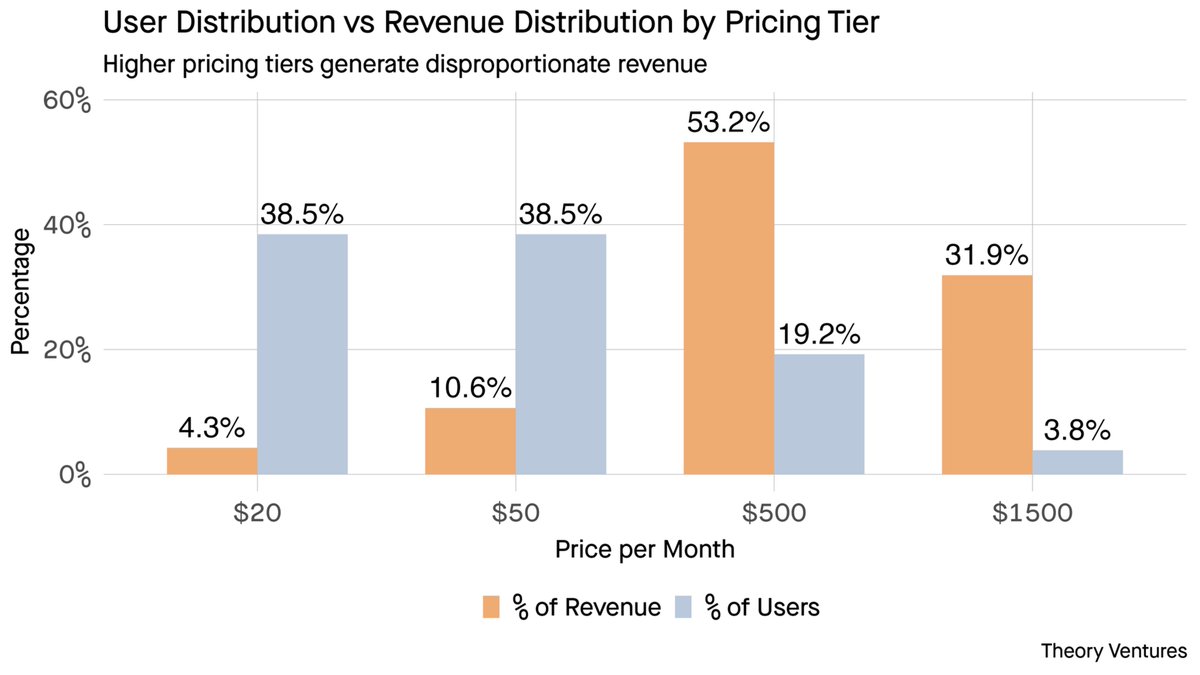
Let’s assume this company has four pricing plans: $20 per month, $50 per month, $500 per month, and $1,500 per month. We assume a 1% conversion rate for the first two plans, a 0.5% conversion rate for the $500 per month pricing plan, and 0.1% for the $1,500 plan.1
The revenue concentration is dramatic. While the $20 and $50 tiers capture 77% of paying users, they generate just 15% of total revenue. The enterprise tiers drive 85% of revenue from only 23% of users. The $1,500 Ultimate tier alone generates nearly 32% of all revenue from just 3.8% of users.
So the majority of the revenue will be at the enterprise, but where will the margin come from?
The reality is there are plenty of pathways to increase margin:
- Caching helps tremendously with better memory management on stable codebases meaning higher cache hit rates and dramatically lower query costs. The more stable the codebase, the greater the cache hit rate
- Microsoft is reporting 90% more tokens per GPU, showing infrastructure efficiency gains are real and accelerating
- Local coding models for smaller tasks can run on-device, reducing cloud inference costs entirely
- Bring Your Own Cloud arrangements, where enterprises use their prepurchased cloud credits, shift inference costs off the vendor’s balance sheet entirely and increase margins for those deployments to well north of 90%, depending on the customer success costs
- Rate limit users to manage outlier usage and maintain predictable unit economics
Today, the most valuable asset is distribution. Venture capital is willing to subsidize that distribution, and over time that distribution will generate profits.
At the point where the companies shift from penetration to maximization, they will need to decide whether the cost of customer acquisition at the lower part of the market is a continued strategic marketing cost or simply too expensive on a margin basis to bear.
The companies that master this transition will define the next decade of software development. Those that don’t will become cautionary tales of the great AI coding economics reckoning.
It is very likely that the conversion rates for these kinds of products from free to paid are significantly higher than those that we found in our go-to-market survey of 2-4% unassisted conversion, but let’s be conservative for now.
https://t.co/yglwA9sWbn
Most startups play defense when discussing pricing with customers. They dance between asking for too little, leaving money on the table, and asking for too much, only to lose the customer’s interest. The very best companies lead their customers in that dance. They use pricing as an offensive tool to reinforce their product’s value and underscore the company’s core marketing message.
For many founding teams, pricing is one of the most difficult and complex decisions for the business. Startups operate in newer markets where pricing standards haven’t been set. In addition, these new markets evolve very quickly, and consequently, so must pricing. But throughout this turmoil, startups must adopt a process to craft a good pricing strategy, and re-evaluate prices periodically, at least once per year.
The Three Core Pricing Strategies
There are only three pricing strategies startups should pursue: Maximization, Penetration and Skimming. They prioritize revenue growth, market share and profit maximization differently.
Maximization (Revenue Growth) - maximize revenue growth in the short term. Startups should pursue maximization when there are no clear differences in customer segments’ willingness to pay, and when the optimal short term and long term prices are equal. Many mid-market software companies price with the goal of revenue maximization, negotiating for the highest possible price in each sale.
Penetration (Market Share) - price the product at a low price to win dominant market share. A bottoms-up strategy lends itself to penetration pricing. Price low to minimize adoption friction, grow quickly, and then move up-market after developing broad adoption. Penetration pricing leads to land-and-expand sales tactics. Expensify, Netsuite, New Relic, Slack follow this model. Penetration prioritizes market share.
Skimming (Profit Maximization) - start with a high price and systematically broaden the product offering to address more of the customer base at lower prices. Skimming is widespread in consumer hardware. Apple sells the latest iPhones at the highest prices, and repackages older models at lower prices to address different customer segments. As Madhavan Ramanujam tells it, Steve Jobs was both a product genius and pricing genius. By pairing the two skills, he led Apple to record-breaking profits quarter after quarter.
Skimming is less common in the software world because few startups develop a product at launch that will be accepted by the most sophisticated customers (and those willing to pay prices that generate the greatest margin). There are exceptions: Oracle’s database, Tanium’s security product, Workday’s human capital management software.
The Seven Factors to Consider When Pricing Your Product
1. The Basis for Pricing
There are three ways to justify a pricing plan:
Value-based pricing charges customers a fraction of the incremental value created by the product or a fraction of the costs saved by the product. This is often seen in ad tech or any type of optimization technology. A startup increases conversions by 50% and they take 10% of the gain as their fee. Value based pricing is also employed in slightly less rigorous ways. Salesforce sells CRM seats based on an aggregate ROI of increased sales productivity for example. So does Expensify, which decreases the time to file expenses.
Cost-based pricing is when startups mark up the product they sell by some margin. Many infrastructure as a service companies do this. AWS, Twilio, Heroku, etc. It’s very common in commodity or nearly-commodity industries, where customers know the prices of the components used to provide the service.
Competition based pricing works well in markets where the price and value of a particular type of product are well established. Startups adopt the pricing model well known in the industry.
2. Positioning
Positioning is the most frequently forgotten of the 4 Ps in Marketing. Salesforce exemplifies exceptional positioning. Used strategically, pricing can be a weapon, a source of competitive advantage in the market. Your company can employ pricing to communicate to the market whether your product is a premium, mid-market or low cost alternative.
Startups can choose to price below the market, to gain share and grow quickly (Zendesk, AirWatch); they can choose to price at the market price and differentiate based on product features (Dropbox and Box); or they can charge a premium for their product, which reinforces their positioning as the gold-standard in the sector (Palantir and Workday).
To be effective, a startup’s pricing strategy must align with its marketing case studies, website messaging, PR releases and sales pitches. If all the arrows point in the same direction, then pricing becomes an asset to reinforce the company’s position in the market.
3. Customer Base Size
The number of total potential customers multiplied by the selling price of the product equals the total addressable market (TAM) for a startup. Generally speaking, bigger TAMs are better. If there are a small number of relevant customers, as in Veeva’s case where the entire market is about 200 pharmaceutical companies, the average revenue per customer must be very high. At IPO, Veeva’s average customer paid the company about $750k per year. On the other hand, if there are millions of potential customers, as in Expensify’s case, the average revenue per company can be much smaller and still justify a billion-dollar-plus TAM.
4. Sales Team Structure
Pricing impacts the structure of a sales team and their day to day performance for two reasons. Higher price points decrease sales velocity, the number of deals closed per sales rep per unit time, and increase sales volatility, the chances a deal closes.
Inside sales teams selling $5-30K products can sustain a deal velocity of 3-8 transactions per month, depending on quota. This keeps morale high and creates a very predictable revenue forecast. No individual customer signing or balking will materially alter the company’s ability to achieve plan.
On the other hand, higher price points require more skilled, more expensive salespeople. Called field sales or outside sales people, their compensation starts at about $250k per year for on-target earnings (OTE - combination of salary and sales commission). Outside sales teams chase larger accounts, and may close 1-3 per year. But if all of them go sideways, the company’s revenues for the year will suffer materially.
5. Contract Length
Many SaaS startups launch with monthly pricing which encourages customers to try the product and engenders demand. At some point, most SaaS startups switch to annual contracts for three reasons. First, revenue becomes much more predictable. Second, annual contracts often include terms that require pre-payment up-front which rewards the startup with lots of cash to grow faster. Third, contracts mitigate churn rates because the customer is only making a renewal decision once per year, instead of 12x per year. Employing contracts can materially improve a startup’s cash position, unit economics and predictability.
6. Your Startup’s Unit Economics
Your pricing plan has to enable the company to become profitable at some point. The value of your business is the discounted sum of all its future profits. Adopting a lower price point may increase sales velocity, create lots of demand, and keep sales teams happy, but if the price point doesn’t generate enough gross margin to achieve reasonably quick payback periods, and the business suffers from an increase in churn, the company is in trouble.
Just a quick reminder:
Payback Period = Cost of Customer Acquisition/Gross Margin
The gross margin is the revenue per customer minus the costs to provide the service. A decrease in price reduces gross margin and will consequently increase payback period.
7. Margin Structure of the Customer Base
Compared to software companies, grocery stores are terrible customers because grocery stores have single digit margins. The margin structure of your startup’s customers matters a great deal when setting pricing. All of your product’s cost must be paid from your customers margin. The more margin your customer has, the more they can pay you for your product.
Pricing Models: Seat-Based vs. Usage-Based
When to use per seat pricing
If your customers demand predictable bills, then per seat pricing is the way to go. The question is do they prefer it or do they demand it? Most customers will prefer predictability, but won’t necessarily demand it. Would they switch if the pricing weren’t predictable? That’s a question worth examining in your pricing research.
If you would like to create switching costs, per seat pricing with annual contracts establishes some lock-in. Usage pricing provides more flexibility to customers to try alternatives.
The Rise of Usage-Based Pricing
Usage-based pricing (UBP) or activity-based pricing (ABP) has emerged as a dominant model for many of today’s most successful software companies. As Lee Kirkpatrick, former CFO of Twilio, noted during Office Hours, “Twilio was one of the pioneers of usage-based pricing.” The company grew from $15M in ARR to more than $1B with this model, consistently achieving better than 130% net dollar retention.
The Strategic Advantages of UBP
1. Aligns vendor success with customer success: When a customer like Uber grows, their usage naturally expands, benefiting both parties. This creates genuine mutual interest in the customer’s growth.
2. Reduces adoption friction: Individual developers or small teams can begin using the product with minimal financial commitment, making it easier to start a relationship that can expand over time.
3. Manages cost structure: For companies with significant COGS (cost of goods sold), UBP allows better management of gross profit by passing through costs when appropriate.
4. Enables natural expansion: MongoDB and Ethereum, two database companies with nearly identical revenue trajectories through 2020, both employ usage-based models that have supported their explosive growth.
5. Lubricates the conversion funnel: Prospects can sign up and grow their accounts seamlessly. Usage data feeds product-led growth (PLG) lead scores, enabling account executives to outbound to the most promising users. As customers’ needs evolve, they can expand naturally without friction.
The Hidden Costs of UBP
While UBP offers many advantages, it does come with tradeoffs:
1. Complicates churn measurement: If a customer uses your product intermittently (every third month, for example), standard monthly churn calculations will show the account churning and reactivating, skewing your metrics.
2. Challenges sales compensation: Building effective compensation plans for sales teams is more difficult because the value of an account can’t be fully measured at the point of sale. Teams must reinvent their GTM strategy with new quota structures, sales materials, and margin calculations.
3. Makes capacity planning harder: With less visibility into maximum usage requirements, engineering teams may struggle to provision infrastructure appropriately.
4. Requires ongoing purchase decisions: Customers must implicitly or explicitly decide to continue using the product each billing period, rather than making a one-time annual commitment.
5. Customer frustration with estimation: Customers may struggle to estimate how much of a product they’ll use and experience surprise from overage charges. This creates anxiety in the purchasing process that doesn’t exist with more predictable seat-based models.
6. Longer sales cycles: Recent data shows usage-based pricing models experienced 29% longer sales cycles in 2023 compared to 21% for seat-based companies. Enterprise-focused companies with usage-based pricing bore the greatest increase at 44%.
The Evolution of Usage-Based Pricing
Many successful companies begin with pure UBP and then evolve their pricing models over time. As Twilio demonstrated, even usage-based companies can create predictable revenue streams by implementing annual contracts with committed usage levels, with overages billed at higher rates (a two-part tariff).
Amazon Web Services exemplifies this hybrid approach with a “spot market” for instances charged via usage alongside a “reserved instance” market where capacity can be pre-purchased for discounts of about 50%. Similarly, Salesforce began with a usage-based approach before shifting to annual seat contracts when churn rates became significant and revenue predictability faltered.
The Deliberate Underselling Strategy
One powerful strategy for usage-based pricing is deliberate underselling. As Lee Kirkpatrick shared, Twilio account executives would intentionally undersize initial contract commitments to:
1. Ensure customer happiness and success
2. Create natural opportunities for expansion conversations
3. Accelerate the initial sales cycle
4. Improve net dollar retention metrics
While this approach trades smaller initial deals for long-term growth, it creates healthier customer relationships and more efficient expansion opportunities. With this model, Twilio maintained contracted revenue at less than 50% of ARR while achieving industry-leading retention metrics.
Implementing Usage-Based Pricing
When selecting a usage-based pricing model, ask these three questions:
1. Is my startup selling an application or infrastructure?
Application software companies typically sell seats. Infrastructure companies sell API calls, licenses per core or host, SMSs, bandwidth, storage by the GB. Switching from the norm in your category introduces friction.
Most application software companies don’t sell via UBP. Slack is a notable exception. Selling constant seat counts stems from the perception that the number of people using software shouldn’t change much from one month to the next. For most application software, the predictability of fixed costs outweighs the benefits of flexibility.
Infrastructure usage, however, can vary widely depending on:
- Seasonality (retail traffic spikes in Q4)
- Developer activity (migration from one architecture to the next)
- New product launches
- Other business-specific factors
Selling UBP to a buyer accustomed to buying a flat seat count introduces friction into the sales process. This effort may not be worth it unless your company’s strategy is specifically to differentiate on price structure.
Even within the same category (Application Performance Monitoring), companies use different units for their usage-based pricing. This diversity can be an advantage: it makes it harder for customers to directly compare prices. How many API calls per host or services per host equal $31 per host per month? The difficulty in comparison potentially reduces price competition.
However, it might also confuse customers who are accustomed to buying the service in a different way. Consider whether your startup is differentiating on pricing to compete with an incumbent, or if you’re selling a superior product at a premium, in which case using the same pricing model with higher fees reinforces your brand positioning.
2. What should my unit of pricing be?
The goal of UBP is to align the cost of software with the value. The unit of pricing is crucial to unlocking that alignment.
The unit must be:
- Easy for a customer to understand
- Simple to predict
- Crystal-clear to avoid future disputes about what constitutes a unit
- Directly tied to the value delivered by your product
3. Can this pricing model achieve certain boundary pricing conditions?
How much should a Fortune 500 bank pay for your startup? How about a 50 person SaaS company? The pricing scheme needs to satisfy these boundary conditions.
Often, a straight UBP pricing model doesn’t scale into the enterprise. A Fortune 500 company may not consume enough units to justify a $250k or $2M deal. To remedy this challenge, consider introducing pricing layers:
- Basic units cost $1
- HIPAA-compliant units cost 3x as much
- FINRA-compliant units cost an additional dollar per unit
Another approach is adding a platform fee to create a two-part tariff. The platform fee instantly boosts the annual contract value and can be tailored per customer segment.
Managing Customer Concerns with UBP
Some customers fear the sticker shock of dramatic usage in the first billing period. To offset this risk, many sales teams cap the charge in the first billing period to ensure customers who sign up and use substantially more of a service don’t experience bill shock. This approach builds trust and gives customers time to adjust to the usage-based model.
A hybrid approach: Two-Part and Three-Part Tariffs
There are many companies who employ a two-part tariff: a base platform fee and an ongoing usage fee to capture positive aspects of both types of pricing strategies. Segment is a good example of this. The platform fee establishes a stable relationship and the usage pricing enables the customer to scale up or down as a function of their traffic which might vary throughout the year.
Modern behavioral economics points toward three-part tariffs as potentially the optimal structure, especially when the number of vendors in a category is small. In a three-part tariff, the software has a base platform fee, but the fee includes a certain amount of usage for free, and each additional unit of usage costs extra.
For example, the software might have a base platform fee of $25,000 because it includes the first 150k events for free. Each marginal event costs $0.15.
Research suggests 3PTs capture more value because customers tend to buy larger plans than they might need. Customers who switch to a three-part tariff increased their usage by 15.1% on average, while those who remained on a two-part tariff increased usage by only 0.9%.
Challenging Pricing Models: Veblen Goods and Performance Pricing
Startups struggle to set the right price for their products because pricing dynamics in the field don’t obey the laws taught in the classroom. The standard supply and demand curves imply that as price increases demand decreases, but this isn’t always the case.
Veblen Goods in SaaS
Veblen goods defy traditional pricing theory. Demand for Veblen goods increases as prices rise. This behavior is commonly observed with luxury goods, but it also manifests in SaaS sales processes, particularly for enterprise customers.
Bill Macaitis, the former CMO of Zendesk, described Veblen goods behavior when Zendesk began to address enterprise customers. The product marketing team initially charged a modest premium for the enterprise product, but demand was immaterial. As they experimented with other price points, the team discovered demand surged as the price ballooned. Today, the Zendesk enterprise plans cost 10x as much as standard plans.
Enterprise buyers often equate price with quality. At a very small price point, they ask: Since the product is so inexpensive, is it a toy or true enterprise solution?
Performance Pricing Challenges
Performance pricing means explicitly pricing a product in terms of the customers’ revenue gained or cost reduced from its use. Conceptually, performance pricing is very rational. The buyer should be willing to pay between 10 to 15% of the revenue or cost savings for the use of the product.
But performance pricing has three significant challenges:
1. It cedes pricing power to the customer. Each year when the contract comes up for renewal, the customer will ask, “What have you done for me this year?” If the SaaS startup cannot continuously improve the performance for the customer, the customer is bound to churn.
2. It commodifies the category by reinforcing a single dominant purchasing parameter: performance. Vendors will all compete on percent improvement of the key metric, leading to discounting and price erosion.
3. Sales teams lose leverage. If the only metric that matters is performance, then great account executives won’t be able to shine. Building a relationship won’t be valued in the category, or at least it’s not enough to overcome sub-par performance.
Datadog is becoming a platform company, & its Q3 2025 results underscore how successful this transition is. If nothing else, the consistency around 25% growth for the last 12 quarters exemplifies this point.
Net dollar retention underpins this growth, combined with accelerating new customer account acquisition. One of the biggest changes in the last five quarters is terrific cross-selling across an increasingly large product suite.
Platform Adoption Deepening
At the end of Q3, 84% of customers were using 2 or more products, up from 83% a year ago. 54% of customers were using 4 or more products, up from 49% a year ago. 31% of our customers were using 6 or more products, up from 26% a year ago & 16% of our customers were using 8 or products, up from 12% a year ago.
Datadog’s platform spans six product categories:
- Digital Experience Monitoring: RUM/Real User Monitoring, Synthetics, Product Analytics
- Security: Cloud SIEM, Cloud Security
- Infrastructure Observability: APM, Log Management, Flex Logs
- Incident Response: Incident Management, On-Call
- AI Capabilities: Bits AI, LLM Observability
- Cost Management: Cloud Cost Management
The steady increase in multi-product adoption demonstrates customers consolidating their observability stack onto Datadog, with the highest-tier customers (8+ products) growing 33% year-over-year as a percentage of the base.
New Customer Momentum
New logo annualized bookings more than doubled year-over-year & set a new record driven by an increase in average new logo land size, particularly in enterprise.
The portion of our year-over-year revenue growth that related to new customers was about 25% in Q3, up from 20% in Q2.
New customer acquisition is also accelerating. This is in concert with a move-up market into the enterprise.
AI Native Customer Expansion
We also experienced strong revenue growth for our AI native customers & a broadening contribution to growth among those customers. There, too, we saw an acceleration of growth in our AI cohort in Q3 when excluding our largest customer.
This group represented 12% of our revenue, up from 11% last quarter & about 6% in the year ago quarter.
The AI native cohort is both growing & maturing. Datadog now has 15 AI native customers spending more than $1 million annually, up from essentially zero a year ago, with over 100 spending more than $100,000.
Revenue Growth
Revenue was $886 million, an increase of 28% year-over-year & above the high end of our guidance range.
The combination of these three factors : a broader product suite that is effectively cross-sold, accelerating new customer momentum, & a very fast-growing AI business, has led to outperformance.
Security Suite Accelerating
Security ARR growth was in the mid-50s as a percentage year-over-year in Q3, up from the mid-40s we mentioned last quarter.
We’re starting to see success in including Cloud SIEM in larger deals, & we’ll get back to that in a bit in our customer examples. And we’re seeing positive trends beyond Cloud SIEM, including fast uptake of good security & an increasing number of wins in cloud security.
Security is becoming a meaningful growth driver for Datadog, accelerating from mid-40s to mid-50s percentage growth & expanding beyond Cloud SIEM into broader cloud security use cases.
Enterprise Deal Momentum
First, we landed a 7-figure annualized deal with a leading European telco, our largest ever land deal in Europe. […] They will adopt 11 Datadog products to start.
Next, we landed a 7-figure annualized deal with a Fortune 500 technology hardware company.
Both of these data points confirm a significant move-up market. A million-dollar land deal with 11 products confirms that Datadog is truly selling a suite.
Datadog’s AI Products
In addition to the existing suite, Datadog is pushing heavily into AI with a broader range of AI deployment products.
- Bits AI SRE Agent (Available in preview, announced June 2025) is an autonomous AI agent that investigates alerts & coordinates incident response 24/7, saving customers significant time on mean-time-to-resolution.
- LLM Experiments & Playgrounds (Generally available, launched 2025) helps teams rapidly iterate on LLM applications by testing prompt changes, model swaps, & application changes against production traces.
- Custom LLM-as-a-Judge Evaluations (Generally available) lets customers write natural language evaluation prompts to assess LLM application quality & safety across traces & spans.
- Datadog MCP Server (Available in preview, announced 2025) bridges Datadog with AI agents like Codex, Claude, Cursor, & GitHub Copilot, providing structured access to metrics, logs, traces, & incidents directly from AI coding environments.
- TOTO, Datadog’s open-source time series forecasting model (launched 2025), was trained on 2 trillion data points & became one of Hugging Face’s top downloads across all categories.
If SaaS companies were dog breeds, many would be temperamental. But Datadog demonstrates continued consistency across a broad range of different businesses.
https://t.co/cTliBsBRmc
OpSec Group / Investcorp Europe Acquisition I deal overview
Brand protection solutions
$426 million enterprise value
$50 million PIPE
10.7x EBITDA '24E
PR: https://t.co/RkGsm4tQML
IR deck: https://t.co/fXPm1xmtw0
Disclosure: Long $IVCB shares + warrants in $ARB.to
* Shockwave to Be Acquired for $335/Share; Closed Thursday at $319.99
* Johnson & Johnson: Shockwave Deal Has Enterprise Value of About $13.1 Billion Including Cash Acquired
* Johnson & Johnson To Fund Transaction With Cash on Hand, Debt
* Johnson & Johnson: Acquisition Extends Position in Cardiovascular Intervention
(via DJ) $JNJ $SWAV
Congrats to Cornell Tech alumni startup @GitLinks on their acquisition by enterprise software company @Infor!
GitLinks was founded by Ian Folau, Johnson Cornell Tech MBA '16, and Nwamaka Imasogie, Computer Science '16. @CornellMBA@CornellCIS https://t.co/RUuzVMqp5Z
📢 CapitalNumbers Infotech Ltd
CapitalNumbers Infotech acquires 100% of US-based Epitome Cloud Inc. for Rs. 40 Cr, equivalent to 19.5% of its market cap and ~23% of its cash and investments.
The acquisition adds enterprise workflow and Salesforce capabilities while retaining Epitome CEO Anand Varanasi to manage US client relationships. With zero debt and Rs. 171.35 Cr of cash, the deal marks a measured entry into inorganic growth.
Key watch: integration, US client retention and the pace of revenue synergies. Strategically, the bolt-on acquisition strengthens CapitalNumbers' capabilities and provides a platform for further M&A-led expansion.
MCap: Rs. 205 Cr
PE: 8.05x
PEG: 0.58x
#CapitalNumbers #ITServices #Acquisition
I speak with @PagerDuty CEO @jenntejada about takeover speculation, the Jeli acquisition, enterprise demand, and the role of AI $PD https://t.co/QvjTMaeHYn
@TCS will acquire MHP Management, the consulting and technology subsidiary of German sports car maker @Porsche, for USD 373 million.
The acquisition is part of a five-year strategic partnership between TCS and Porsche valued at USD 1.4 billion. The partnership will focus on artificial intelligence-led transformation across Porsche’s engineering, manufacturing, operations, customer experience, and enterprise functions.
Read More: https://t.co/wbpJVOPYK3
#TCS #Porsche #MHP #Acquisition #ArtificialIntelligence #DigitalTransformation #Technology #Consulting #Automotive #IndiaBusiness


![ttunguz's tweet photo. Datadog is becoming a platform company, & its Q3 2025 results underscore how successful this transition is. If nothing else, the consistency around 25% growth for the last 12 quarters exemplifies this point.
Net dollar retention underpins this growth, combined with accelerating new customer account acquisition. One of the biggest changes in the last five quarters is terrific cross-selling across an increasingly large product suite.
Platform Adoption Deepening
At the end of Q3, 84% of customers were using 2 or more products, up from 83% a year ago. 54% of customers were using 4 or more products, up from 49% a year ago. 31% of our customers were using 6 or more products, up from 26% a year ago & 16% of our customers were using 8 or products, up from 12% a year ago.
Datadog’s platform spans six product categories:
- Digital Experience Monitoring: RUM/Real User Monitoring, Synthetics, Product Analytics
- Security: Cloud SIEM, Cloud Security
- Infrastructure Observability: APM, Log Management, Flex Logs
- Incident Response: Incident Management, On-Call
- AI Capabilities: Bits AI, LLM Observability
- Cost Management: Cloud Cost Management
The steady increase in multi-product adoption demonstrates customers consolidating their observability stack onto Datadog, with the highest-tier customers (8+ products) growing 33% year-over-year as a percentage of the base.
New Customer Momentum
New logo annualized bookings more than doubled year-over-year & set a new record driven by an increase in average new logo land size, particularly in enterprise.
The portion of our year-over-year revenue growth that related to new customers was about 25% in Q3, up from 20% in Q2.
New customer acquisition is also accelerating. This is in concert with a move-up market into the enterprise.
AI Native Customer Expansion
We also experienced strong revenue growth for our AI native customers & a broadening contribution to growth among those customers. There, too, we saw an acceleration of growth in our AI cohort in Q3 when excluding our largest customer.
This group represented 12% of our revenue, up from 11% last quarter & about 6% in the year ago quarter.
The AI native cohort is both growing & maturing. Datadog now has 15 AI native customers spending more than $1 million annually, up from essentially zero a year ago, with over 100 spending more than $100,000.
Revenue Growth
Revenue was $886 million, an increase of 28% year-over-year & above the high end of our guidance range.
The combination of these three factors : a broader product suite that is effectively cross-sold, accelerating new customer momentum, & a very fast-growing AI business, has led to outperformance.
Security Suite Accelerating
Security ARR growth was in the mid-50s as a percentage year-over-year in Q3, up from the mid-40s we mentioned last quarter.
We’re starting to see success in including Cloud SIEM in larger deals, & we’ll get back to that in a bit in our customer examples. And we’re seeing positive trends beyond Cloud SIEM, including fast uptake of good security & an increasing number of wins in cloud security.
Security is becoming a meaningful growth driver for Datadog, accelerating from mid-40s to mid-50s percentage growth & expanding beyond Cloud SIEM into broader cloud security use cases.
Enterprise Deal Momentum
First, we landed a 7-figure annualized deal with a leading European telco, our largest ever land deal in Europe. […] They will adopt 11 Datadog products to start.
Next, we landed a 7-figure annualized deal with a Fortune 500 technology hardware company.
Both of these data points confirm a significant move-up market. A million-dollar land deal with 11 products confirms that Datadog is truly selling a suite.
Datadog’s AI Products
In addition to the existing suite, Datadog is pushing heavily into AI with a broader range of AI deployment products.
- Bits AI SRE Agent (Available in preview, announced June 2025) is an autonomous AI agent that investigates alerts & coordinates incident response 24/7, saving customers significant time on mean-time-to-resolution.
- LLM Experiments & Playgrounds (Generally available, launched 2025) helps teams rapidly iterate on LLM applications by testing prompt changes, model swaps, & application changes against production traces.
- Custom LLM-as-a-Judge Evaluations (Generally available) lets customers write natural language evaluation prompts to assess LLM application quality & safety across traces & spans.
- Datadog MCP Server (Available in preview, announced 2025) bridges Datadog with AI agents like Codex, Claude, Cursor, & GitHub Copilot, providing structured access to metrics, logs, traces, & incidents directly from AI coding environments.
- TOTO, Datadog’s open-source time series forecasting model (launched 2025), was trained on 2 trillion data points & became one of Hugging Face’s top downloads across all categories.
If SaaS companies were dog breeds, many would be temperamental. But Datadog demonstrates continued consistency across a broad range of different businesses.
https://t.co/cTliBsBRmc](https://pbs.twimg.com/media/G5adQDhbcAIEj3Z.jpg)








![ttunguz's tweet photo. Datadog is becoming a platform company, & its Q3 2025 results underscore how successful this transition is. If nothing else, the consistency around 25% growth for the last 12 quarters exemplifies this point.
Net dollar retention underpins this growth, combined with accelerating new customer account acquisition. One of the biggest changes in the last five quarters is terrific cross-selling across an increasingly large product suite.
Platform Adoption Deepening
At the end of Q3, 84% of customers were using 2 or more products, up from 83% a year ago. 54% of customers were using 4 or more products, up from 49% a year ago. 31% of our customers were using 6 or more products, up from 26% a year ago & 16% of our customers were using 8 or products, up from 12% a year ago.
Datadog’s platform spans six product categories:
- Digital Experience Monitoring: RUM/Real User Monitoring, Synthetics, Product Analytics
- Security: Cloud SIEM, Cloud Security
- Infrastructure Observability: APM, Log Management, Flex Logs
- Incident Response: Incident Management, On-Call
- AI Capabilities: Bits AI, LLM Observability
- Cost Management: Cloud Cost Management
The steady increase in multi-product adoption demonstrates customers consolidating their observability stack onto Datadog, with the highest-tier customers (8+ products) growing 33% year-over-year as a percentage of the base.
New Customer Momentum
New logo annualized bookings more than doubled year-over-year & set a new record driven by an increase in average new logo land size, particularly in enterprise.
The portion of our year-over-year revenue growth that related to new customers was about 25% in Q3, up from 20% in Q2.
New customer acquisition is also accelerating. This is in concert with a move-up market into the enterprise.
AI Native Customer Expansion
We also experienced strong revenue growth for our AI native customers & a broadening contribution to growth among those customers. There, too, we saw an acceleration of growth in our AI cohort in Q3 when excluding our largest customer.
This group represented 12% of our revenue, up from 11% last quarter & about 6% in the year ago quarter.
The AI native cohort is both growing & maturing. Datadog now has 15 AI native customers spending more than $1 million annually, up from essentially zero a year ago, with over 100 spending more than $100,000.
Revenue Growth
Revenue was $886 million, an increase of 28% year-over-year & above the high end of our guidance range.
The combination of these three factors : a broader product suite that is effectively cross-sold, accelerating new customer momentum, & a very fast-growing AI business, has led to outperformance.
Security Suite Accelerating
Security ARR growth was in the mid-50s as a percentage year-over-year in Q3, up from the mid-40s we mentioned last quarter.
We’re starting to see success in including Cloud SIEM in larger deals, & we’ll get back to that in a bit in our customer examples. And we’re seeing positive trends beyond Cloud SIEM, including fast uptake of good security & an increasing number of wins in cloud security.
Security is becoming a meaningful growth driver for Datadog, accelerating from mid-40s to mid-50s percentage growth & expanding beyond Cloud SIEM into broader cloud security use cases.
Enterprise Deal Momentum
First, we landed a 7-figure annualized deal with a leading European telco, our largest ever land deal in Europe. […] They will adopt 11 Datadog products to start.
Next, we landed a 7-figure annualized deal with a Fortune 500 technology hardware company.
Both of these data points confirm a significant move-up market. A million-dollar land deal with 11 products confirms that Datadog is truly selling a suite.
Datadog’s AI Products
In addition to the existing suite, Datadog is pushing heavily into AI with a broader range of AI deployment products.
- Bits AI SRE Agent (Available in preview, announced June 2025) is an autonomous AI agent that investigates alerts & coordinates incident response 24/7, saving customers significant time on mean-time-to-resolution.
- LLM Experiments & Playgrounds (Generally available, launched 2025) helps teams rapidly iterate on LLM applications by testing prompt changes, model swaps, & application changes against production traces.
- Custom LLM-as-a-Judge Evaluations (Generally available) lets customers write natural language evaluation prompts to assess LLM application quality & safety across traces & spans.
- Datadog MCP Server (Available in preview, announced 2025) bridges Datadog with AI agents like Codex, Claude, Cursor, & GitHub Copilot, providing structured access to metrics, logs, traces, & incidents directly from AI coding environments.
- TOTO, Datadog’s open-source time series forecasting model (launched 2025), was trained on 2 trillion data points & became one of Hugging Face’s top downloads across all categories.
If SaaS companies were dog breeds, many would be temperamental. But Datadog demonstrates continued consistency across a broad range of different businesses.
https://t.co/cTliBsBRmc](https://pbs.twimg.com/media/G5adQDibcAQ8BqE.jpg)