What happens when vibe coding meets Web3?
Building apps, deploying AI agents, and launching tokens have each belonged to a different platform until now.
@0G_labs' 0G App connects them on a single platform. The App Launcher generates apps from natural language, the Claw Launcher deploys AI agents, and the Token Launcher issues tokens. Today, sending code to an AI service means trusting whoever runs it. 0G App processes every prompt inside isolated hardware that even the operator cannot access, and signs each response so you can verify it was handled safely.
Second in a 3-part research series 0G.
https://t.co/NpB8oXyhrG
Introducing 0G Private Computer. Using AI does not have to be a trust exercise.
Every inference request runs inside a TEE. Hardware proves what happened. No one in the supply chain can peek, not even the provider.
Experience true AI privacy: https://t.co/RjzezR8p9M
3/ Why this matters:
Onchain asset-management AUM grew ~118% YTD to ~$35B in 2025, is tracking ~$64B by 2026, and flows are dominated by whales/dolphins (70–99% of AUM).
Vaults are now the standard wrapper. The edge is time-to-deploy, clear monitoring, and reliable redemptions
✅️ @Official_NODO’s vault architecture on Sui is three rails that ship together: Data → Simulation → Deployment/Monitoring.
• Pool Data API: tick-level liquidity/price across 100+ Sui pairs.
• Simulation SDK: backtest + stress-test LP/lending strategies locally.
• Deployment API: push the same model to mainnet (~24h); one SDK covers data, sim, deploy.
This cuts typical build time from 3–5 months to ~2 weeks and removes fragmented integrations.
2/ Example: a USDC-only, treasury-grade lending vault
1. Ingest market data → pick venues; set utilisation cap and clear fee policy.
2. Rehearse locally: backtests + stress tests to check withdrawals and edge cases.
3. Launch the same configuration on mainnet and monitor 24/7 with built-in emergency controls.
Why these guardrails? 2025’s curator incidents showed how risky collaterals + thin liquidity led to 100% utilisation and frozen withdrawals (e.g., Compound vault pause during deUSD contagion). Our defaults are designed to block that failure mode.
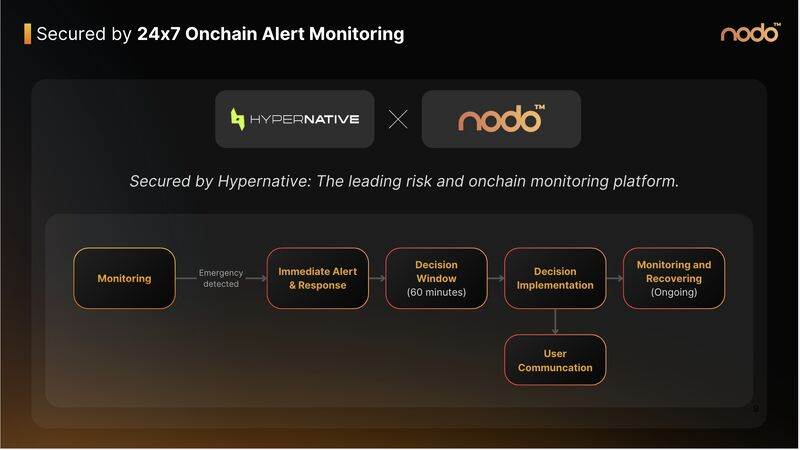
Today we’re partnering with @HypernativeLabs to harden @Official_NODO’s agentic LP vaults on @SuiNetwork
This adds always-on risk monitoring and automated incident response to our stack so curators and institutions can evaluate faster, operate safer, and scale with confidence.
It's real-time anomaly detection across on-chain + off-chain signals, with playbooks that act in seconds (pause, isolate, redirect liquidity).
As we extend coverage to more vaults and venues, the bar stays the same: security that’s measurable, programmable, and visible.
We launched the LBTC/WBTC Vault with our long term partner @MMTFinance to bring AI-managed Bitcoin liquidity to @SuiNetwork.
Real-time market moves, on-chain rebalancing, currently about ~13% base APY.
@Lombard_Finance is growing on Sui (~$34M TVL), which means more native BTC exposure, self-custody and growing yield.
Bitcoin is Live on NODO and It’s Supercharged!
NODO just launched the LBTC/WBTC Vault on @MMTFinance, delivering AI-managed Bitcoin Liquidity that moves with the market, reacts in real time, and captures the strongest BTC flows across @SuiNetwork.
When $BTC assets like LBTC from @Lombard_Finance gains major traction across the ecosystem ($34M TVL on Sui), NODO expands its liquidity layer to support more $BTC options and give users deeper, smarter Bitcoin exposure.
The vault delivers a real 13% base APY, breaking DeFi Benchmarks and setting a new standard for BTCFi yield.
This is active, optimized Bitcoin, managed by NODO's on-chain AI to maximize stability and sustain performance for every vault user.
👉 Deposit now and experience next-level BTCFi on Sui: https://t.co/2JRYqyTUI9