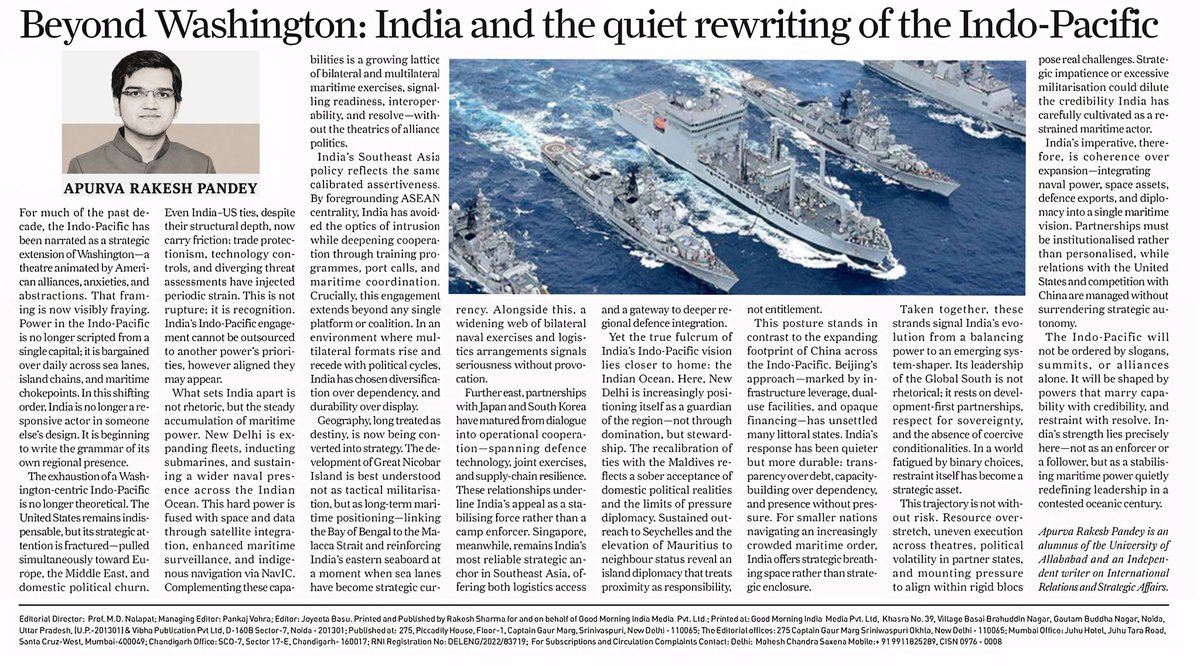
My latest in The Daily Guardian explores India's evolving Indo-Pacific vision—strategic autonomy, maritime power, and diversified partnerships in an increasingly contested region.
@dravirmani@AkbaruddinIndia@HappymonJacob@KanwalSibal@c_aashish
https://t.co/xxhd7ivRVp
India has always had a China policy shaped by its own 50 yr experience of PLA salami slicing & proxy war. Difficult issue is of autonomy from US coercion or carrot & stick policy viz Russia. We can reduce cost/benefit ratio by integration with EU & 🇷🇺 Hitech/defense JVs in 🇮🇳
Four points on India-US relations and strategic autonomy:
1. India should deepen ties with the US, but not accept dependence.
2. Strategic autonomy remains necessary where interests diverge.
3. Russia, energy and trade cannot be viewed only through the prism of US priorities.
4. On China, India must build its own strength and preserve independent judgement, rather than over-rely on the US.
I develop this argument in The Sibal Brief:
https://t.co/dDUbbY9Hvr
In an increasingly volatile and unpredictable world, multi-alignment isn't about courting multiple partners as is traditionally understood. It’s about diversifying risk.
Trust is risky business.
In an increasingly volatile and unpredictable world, multi-alignment isn't about courting multiple partners as is traditionally understood. It’s about diversifying risk.
Trust is risky business.
#OPINION | Despite being one of the world’s largest trading economies, nearly 70-75% of India’s transshipment cargo is routed through foreign ports, chiefly Singapore and Colombo, writes
Apurva Rakesh Pandey
#maritimetrade#Greatnicobarisland
https://t.co/aQO5DWW54P
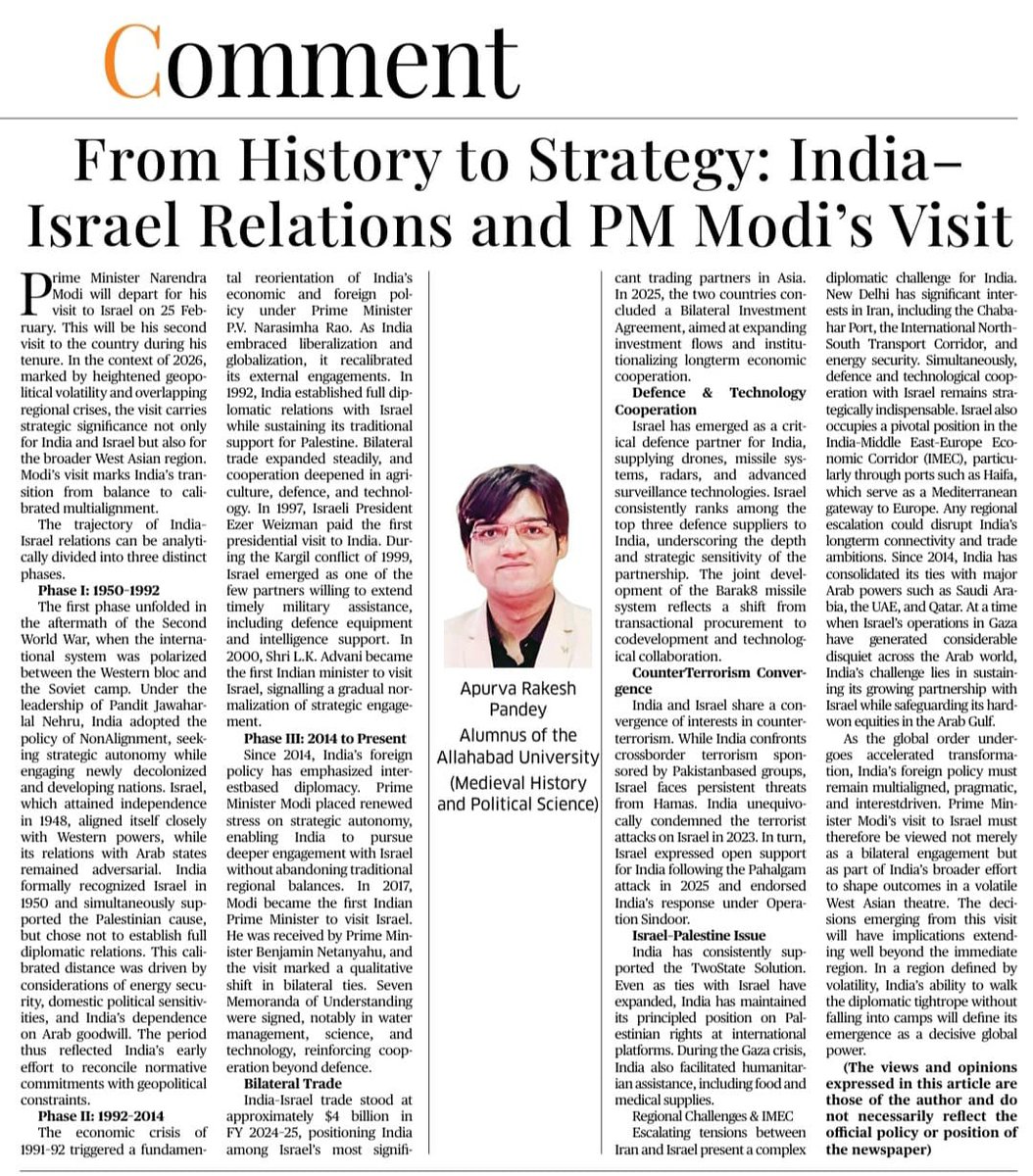
Delighted to share that my article has been published for the first time in a regional English newspaper, Central Chronicle. The piece examines the historical, strategic & diplomatic implications of India–Israel relations in a shifting global order. @dravirmani#IndiaIsrael
Despite being one of the world’s largest trading economies, nearly 70-75% of India’s transshipment cargo is routed through foreign ports, chiefly Singapore and Colombo. This leads to longer shipping cycles, higher costs, and externalised control over critical supply chains. The GNP seeks to reverse this structural imbalance with a deep-draft port capable of handling ultra-large container vessels.
https://t.co/PyUmBfrzQD
- @ask_apurvap
#OPINION | Despite being one of the world’s largest trading economies, nearly 70-75% of India’s transshipment cargo is routed through foreign ports, chiefly Singapore and Colombo, writes
Apurva Rakesh Pandey
#maritimetrade#Greatnicobarisland
https://t.co/aQO5DWW54P
The Great Nicobar Project suggests India's willingness to become a maritime power, writes Apurva Rakesh Pandey.
#Nicobar#economy#NicobarProject@leo_mukherjee
https://t.co/mkMO90pdMu
All the standard IR concepts developed for a 20th century liberal international order are irrelevant in a Hegemonic World (dis) Order (2025+). India's governing elites are still floundering in a World in which superpower #Hegemons act like #predators extracting rents!
The challenge to our strategic autonomy lies in our material vulnerability.
When a state relies on external suppliers for its energy security, and depends on competing external powers (the Middle East, China, the US, Russia, France, and Israel) to sustain its manufacturing, technological, and defense ecosystems, 'autonomy' becomes an aspiration rather than a reality.
Strategic autonomy is a function of national power rather than just political intent.
Dear @RBI: Do not let the psychology of Rs 100 per dollar determine your policy response. 100 is just a number, like 99 and 101. Whether the oil shortage is short-lived or long-lived, the right response at this moment is to let the rupee depreciate. 1/6
You ask uncomfortable questions to a diplomat: That is journalism.
The diplomat answers the questions in a manner he can: That is diplomacy.
You heckle the diplomat repeatedly & stage a walkout: That’s activism, not journalism.