"First do it, then do it right, then do it better."
Just start. The journey to success often begins with a single step, but that first step can be the hardest to take. It's easy to get caught up in the fear of failure or the desire for perfection, but I hope this quote I first shared in 2013 can be a reminder of the importance of simply getting started as we go into 2024.
Just Start Somewhere
"Start slow if you have to. Start small if you have to. Start privately if you have to. Just start." - James Clear
Taking that first step doesn't require perfection or immediate mastery. The key is to overcome inertia and take action, as this action will lead to progress, learning, and (if you’re lucky and consistent) ultimately success.
When you start, you allow yourself the opportunity to grow, adapt, and move forward.
The Power of Starting
Beginning a new project or habit often feels daunting. According to psychologists, we tend to overestimate the pain of starting and underestimate our ability to persist.
However, studies show that "small starts" predict eventual success better than initial enthusiasm or early progress. This phenomenon is known as the fresh start effect - taking the first step energizes us and bolsters motivation.
So focus on starting without putting pressure on perfection. Progress and course corrections will follow.
First, Do It: Embrace the MVP Mindset
Doing it = get the simplest MVP out.
A Minimum Viable Product (MVP) represents the simplest version of a product or idea that allows you to test, gather feedback, and iterate.
By embracing this mindset (just get something done - it's OK if rough, a prototype, a draft), you focus on progress over perfection, understanding that getting something out into the world is far more valuable than waiting for the perfect moment.
Expand Your Comfort Zone
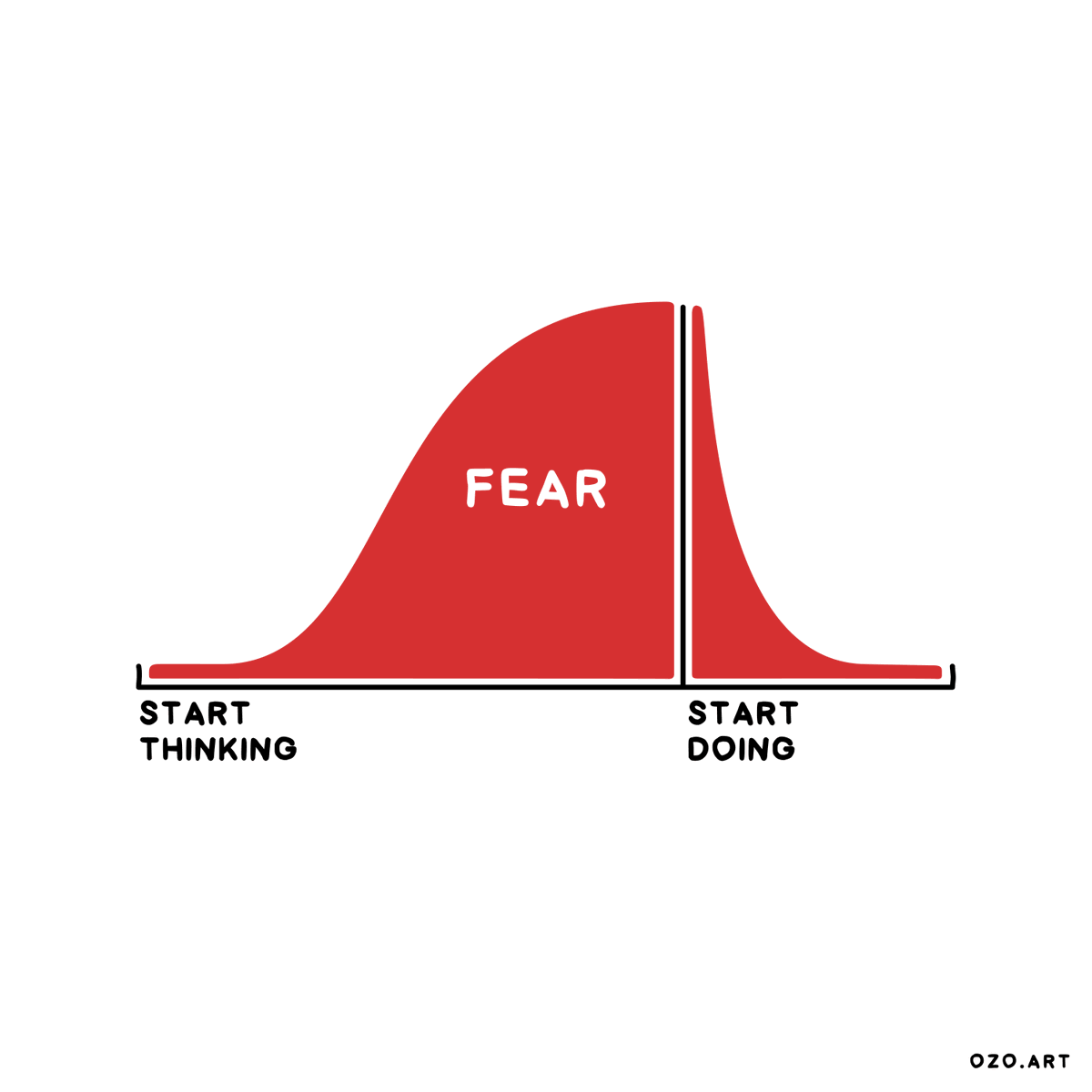
Venturing outside one's comfort zone can elicit fears of failure. Leaning into discomfort not only builds confidence and skills, but research shows it makes us more receptive to learning. Recognize that fear is often the mind's way of urging us to grow. Don't let it stop you from progressing.
Then, Do It Right: Refine and Correct
Doing it right = fix correctness issues.
Once you've taken that first step and put your MVP out into the world, it's time to refine and correct. This stage is about learning from feedback, identifying areas of improvement, and making adjustments accordingly.
It's a chance to iterate on your idea, ensuring that it meets the needs of your audience or customers while aligning with your vision.
Cultivate Curiosity and Resilience
Meeting new challenges with curiosity and resilience makes venturing outside our comfort zone more sustainable and enjoyable. Cultivate curiosity about growth opportunities and your capacity to rise to them. Set mini-challenges to incrementally expand your horizons.
When facing inevitable setbacks, avoid self-criticism and tap into resilience - the ability to recover, learn and continue progressing.
Self-compassion, adaptability and maintaining perspective are key here. With consistent effort, you build confidence in your ability to start, stumble, learn and work toward mastery.
Finally, Do It Better: Strive for Continuous Improvement
"Doing it better = iterate towards an ideal end-state (e.g., make it fast)."
The journey doesn't end with merely doing it right.
The final step is to continuously improve, striving for excellence and growth.
By iterating towards an ideal end-state, you demonstrate a commitment to progress, ensuring that your product, idea, or project remains relevant, innovative, and successful.
Set New Goalposts
As you improve, have a clear idea of when you are “done” or update your goalposts. Elite athletes turn small gains into competitive edges via the aggregation of marginal gains. Identify areas of potential improvement and set measurable stretch goals, from increasing efficiency to enhancing user delight.
Overcoming the Greatest Barrier to Progress
"The greatest barrier to progress is not lack of resources or talent, but fear of failure."
Recognizing that fear of failure is the most significant obstacle in the pursuit of success allows you to confront it head-on.
By acknowledging this fear, you can focus on taking that first step, knowing that once the ball starts rolling, it becomes much easier to keep it in motion.
Remember that starting is more than half the battle. Don't wait until you feel ready, because the perfect moment may never come.
The Bottom Line
Rather than striving for perfect execution, embrace the power of starting - put forth an MVP, soft launch an initiative, or set a milestone. Progress begets motivation. By simply starting, you open the door to growth and innovation. The rest will follow.
Embrace the power of starting and then iterating until you're happy.
CSS Trick! ⚡️
You can use scroll-driven animation with background-attachment to create a dynamic glowing card scroller without JS 🔥
section { animation:vibe; animation-timeline:--list; }
@keyframes vibe { to{--hue:320;}}
.glow {background: hsl(var(--hue) 80% 50%);}
Here's how! 🤙
You can use the background-attachment trick used in other glow card demos 😎
article {
background-attachment: fixed;
}
The difference here is that you aren't going to update the fixed background position with your pointer this time. It can remain fixed.
The magic part is that as you scroll, the background will leave the card that's leaving and enter the card that's entering ✨ For the extra background glow, you can use a fixed pseudo element on the list container itself 💪
Once that's in place, you're only task is to change the color of the background as you scroll 🤔
Create a custom property declaration for the --hue
@property --base {
inherits: true;
syntax: '<number>';
initial-value: 0;
}
Then create an animation that updates this value
@keyframes accent { to { --hue: 320; }}
The last piece is hooking it up to scroll and there is a little trick in here 👀
First, you need an inline scroll-timeline on the list
ul {
scroll-timeline: --list inline;
}
Then you can use timeline-scope to hoist that scroll-timeline up so a parent can use it. You then animate the custom property on this element and let the value cascade down to the places that need it 🔥
section {
timeline-scope: --list;
animation: accent both linear;
animation-timeline: --list;
}
For example, the glow uses the --hue this way
[data-glow] {
background-image: radial-gradient(
150px 150px at 50% 50%,
hsl(var(--hue) 100% 70% / 0.25), transparent
);
}
Lastly, scroll-snap is optional of course but plays nice with the scroll-driven animation demos ✨ The key for that is
ul { scroll-snap-type: x mandatory; }
li { scroll-snap-align: center; }
That's it! Pretty fun trick to play with! 🤓 Any questions, let me know! Should we add it to the video walkthrough list?
@CodePen link below! 👇
My AI side projects this year:
◆ https://t.co/C4nyqOycgD: 2.1 million users
◆ https://t.co/3NFbnMVfzn: 400k users
◆ https://t.co/wxXedGzPXW: 200k visitors
◆ https://t.co/ByPuxOeGtk: 29k downloads
Here's exactly how I approach building AI side projects in 6 steps:
1. Think of an idea that excites me but that is very simple. I should be able to describe it in 5 words to anyone.
2. Take a weekend and block it off entirely to focus on building the app. I'll generally take 15-30 hours to build an initial version.
3. Try to incorporate the latest AI models so the end result is especially impressive (even though it's trivial with code, like 1 API call to an ML model)
4. Launch early then iterate based on feedback from users. The benefit of launching early is that you can pivot or work on a new idea if what you launched isn't working out so you don't sink too much time into a failed project.
5. Make it free + open source so folks can learn from it and are incentivized to share it and follow you. I gained about 20k Twitter followers and 18k GitHub stars from the 4 projects above.
6. Make sure the UI looks good and is straightforward to use. Nobody will use your project if it doesn't look great, so I typically focus a lot on this aspect.
I do want to call out that I do have a large twitter audience and that helps a lot. With that said, I've seen folks without any followers have successful side projects by doing the things I talked about, so I still stand by them!
This exercise should be mandatory if you sit at a desk.
It's called a Glute Bridge Hold.
Here's why you need to do this:
Your glutes should be one of the strongest muscles in your body.
But due to desk jobs & long periods of sitting they get weaker. This puts more pressure on the lower back to support the body causing low back pain.
When you sit for hours on end you put pressure on your glute muscles. This keeps them in a lengthened position & tightens the hip flexors making the glutes less likely to fire properly.
A simple set of 12-15 reps before or after sitting down can be enough to "wake up" your glutes so they stay activated.
Make sure to focus on your butt muscles squeezing at the top of the movement.
Remember that humans were not meant to sit at a desk for 8 hours a day.
This exercise will help reverse the effects. You might even feel some relief in your low back as a result of doing it.
30 short habits with massive return on life:
1. Create a system for capturing thoughts—your brain is for having ideas, not holding them.
2. Swap your phone for a Kindle at bedtime (this fixed 90% of my sleep problems)
3. Read something every day. Even just 1 page.
4. Write something every day. Even just 1 paragraph.
5. Automate small decisions/tasks. Save your brain power for bigger things.
6. Write a 5 item to-do list each morning. Prioritize it by importance.
7. Learn to use body scan meditation to fall asleep quickly.
8. Go to bed 30 minutes earlier.
9. If you want something—ask for it. Closed mouths don't get fed.
10. Keep a swipe file of things that resonate with you.
11. Break down problems into the smallest possible action steps.
12. Write down 1 story-worthy moment each day. In a month, you'll have 30 stories to tell.
13. Double down on creative activities that make you lose track of time.
14. Put your phone out of reach while you're working.
15. Track every minute of your day for a week. See where your time is actually going.
16. Be bored more often. Give your brain space to be creative.
17. Listen more than you speak.
18. Create more than you consume.
19. Compliment more than you complain.
20. Delete apps you don’t need.
21. Donate clothes you don’t wear.
22. Make a habit of reaching out to old friends.
23. Never say “yes” out of obligation.
24. Take care of your information diet—Junk info hurts our brains like junk food hurts our bodies.
25. Never do an activity just so you can tell others about it.
26. Revisit things that have brought you joy in the past. They'll do it again.
27. Stop comparing your behind-the-scenes to every one else’s highlight reel.
28. "Read what you love, until you love to read" - Naval Ravikant
29. Take care of your body, you only get one.
30. Leave it better than you found it.
According to Steve Jobs, there is one single thing that "separates the people that do things from the people that just dream about them."
It isn't their intelligence, their work ethic, or their financial means.
It's something much more simple...
When Jobs was only 12 years old he opened the phone book and placed a call to Bill Hewlett (the co-founder of Hewlett-Packard).
On the call Jobs asked if Bill happened to have any spare computer parts he could have for a project he was working on––building a frequency counter.
Not only did Bill have the parts, he gave Steve a job that summer working on the assembly line at his company.
To quote Jobs, "I was in Heaven."
So what did Jobs do that was so special? (Besides calling the co-founder of a computer company when he was just 12 years old).
He asked.
Yep, that's all.
So many of us are held back by our own self-doubt or unwillingness to ask that opportunities we never even know are available pass us by.
A simple question I've used for years that has served me well:
Will I be any worse off than am I now by asking for this opportunity?
If the answer is no, which I'd argue it almost always is, ––then you've got nothing to lose.
If you're too afraid to ask, you're too afraid to fail.
And without failure, you'll never grow.
Just take action. Just ask.
If you enjoy content like this, follow me @blakeaburge for more.
My 9-year-old son asked me about ChatGPT.
So we got into prompting.
How do you work with ChatGPT?
What is the easiest way he could ask GPT questions?
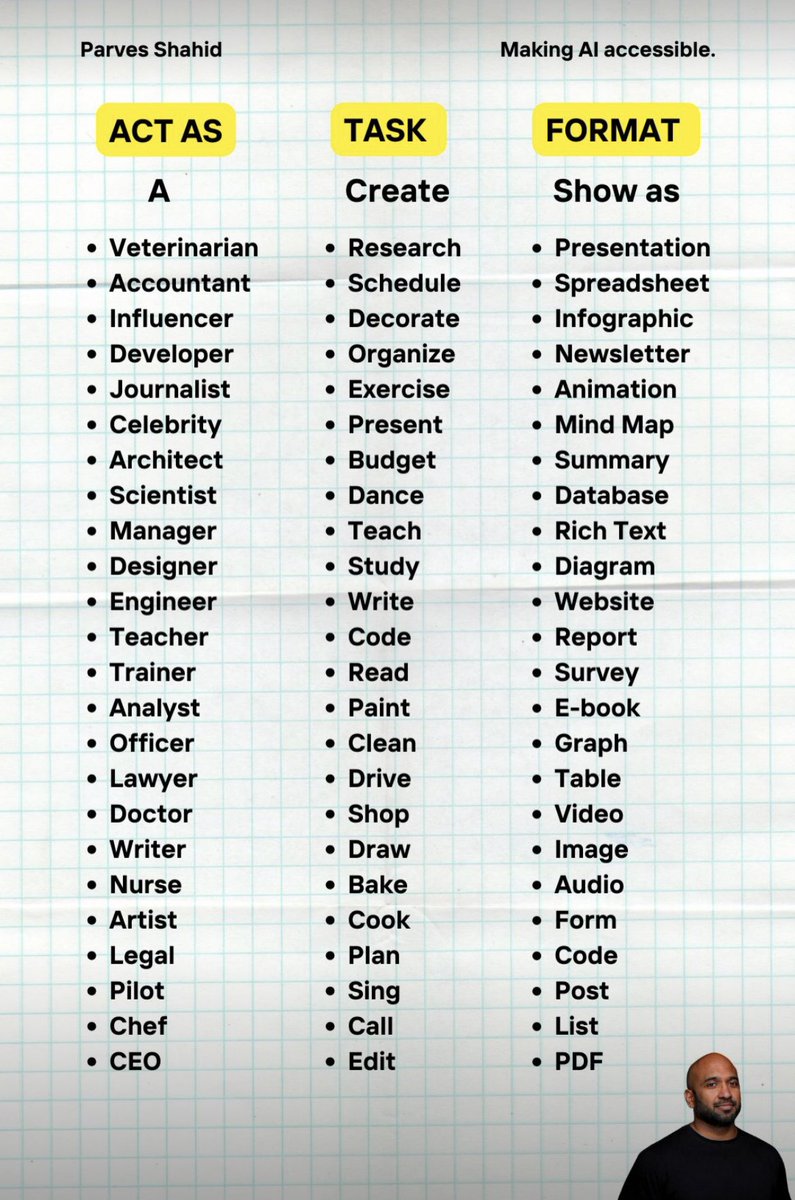
The RTF framework.
R = Role
T = Task
F = Format
Act as a (Role)
Do (Task)
Show in this (Format)
If you are a beginner or if you know anyone who's interested, this is perfect.
Here are a few examples.
Enjoy.