This, I explain to my friends over and over. If you want to know the high-level last 3 to years of how ai evolved and where it goes from here : listen to all Jensen Huang podcast all Nvidia GTC from at least from 2022, 2021, I keep doing that every day.
Today, we released Lyra 2.0, a framework for generating persistent, explorable 3D worlds at scale, from NVIDIA Research.
Generating large-scale, complex environments is difficult for AI models. Current models often “forget” what spaces look like and lose track of movement over time, causing objects to shift, blur, or appear inconsistent. This prevents them from creating the reliable 3D environments required for downstream simulations. Lyra 2.0 solves these issues by:
✅ Maintaining per-frame 3D geometry to retrieve past frames and establish spatial correspondences
✅ Using self-augmented training to correct its own temporal drifting.
Lyra 2.0 turns an image into a 3D world you can walk through, look back, and drop a robot into for real-time rendering, simulation, and immersive applications.
➡️ Learn more: https://t.co/ROR7miJeCU
📄 Read the paper: https://t.co/1osU9EGjGD
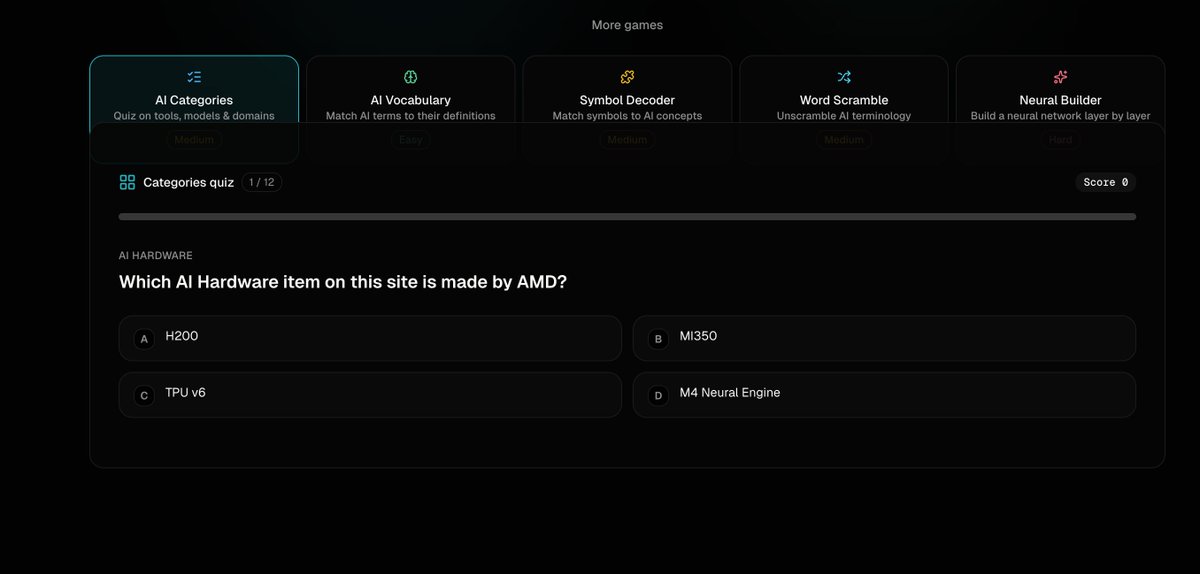
https://t.co/2nJRxXQ6BP : I wanted something to read at nite on my phone without doing extensive search on different aspects of AI.
built with $30 budget , 1 day : models used opus and gemini flash 2.5 :
boost your curiosity with organized knowlede on AI ( a hobby project) : #quiz, #breakthrough , #AI safety
its pretty cool and important approach in robotics :
"It’s not so much about having a specialized humanoid that can do your laundry or wash the dishes. What I’m trying to build is a fundamental set of skills, what I call a pre-trained humanoid. Trained at the level of what, say, a 10-year-old human, can do, but not yet specialized. Once we have that, it’s providing a platform, like an iPhone. People can write applications for it. That’s the level of foundation we’re trying to build. People will take it and build applications we haven't even imagined yet."
https://t.co/zSotggG0bX
@AIDRIVR The backside of the oncoming lanes traffic light are seen much earlier. The AI that is trained on sufficient data should predict 4 way intersection and traffic lights.
It features 6,015 unique tasks across 1M+ trajectories.
The data covers 9,869 unique scenes and 43,237 unique objects.
Pretraining used 100,000 NVIDIA H100 GPU hours to build 2B and 14B model variants.
https://t.co/GkYYbQtqkx