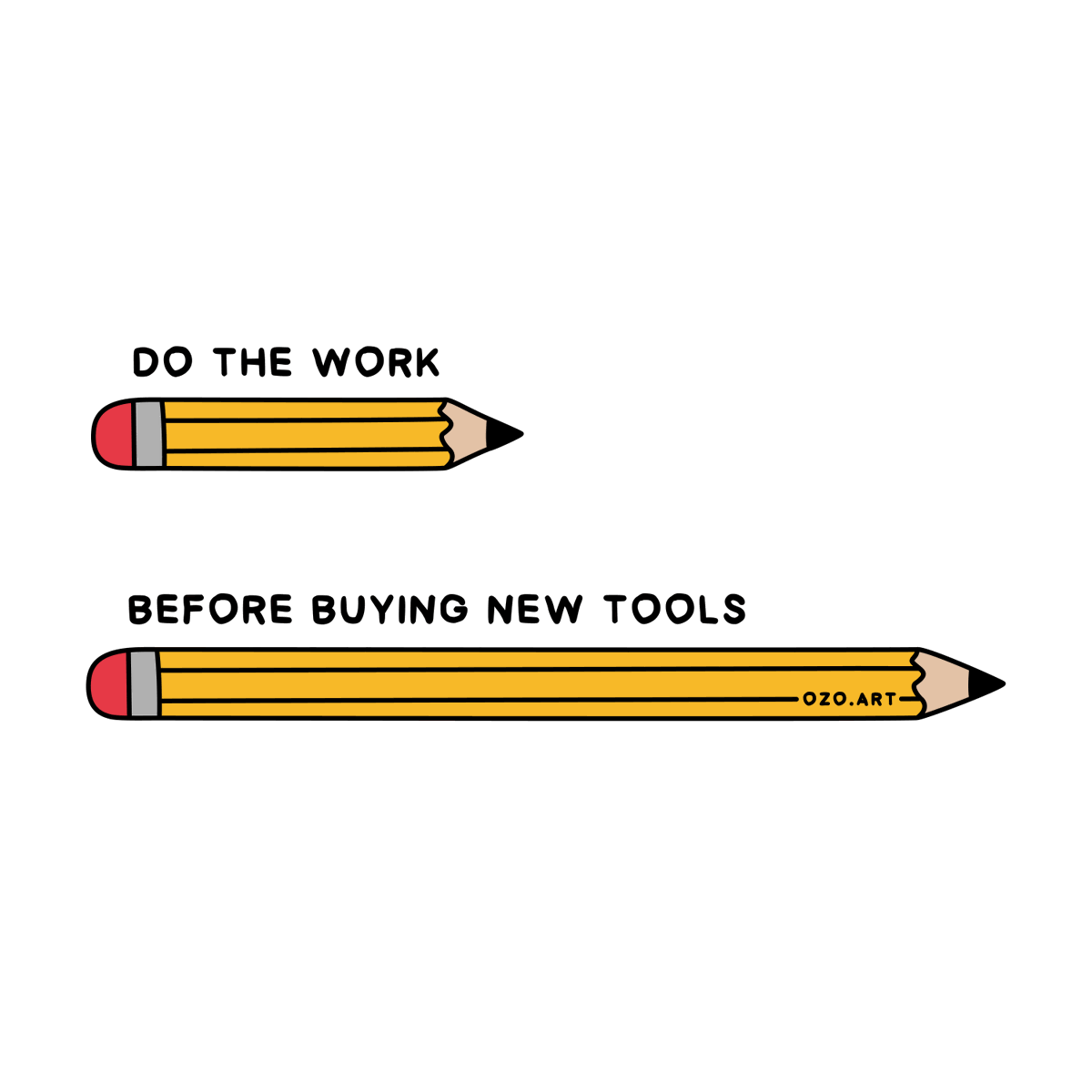
Dejen de perder tiempo en optimizar agents, prompts y sistemas que nunca va a usar nadie. Salgan a la calle, hablen con personas reales, entiendan que problemas reales hay que resolver y enfóquense en el problema. El gran paralelismo de Blockchain con AI es que están todos tan enamorados de la tecnología, que la quieren aplicar a toda costa, en soluciones que nadie necesita.
Hoy la posta es APRENDER A VENDER. Y vender es básicamente saber ESCUCHAR.
It only takes five minutes to break the cycle.
Five minutes of exercise and you are back on the path. Five minutes of writing and the manuscript is moving forward again. Five minutes of conversation and the relationship is restored.
It doesn't take much to feel good again.
Bit by bit, we are starting to see what the new AI assisted software development world is going to look like for the next several years.
My current (still evolving) take:
- Massive unleashing of experimental work, proofs of concept, rough drafts
This should lead to a huge boost in the amount and creativity of software products that come to market, at the cost of a sudden increase in noise, a veritable din
- Significant decline in average code quality
Some code gets better, a lot gets worse, and the limitations of the current technology and unlocking less experienced developers to create software will lead to a near crisis in poorly built products in the near term
- Large proliferation of tools
As we scramble to adapt, experimentation and perspectives will lead to a vast array of possible solutions, each with their own sets of tradeoffs. Reminds me of the early days of Web 2.0, where there was a new framework every week and they all sucked
- Some emerging best practices
Over the past 6 weeks I have talked to many very experienced developers (often 1 on 1 video calls), and we are now starting to circle some common threads for AI-assisted software dev best practices (these are off the cuff, so don’t expect perfection):
1. Slow down, learn the tools, figure out the tradeoffs
2. Quality still matters when it matters; often, the existing models and tools fall short of maintaining that quality on larger code bases
3. The developer is responsible for the code they ship
4. Documentation (via skills, tasks, or just markdown docs) is tremendously helpful, but you should also understand it, not just rely on the AI to
5. High level architecture is still an area where a human with a lot of experience can add a ton of value
6. AI is not a substitute for good taste (and caring about things)
7. Some techniques are locally productive and globally harmful (more on this below)
8. The bottleneck is in review, understanding, and higher level systems architecture more so than coding speed.
9. Some developers are more adept than others at various parts of this new value chain. Current teams are full of developers vetted for and hired to do one job who are facing a significantly different way of doing it.
10. Coding itself might get done a different way, but the fundamental engineering patterns are often still extremely important. Not in cases where it’s just about satisfying some developer love of symmetry, but definitely in domains like data modeling and the like.
More on local optimization vs global concerns: agent chains like Ralph and aggressive code gen can feel incredibly fast, but tend to accumulate inconsistencies and tech debt over time. Speed at a file/feature level does not guarantee speed at the overall system level, and I have felt this personally when I’ve leaned too hard on such tools.
- We will learn more as time moves on. Be kind
We are adapting, evolving, playing with the tools, sharing, feeling the bruises when we get it wrong. There are educators trying to stay ahead of it and provide value. There are normal devs just trying to make a living, and stay relevant. None of this is as unique to you as you might think — I hear from others, and they’re feeling the same pressures. Be kind to each other
Devs need to get outside of the tech bubble and go solve real problems for non-tech people. We are an overserved market. Go ask your brother-in-law how his software is at his non-tech job and watch the wheels start turning.
Really enjoying the AI SDK crash course by @mattpocockuk . I’d been feeling a bit behind on AI lately, but this is the perfect place to start catching up.
My Steam store page was just approved today!
I'd be honored if you would Wishlist and Follow the game.
Apparently I need at least 700 wishlists before Steam takes me seriously, so each one matters.
Thank you so much for your support! You are awesome!
https://t.co/kE5YEwksu2
Mega caliente el sector de stablecoins a nivel global.
Si la comparativa es Vs 2021 puede ser que signifique una exuberancia irracional (totalmente natural en la industria VC) o un cambio de paradigma en la industria financiero global. Veremos que pasa https://t.co/ggqYvT2ofT
Finally got something to show - we're working on a new 3D library for React Native! 👀🧊
👉 Powered by native Graphics APIs (Metal/Vulkan)
👉 Full control over rendering in JS
👉 120 FPS rendering on a Worklet Thread (no lags!)
👉 Supports hotswapping .glb/.gltf models
There are infinite ways to write software poorly.
There are few ways to write software well.
We're a young industry, but we know what works:
Break tasks down.
Deploy frequently.
Use source control.
Name things clearly.
Colocate related stuff.
Decompose solutions.
Get feedback early and often.
Integrate often. Feature flag if it's not done.
Automate quality checks, builds, and deployments.
React Navigation 7 supports animations for Bottom Tabs 🌟
Currently, 2 built-in animations are supported, but it's also possible to write custom animations, with a similar API to stack navigator.