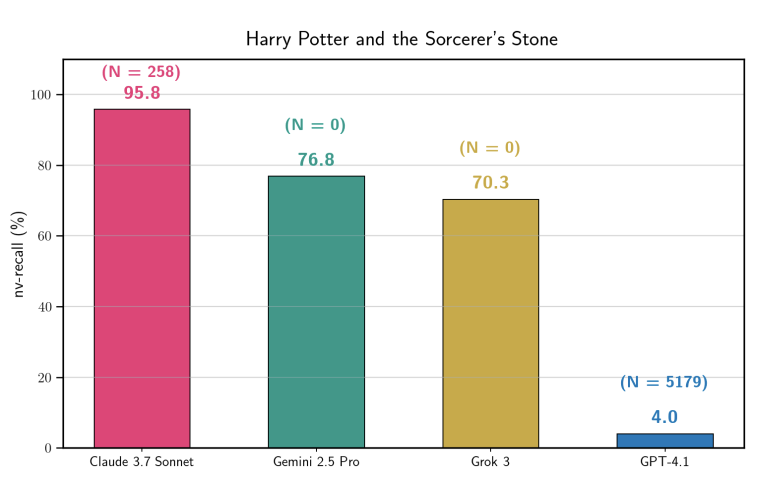
A new paper from Stanford adds further, incontrovertible evidence that LLMs memorize training data.
The authors showed that copyrighted works can be extracted from every LLM they tried: GPT-4.1, Gemini 2.5 Pro, Grok 3, and Claude 3.7 Sonnet.
For example, Claude 3.7 Sonnet reproduced *95.8%* of Harry Potter and the Philosopher's Stone.
"We find that is possible to extract large portions of memorized copyrighted material from all four production LLMs".
Some in AI, and even some courts, have claimed that AI models don't memorize training data. This is simply false. They do, as has been repeatedly shown.
https://t.co/OaLIWPAVuQ
How does an embryo reliably "compute" its form - "cell by cell" - using only local interactions and mechanics, yet produce a precise global body plan? I’m excited to share our Nature Methods paper "MultiCell: geometric learning in multicellular development", presenting #AIxBiology research led by @HaiqianYang and the result of a great collaboration with Ming Guo, George Roy, Tomer Stern, Anh Nguyen and Dapeng Bi.
A long-standing challenge in developmental biology is to predict how thousands of cells collectively self-organize as tissues fold, divide, and rearrange. In MultiCell, we represent a developing embryo as a dual graph that unifies two complementary views of tissue mechanics with single-cell resolution: cells as moving points (granular) and cells as a connected foam (junction network). This lets the model learn dynamics from both geometry and cell–cell connectivity.
On whole-embryo 4D light-sheet movies of Drosophila gastrulation (~5,000 cells), our model predicts key cell behaviors and the timing of events, including junction loss, rearrangements, and divisions with high accuracy, at single-cell resolution. Beyond prediction, the same representation supports robust time alignment across embryos and offers interpretable activation maps that highlight the morphogenetic "drivers" of development. The broader goal is a foundation for cell-by-cell forecasting in more complex tissues, and eventually for detecting subtle dynamical signatures of disease.
Kudos to the team for this inspiring collaboration with brilliant researchers to push the boundary of AI for biology!
Citation: Yang, H., Roy, G., Nguyen, A.Q., Buehler, M.J., et al. MultiCell: geometric learning in multicellular development. Nature Methods (2025), DOI: 10.1038/s41592-025-02983-x
Code/data links are in the manuscript.
Today, we’re announcing a new organization called the Creators Coalition on AI. All creators are facing the same threat from the unethical business practices a lot of the big AI companies are guilty of.
Sign up and show your support: https://t.co/EuVo9Eta5J
The primary use of AI glasses is clearly criminal - conducting privacy-violating ID data searches on people who stand still long enough to be scanned.
Watch the footage below to see them operating in real time.
Ban them in your country.