Amazing blog by Alisa on her job search. Here are the resources she used to study ML/LLM stuffs:
1. Stanford's "Language Modelling from Scratch" course: https://t.co/6SYi2CDHnN
(To understand the breadth of the field and keep a coherent picture in the mind)
2. After getting the breadth, she deep dived into concepts ONE at a time using blogs, papers, chatting with ChatGPT and Claude and implementing things from scratch.
3. Implementing / debugging a transformer comes up so often in interviews. Turn it into muscle memory: https://t.co/IBORUhmfU1
4. Ofc, do Leetcode🥲 https://t.co/VDawahkLOO
5. Other Learning resources she shared:
a. Self-Attention & Transformers: https://t.co/Vlowc8Ectr
b. The Illustrated GPT-2: https://t.co/f4Bui6UD1u
c. Backpropagation
https://t.co/FLoTwkMppw
d. Introduction to Policy Gradient for LMs
https://t.co/QlwnkKVTRd
e. Lightweight Guide to understanding GRPO and RL principles
https://t.co/FBBnnuZXZt
f. How to Scale Your Model
https://t.co/ryFY5Kpjmn
Guys, you should have 3 trading accounts.
1. LONG TERM ACCOUNT
This is for market leading ETFs like $SPY & $QQQ plus your highest conviction stocks. If these positions are profitable and the thesis remains intact, they're add only and you don't sell them.
2. SWING TRADING ACCOUNT
This is for short term trades. Positions are actively managed with strict risk management and defined entry and exit criteria. Trades can last from a few days to a few weeks.
3. DAY TRADING ACCOUNT
I keep just enough money in this account to meet margin requirements and all positions are closed by the end of the day without exception.
Structuring your accounts this way helps you stay disciplined and makes it easier to separate trading from investing.
The most common question I get asked is when to trade shares vs options...
My general framework:
I prefer shares when buying pullbacks in leading stocks and momentum isn't exceptionally strong.
Why?
Because shares give me staying power.
If I buy a great stock on a pullback and it chops sideways for a few days or even a few weeks before moving higher, I don't have to worry about time decay. I can focus on the thesis and let the trade develop.
Many of the best opportunities don't immediately work.... They require some patience that options sometimes can give you due to IV/theta decay
Shares allow me to sit through normal volatility, hold through consolidation, and avoid getting forced out of a position simply because time ran out.
I prefer options when momentum is expanding and conditions are favorable.
In particular, I like when the VIX is relatively low (ideally below 18) and the market is showing signs of strong directional movement.
In those environments, options can be a powerful tool because they allow me to gain leveraged exposure to a move that I expect to happen relatively quickly.
The key is understanding that options require more than being right on direction.
You also need to be right on timing.
A stock can eventually move exactly where you expected and you can still lose money on an options trade if the move takes too long.
That's why I generally reserve options for situations where I believe momentum can do the heavy lifting.
The way I think about it:
-Shares are for patience.
-Options are for momentum.
-Shares are for letting a thesis play out.
-Options are for capitalizing on a move that is already starting to accelerate.
Neither is inherently better.
The mistake is using options in a situation that calls for shares, or using shares in a situation where options offer a better risk/reward profile.
The market environment should determine the tool you use... not the other way around.
Most traders are looking for cheap stocks.
I look for strong stocks. ����📈
Every single one of my biggest winners came from this free screener.
Not because the screener finds winners.
Because it finds stocks with the characteristics of past winners.
Here’s what I look for 👇
1. Massive Relative Strength: The stock should already be outperforming the market. Strong stocks tend to get stronger.
2. Clear Uptrend: EMA8 above EMA21 and both moving higher. I want institutions already pushing the stock higher.
3. Fast Movers: ADR% above 4.5. Big winners rarely move 1% per day.
4. Huge momentum: At least 70% above the 52-week low. Most monster winners start from positions of strength.
5. Consistent Performance: Positive performance over the last 3 months, 6 months, and 12 months. I want proven leadership.
6. Liquid Stocks: Enough volume to allow institutions to build meaningful positions.
The screener is only the first step.
Now the real work begins:
• Study the chart
• Research the story
• Look for accumulation
• Wait for a tight setup
• Buy only when the risk/reward is attractive
The goal is not to buy every stock in the screener.
The goal is to find the next exceptional winner.
📎 Free Screener for TradingView: https://t.co/FfuBt33xQb
These patterns repeat.
I've taught this process to thousands of traders.
You can learn it too.
One of the hardest pills to swallow as a real estate agent is working with a buyer for six months, showing them 30+ homes, writing four offers, losing three of them to cash buyers... and then they go buy a FSBO they found on Facebook without telling you.
You find out from an MLS alert that the house closed. That's how it ends.
When market starts acting better. Our job is to listen, plan and execute.
One major flaw traders make it- Looking for cheap stocks. My advice is - Make a simple switch and look at leaders and emerging leaders. If they're looking good now, they will do even better in uptrending markets.
Here's my watchlist right now:
Near 21 EMA
$HUT
$NET
$ON
$RDDT
$LITE
$TWLO
$DDOG
$OUST
Near 9 EMA
$ARM
$MRVL
$NBIS
$WULF
$CRWD
$AMD
$GFS
Breakout setups
$INTC
$ALAB
$CRDO
$APLD
$HIMS
$DRAM
$VELO
You cannot get into all of them, so here's the approach:
1. Pick your top 7-8 stocks, and ignore the rest. Zero FOMO
2. Get a good risk entry which allows you to manage risk and offer great upside
3. Let them work out, if they dont need your attention- you leave them alone
4. Manage if you have to by switching stocks if one starts acting up.
These will generate many years worth of returns in the next 2 months.
One of the biggest mistakes traders make is evaluating setups without considering the environment they're trading in.
A breakout can be the exact same pattern on two different days and produce completely different results.
Why?
Because the market backdrop matters.
As @Qullamaggie says:
"You want to trade aggressively when the indexes are above their 10/21 EMAs, ideally when they're rising. That's when the big money is made."
Most traders read that quote and move on.
Instead, go study it.
Pull up charts from periods when SPY and QQQ were above rising 10 & 21 EMAs.
Then compare them to periods when the indexes were below those moving averages or when the averages were flattening out.
Look at:
-Breakout success rates
-Relative strength leaders
-Follow-through after entries
-Number of stocks making new highs
-Average trend duration
-How often pullbacks get bought
You'll start to notice something:
The best stock setups tend to appear when the overall market is providing tailwinds.
Many traders spend years trying to perfect entries while ignoring the single factor that has the biggest impact on their results... the market environment.
Before analyzing individual stocks, analyze the conditions those stocks are trading in.
The trend of the indexes often determines how much opportunity is available.
Patience is required now...
You have to allow time for this market to digest and re-set itself. Need discipline and maturity to wait out these periods. Often times, I feel like this is where so many traders lose patience and let frustration get the better of them.
New traders should learn these things immediately:
You're never going to sell at the exact top
You will never bottom tick the market or stock. You sell when you're happy and you start scaling into a position when technicals tell you to.
Growth stocks that ran with the market will drop harder than the market. It's just math. If your stock went up 40% while $QQQ went up 10%, the drawdown will also be larger.
Technical analysis will save you when Fundamental analysis fail.
Your stop losses are better left alone. I lost enough money and hair to tell you this - all my 20k losses started as 2k losses when I moved the SL.
The market gives you 3 opportunities every year to press gas. The rest of the time you just glide based on your good decisions. Big corrections. Small mini corrections. We're in a mini one right now. If we dip a bit more, it's an attractive entry.
The VIX rule:
→ VIX above 20 = volatile moves. Take fewer trades or use wider stops.
→ VIX at 20 = S&P could move 1.25% in a day
→ VIX at 30 = S&P could move 1.87% in a day
If you can nail this- 60% of your trading is solved immediately.
This is one of the biggest mistakes I see beginner traders make:
They blindly enter when a stock touches a key support level
That's how you get bagged. Try this insead👇
Países de Europa donde NO deberías vivir:
🥉 Mal
· Portugal 🇵🇹 (salarios bajos, alquileres disparados)
· Bélgica 🇧🇪 (impuestos altos y clima deprimente)
· España 🇪🇸 (sueldos bajos para el coste actual)
· Italia 🇮🇹 (oportunidades laborales limitadas)
🥈 Peor ↓↓
The best mosquito repellent for your patio costs $20 and runs on a wall outlet: a fan.
Mosquitoes are terrible fliers with a top speed of about 1-2 miles an hour, slower than you walk, and they struggle to make headway against even a gentle breeze. Point an oscillating fan at your outdoor seating area and they'll physically struggle to get to you.
It works on two levels too. A mosquito finds you by following the plume of carbon dioxide you exhale, plus the heat and scent rising off your skin. A fan scatters all of it and erases the trail that leads them in. So it knocks them out of the air and helps hide you from their senses at the same time.
This isn't folk wisdom. The CDC notes that fans reduce mosquito landings, and studies have found that using a fan can substantially reduce mosquito bites.
Citronella candles offer only modest protection and are generally much less effective than a fan or EPA-registered repellents. Plug in a fan, aim it at the table, and take your evening back.
What made the March 2009 bottom the real deal was everyone hated the market. Even the media & politicians hated it. They were practically giving stocks away. On March 6, 2009 I bought Citigroup for 97 cents a share. The bottom calling today is almost comical 😇.
One of the most important things Ive learned in trading is:
Focusing on stocks that are in the upper right hand corner of your screen
Not stocks trying to bottom.
Not stocks "that look cheap."
Not stocks that are down 80%.
The biggest winners are usually making new highs, holding above key moving averages, and showing persistent relative strength.
Our brains are trained to look for "deals", on stocks that are way oof the highs and lagging...
But when you start training you eyes to look for stocks that are leading, you'll start seeing that they are leading for a reason...
The best stocks go higher for a reason.
This changed the way I scanned the market...
I know scan for:
-52 week highs
-Stocks that doubled over 52 weeks
-Above the 21 EMA and 50 SMA
-Relative strength vs. the market
-Accumulation volume
-Strong sectors and themes
These stocks create my larger watchlist that I review each day for setups, in the stocks/groups that are the strongest....
Instead of trading A+ setups in lagging groups/sectors
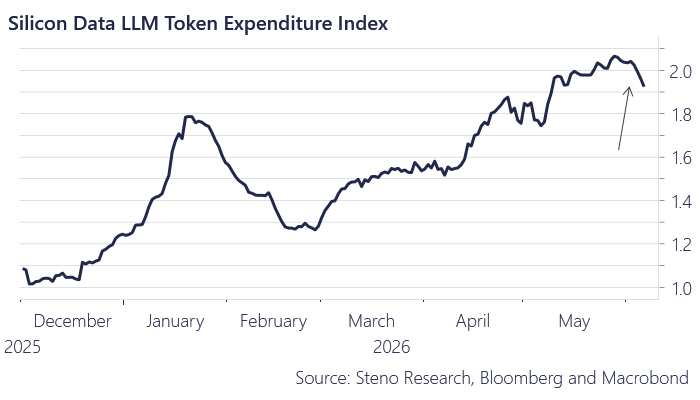
This is the chart that everyone should be watching.
If the Token Pricing rolls over, everything from the memory trade to the broader hard-ware and data-centre trade is over for this cycle imho.
The whole setup depends on this..
Una volta la nonna mi aveva dato consiglio:
Nei periodi difficili, vai avanti a piccoli passi. Fai ciò che devi fare, ma poco alla volta. Non pensare al futuro, nemmeno a quello che potrebbe accadere domani. Lava i piatti. Togli la polvere. Scrivi una lettera. Fai una minestra.
Vedi?
Stai andando avanti passo dopo passo. Fai un passo e fermati. Riposati. Fatti i complimenti. Fai un altro passo. Poi un altro.
Non te ne accorgerai, ma i tuoi passi diventeranno sempre più grandi.
E verrà il tempo in cui potrai pensare al futuro senza piangere.
Elena Mikhalkova, La stanza delle chiavi antiche
As the market opens higher this morning, it's important to remain disciplined and avoid chasing an early rally—especially following a significant down day and a weak close on Friday.
One of the most common mistakes investors make is assuming that the first bounce marks the start of a sustainable advance. In many cases, the initial rally is simply an oversold reaction or what traders refer to as a "dead cat bounce."
Historically, after a sharp decline, I prefer to give the market time—often until midweek or even the end of the week—to see whether buyers are truly stepping in with conviction. Very often, after the first reaction higher, the market resumes its downtrend, undercuts the recent lows, and additional damage occurs.
Patience and selectivity are critical. Let the market reveal its true character before becoming overly aggressive. Focus on preserving capital, managing risk, and allowing the price action to confirm whether the move is the beginning of something meaningful or merely a temporary bounce within a larger decline. https://t.co/JXzFFTmMtn