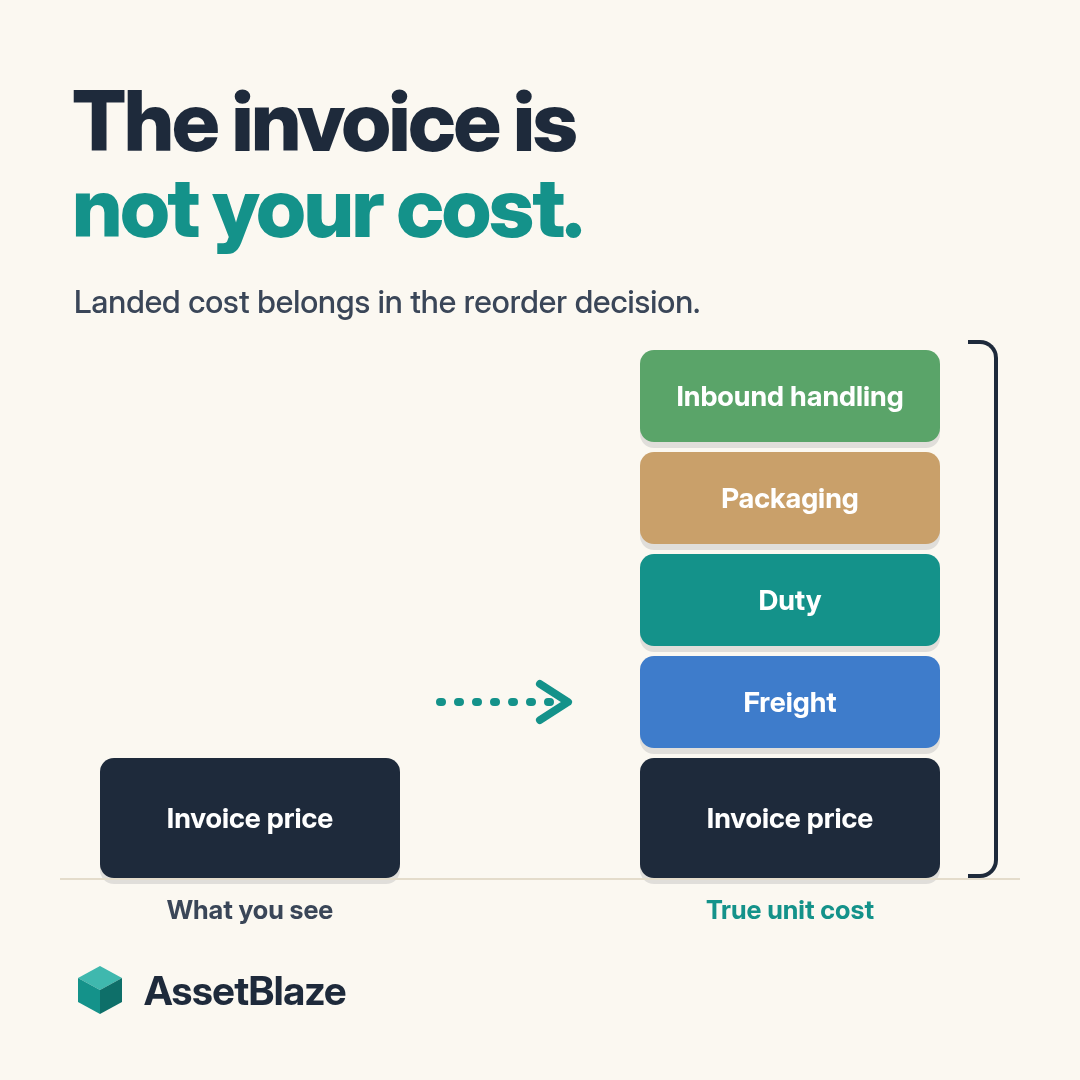
The invoice is not your cost.
Freight, duty, packaging, and inbound handling land on top of every unit. True unit cost moves, and so does margin.
If reorders only see the supplier price, you are buying on a partial number.
Follow @assetblaze for practical inventory ops.
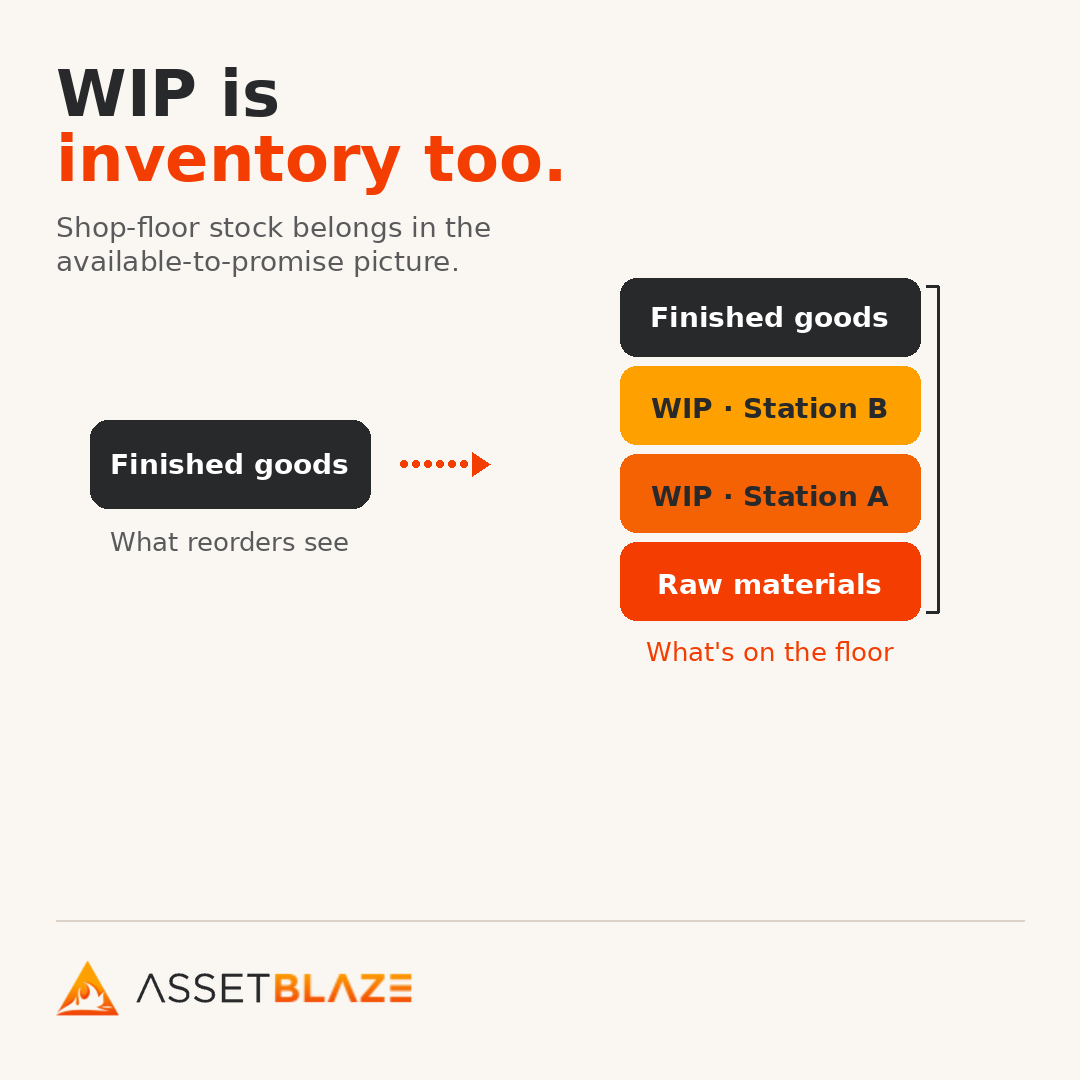
WIP is inventory too.
Finished goods on the shelf is only part of the picture. Work-in-progress between stations is real stock that reorders and available-to-promise miss when it lives on a whiteboard.
Follow @assetblaze for practical inventory ops.
@e2link Useful distinction. Being off the Food Traceability List does not mean no lot records. Packer-level supplier lot and sub-lot codes still matter when a recall (or customer) asks what left the dock.
@glepkoff127 Agree. Ordering to today's sell-through without production time, freight, and promo lift is how stockouts become air-freight emergencies. Build the PO clock from lead time first, then layer the campaign.
@mike_begg Move 1 is right. Ads cannot rescue an empty bin. Fixing replenishment before campaign spend is the difference between buying demand you can fill and buying refunds.
@GS1_US This is the hard part of FSMA 204. Knowing the rule is one thing. Day-to-day ops only get safer when lot and shipping records answer who received what without a binder scramble. Pilot lessons from that scale are worth studying.
@Anthony_Mellor1 That cycle is painfully common. Reactive buys compress into air freight, which fixes the stockout and wrecks the margin in the same week. Planning to lead time (not today's sell rate alone) is what breaks the loop.
@clementclaudiu Exactly. The supplier invoice is the easy number. Once freight, duty, packaging, and inbound land on top, your true unit cost (and margin) move. Landed COGS belongs in the inventory decision, not just the freight quote.
@Sudhakarve This is the Monday list that matters. Open quotes past SLA, credit holds, and orders stuck on stock are usually the same root problem: available-to-promise and warehouse truth never met. Rank by revenue at risk and the meeting gets short.
@USAFactoryNet Recalls almost always trace back to a gap between what left the dock and what the records can prove. Lot and batch visibility before the crisis is what keeps the scramble from becoming a guess.
@supplychain10x Love the B option. Safety stock formulas are useful, but the number that surprised you is usually where the model and the real lead time or demand shape diverged. Those stories teach judgment faster than the textbook definition.
@Boldliteagency Exactly. A manufacturing stockpile is not just a production story. It is cash parked in raw materials, WIP, and finished goods until demand clears it. Visibility by stage is what turns that pile into a working-capital decision.
@SupplierAlly Well put. The freight quote is the easy line. Landed cost plus how long the inventory sits waiting for the ocean move is what actually hits cash. Urgency and holding cost belong in the same comparison as the rate card.
@mingxitogo Agree on the batch lock. Early country allocation feels tidy, then demand shifts and you are stuck with the wrong pile in the wrong place. Holding allocation until closer to ship usually costs less than overpaying for flexibility later.
@rohitdhimandev Dead stock is awkward because the balance sheet still calls it an asset while the rack knows better. Ageing by FIFO (or FEFO for anything dated) turns the quiet cash trap into a line-by-line decision instead of a year-end surprise.
@CodeStringers This is the classic three-system problem. Shopify, QuickBooks, and the warehouse each feel authoritative until a receipt, return, or transfer lands in only one of them. One master for on-hand, with the others reading it, beats reconciling three truths every week.
@RevParts Mismatched counts across branches. Stockouts and dead stock are loud; wrong branch truth is quieter and often causes both. One number per SKU per site beats four conflicting sheets.
@Miss1936 The revenue line can look great while inventory days quietly climb. In manufacturing, that usually means cash is sitting in WIP and finished goods waiting for the demand signal to catch up.
@InsideFMCG Interesting move for a wholesale distributor. Conversational portals help buyers ask better questions, but the answers still only work when catalog, price, and available stock agree behind the scenes.
@Ourcargo_ Well said. Volume only helps when the shipment shape, timing, and true landed cost are clear. Bigger boxes with unclear inventory timing still burn cash on the dock and in the warehouse.