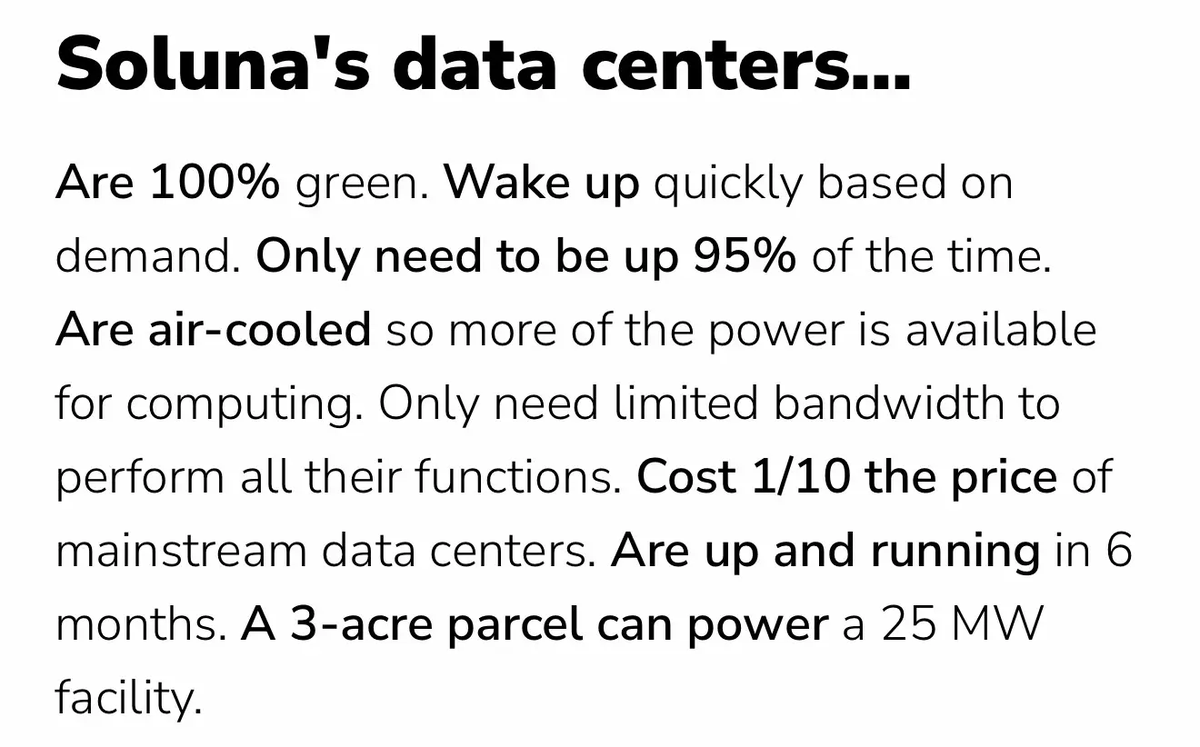
$SLNH Communities are rejecting big data centers in residential areas that drain grid power and raise bill. $SLNH solves this by building modular data centers co-located with wind/solar farms, using surplus curtailed renewable energy that would otherwise be wasted. No grid strain, truly green, ultra-low costs. Perfect for AI, Bitcoin mining & HPC. Scalable, fast-deploy, and aligned with the energy transition boom. Traditional data centers face NIMBY fights—Soluna turns renewable waste into computing gold.
It has been a week since the Robinhood Chain has launched, and the momentum has been rapidly increasing. It's been awesome to see.
The early success of the Robinhood Chain is an illustration of my vision for what success looks like for the two foundations it is built on top of: Ethereum and Arbitrum.
Ethereum: Robinhood utilizes $ETH as the native gas token of the chain. In other words, for every transaction to occur someone needs to be holding and spending $ETH. This motion continues to cement $ETH as the native onchain asset across the programmable economy. All the major trading pairs on the chain right now are utilizing WETH on Uniswap. Bringing on 27m users into Ethereum's sphere of influence is a generational and historic moment for Ethereum.
Arbitrum: Robinhood's tokenized equities have been housed on Arbitrum One for the last year, prior to the launch of the Robinhood Chain. The Robinhood Chain is now utilizing the underlying Arbitrum stack to power its experiences. The way the license works, Robinhood shares with the ArbitrumDAO Treasury 10% of its transaction fee profits for utilization of the technology. So, while Arbitrum One remains the core focus and priority for supporting enterprises, startups and protocols, the monetization strategy extends with their growth motions. I look forward to continued and deepened collaboration between Arbitrum and Robinhood across a number of different initiatives.
Building business models that align with the success of the adoption of the underlying technology has always been necessary, but has become absolutely critical as investors are looking more at capture than proliferation today. Both Ethereum and Arbitrum are extremely well set up as the onchain economy increases 100x in the coming years.
Ethereum for settlement and medium of exchange.
Arbitrum for execution, scalability and cusomizations.
Powerful combination with a lot more to come. The playbook is being written as we speak.
@JackCrypto____ Curious. Outside of using utility tokens to facilitating transactions ( $ETH, $SOL, $POL, ECT) what are some examples of successful utility tokens?
$SLNH CEO John Belizaire will be speaking at the Energy Investors Forum 2026 in Dallas this July.
EIF brings together investors, energy operators, data center leaders, Bitcoin miners, infrastructure companies, and capital allocators for a timely conversation on the convergence of energy, compute, and capital — one of the most consequential market themes shaping infrastructure investment right now.
📍 Dallas, Texas
🗓️ July 23-24, 2026
🎟️ Use code EIF20 for 20% off tickets
🔗 https://t.co/ShAayK903I
#EIF2026
The Robinhood onboarding begins.
Retail's most trusted brand (a $100B+ company) is starting to push crypto to its massive user base.
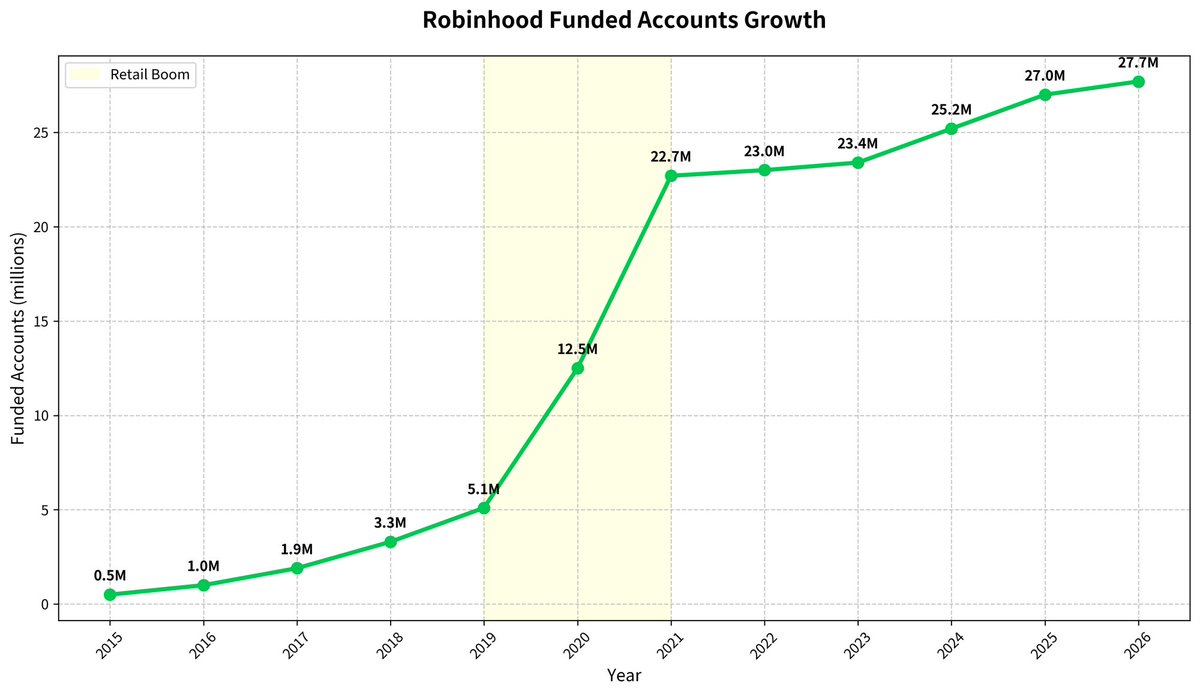
RH has almost 28M ACTIVE users, and its growth has been strong & consistent.
By active users, I mean funded accounts pushing ~$10–16B equity notional volume every day (see the growth chart below).
When we reach full app integration, the barrier between trading equities and on-chain will disappear. This will likely take weeks to months to ship.
In the meantime, the Robinhood team is incentivized to encourage the eco activity. It helps them:
- Bootstrap activity/attention
- This acts as a revenue engine
- Positions them to dominate onchain
It's only been a little over a week. I doubt the marketing push ends with one tweet.
They have a bigger goal in mind. Vlad greenlit memecoins in his L2 for a reason.
Higher for longer.
⚡ Soluna is transforming curtailed renewable energy into productive compute by building data centers directly at generation sites, creating scalable infrastructure to power Bitcoin mining, AI, and high-performance computing while maximizing every megawatt. 🌱🤖
$SLNH #RenewableComputing #AIInfrastructure #BitcoinMining #HPC #DigitalInfrastructure
Read more: 🔗 https://t.co/erN8Pj2sVh
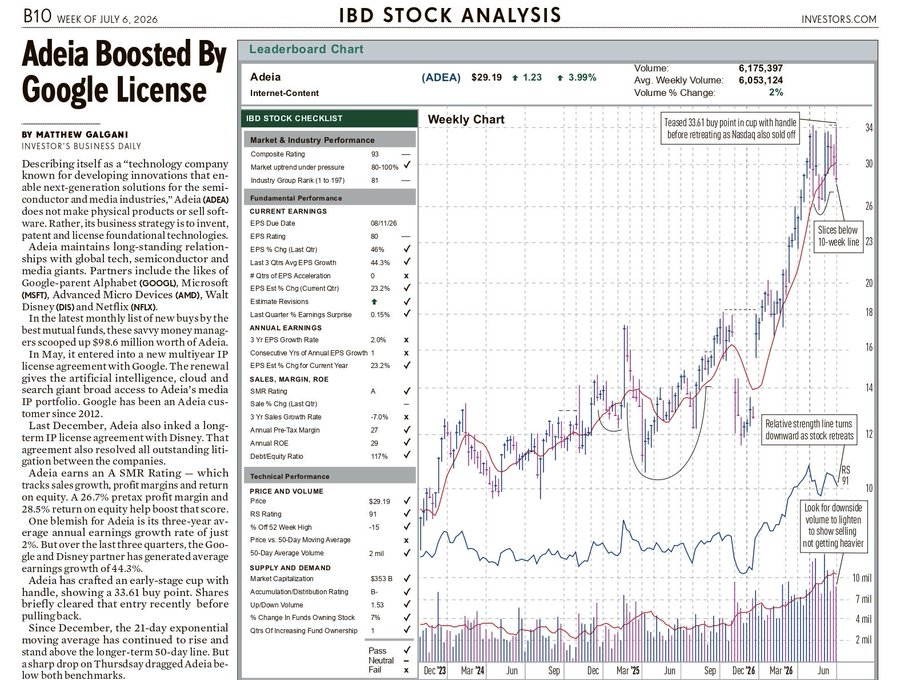
$ADEA
Adeia (ADEA)
Business model:
• Adeia doesn’t build hardware — it invents, patents, and licenses foundational tech.
• Ultra‑high‑margin IP licensing model (41% pretax margin, 40% ROE).
• Partners include Google, Microsoft, AMD, Disney, Netflix — elite tier clients.
Recent catalysts:
• New multiyear Google license → recurring revenue locked in.
• Renewals with major media + semiconductor companies → strong demand for their IP.
• Licensing deal with Disney + SMR Partners → expanding media footprint.
• Strong mutual fund ownership → institutional confidence.
Financial strength:
• EPS growth: +26% last quarter, +27% previous quarter
• Annual EPS growth est: +26% this year, +27% next year
• 3‑year EPS growth: 27%
• 3‑year sales growth: 5% (slow but stable — IP model is margin‑driven)
Why This Is Bullish for ADEA
• Big Tech doesn’t sign multiyear IP deals unless the tech is essential.
• Recurring licensing revenue = predictable, high‑margin growth.
• Adeia’s IP sits inside semiconductors, media platforms, and cloud ecosystems.
• Strong EPS growth + elite ROE = high‑quality fundamentals.
• Institutional accumulation signals confidence in long‑term performance.
• IP companies scale without manufacturing costs — margins stay huge.
• Renewals show Adeia’s patents are must‑have, not optional.
Renewable plants are producing more than transmission infrastructure can carry.
The energy gets curtailed or wasted.
We show up and buy it to power high-performance computing like Bitcoin and AI.
Sell. Every. Megawatt.
$SLNH
$SLNH
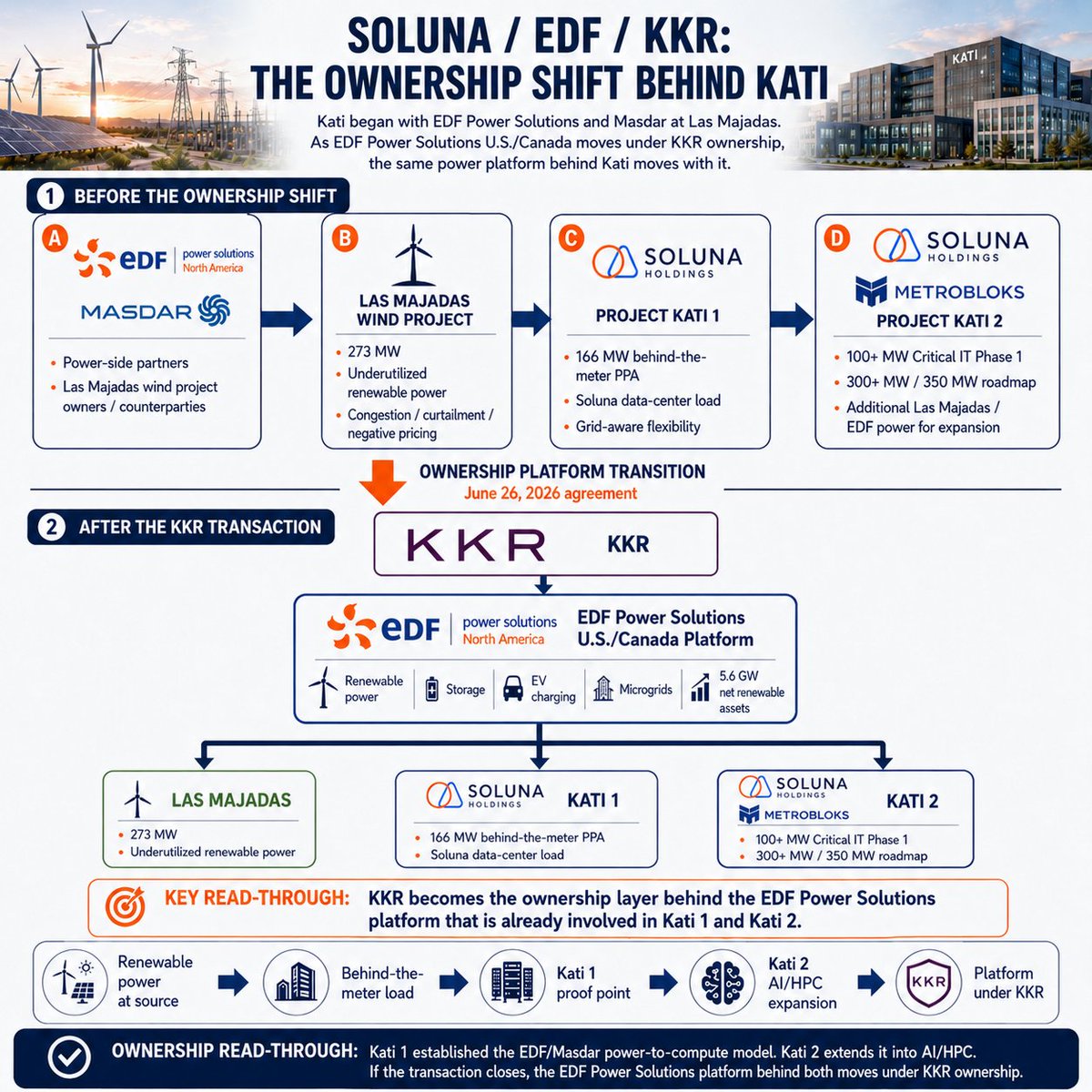
Here is the clean ownership flow behind the Soluna / EDF / KKR discussion.
Soluna’s Project Kati relationship started with EDF Power Solutions North America and Masdar at the Las Majadas Wind Project in Texas.
EDF / Masdar own the power-side asset.
Soluna became the data-center load through the Project Kati behind-the-meter PPA, using renewable power close to the source instead of waiting on traditional grid expansion.
That created the first layer:
Las Majadas renewable power
→ EDF / Masdar power platform
→ Soluna Project Kati
→ behind-the-meter data-center load
Then came Kati 2.
Soluna and Metrobloks are now trying to expand the same power-backed model into AI/HPC infrastructure, with Kati 2 positioned around 100MW+ Critical IT in Phase 1 and a larger roadmap beyond that. Soluna has also said the parties are working with EDF Power Solutions to source additional Las Majadas power for the expansion.
That creates the second layer:
Soluna + Metrobloks
→ Kati 2 AI/HPC expansion
→ additional EDF / Las Majadas power pathway
→ potential AI/HPC tenant + project financing
Now add the ownership shift.
EDF has signed an agreement for KKR to acquire EDF Power Solutions in the U.S. and Canada. If that transaction closes, the EDF Power Solutions platform already tied to Kati moves under KKR ownership.
That does not mean KKR has announced a direct Soluna deal.
It means something more precise:
Soluna’s existing EDF Power Solutions power relationship would sit inside a KKR-owned North American infrastructure platform.
That is the important ownership read-through.
Before:
EDF / Masdar
→ Las Majadas
→ Soluna Kati 1 / Kati 2
After the KKR transaction closes:
KKR
→ EDF Power Solutions U.S. / Canada
→ Las Majadas power platform
→ Soluna Kati 1 / Kati 2
This is why the KKR angle matters.
Kati is no longer only a small renewable data-center project with EDF/Masdar. It may become a reference model sitting inside a much larger infrastructure ownership platform focused on power, capital, data centers and speed-to-market.
Infrastructure is the new moat.
The companies that understand the energy and compute behind AI won't just compete — they'll set the terms.
On July 15, $SLNH CEO John Belizaire joins leaders from @TAHOLabs and Bluedge Ventures to talk about it.
Link to register: https://t.co/lsKn0DgnIe
Instead of asking whether $SLNH is cheap, ask why companies like $IREN became expensive.
I think the better question is: what has the market historically rewarded?
It wasn’t announcements.
It was execution.
Today, $SLNH trades around a ~$227M market cap while still generating relatively modest revenue and negative earnings. That’s why many dismiss it.
But here’s what people overlook:
• $IREN spent years diluting shareholders before the market believed the execution story.
• $CORZ wasn’t rewarded until AI contracts became tangible.
• Nearly every successful infrastructure play looked “expensive to fund” before scale made the math obvious.
The real risks are obvious:
• Capital requirements
• Execution
• Competition from larger behind-the-meter power owners
None of those should be ignored.
But neither should the upside.
If $SLNH executes, with its 4.3+ GW pipeline already in place and having doubled its operating capacity. Today’s valuation isn’t being compared to today’s business.
It’s being compared to what a proven owner/operator of scarce power infrastructure can become. The kind of valuation $IREN and $CORZ reached once they showed they could actually scale.
That’s why I’m bullish.
Not because execution is guaranteed.
Because the current valuation still prices in a lot more doubt than success.
Markets don’t usually reward optionality until it’s close to becoming cash flow.
That’s exactly why asymmetric opportunities exist.
Robinhood Banking hits new milestones: $3B+ in deposits from 200K+ customers 🔥
Robinhood is a financial technology company, not a bank. Banking services are provided by Coastal Community Bank, Member FDIC.
Bitcoin didn't just validate our business model. It stress-tested it.
We built and operated behind-the-meter data centers through market compression, halving cycles, and volatile conditions, and delivered on every commitment.
That operational track record is the foundation for everything we build next.
The workload evolves. The infrastructure holds.
$SLNH
🚨🚨🚨 @SolunaHoldings Business Segments
⚡ 4 revenue streams spanning prop mining, grid services, HPC, and third-party hosting — rare diversification for a sub-$1B miner
⚡ Prop Bitcoin mining runs on Soluna or JV-owned machines with daily BTC sales and managed infrastructure services
⚡ Grid Ancillary Services pays on a $/MWh basis — Soluna acts as behind-the-meter flexible load, monetizing curtailment
⚡ HPC colocation targets AI-ready data center demand via JV-developed sites with managed infra layered on top
⚡ Hosting segment brings in third-party miner revenue at Soluna Data Centers with the same managed infra model
⚡ 1GW+ power target underpins the scale ambition across all four verticals
Four revenue levers, one power platform — $SLNH is building the infrastructure stack, not just mining BTC!!!
When Google spends $4.75B to acquire a co-location developer, it's not a bet. It's a verdict.
Co-location isn't a workaround. It's the architecture. The developers who control power at the source (not those waiting on grid capacity that doesn't exist yet) are the ones positioned to meet AI infrastructure demand at scale.
Soluna has been building behind-the-meter at renewable generation sites since before this was the obvious play.
The market is arriving at a conclusion we've been building toward for years.
$SLNH #RenewableComputing