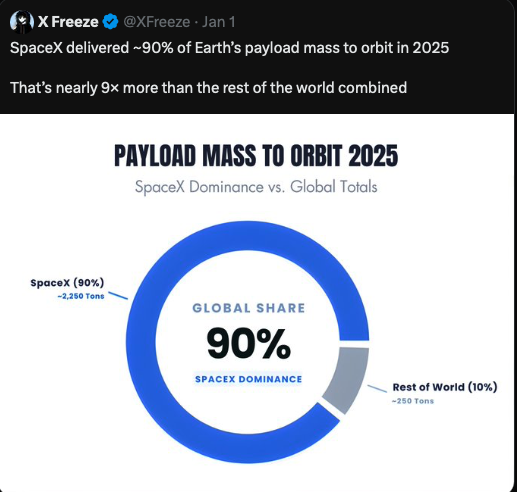
The single biggest bottleneck in the entire space industry is the launch vehicle itself.
@SpaceX isn’t just a company that’s slightly better at building rockets.
That image says everything. When the starship works, that figure is close to 100%.
Unlike cars, trains, airplanes, or ships in other industries, there are no alternative options in space — there’s only the launcher. People talk about “various launch vehicle choices,” but those only matter once you’re already in space.
Every high-margin space market — including orbital data centers — is fundamentally bottlenecked by the launch vehicle. The market is already pricing in some of SpaceX’s value based on the belief that it will make orbital data centers feasible. The surrounding companies are simply riding that wave and sharing in the upside.
But here’s my view: even if SpaceX begins full Starship commercialization and starts launching orbital data center pilot missions next year, it will still be almost impossible for other companies to catch up in any meaningful way.
Even if they somehow manage it, it will take a minimum of 5 years — and more realistically 10+ years. And trying to close the gap against a SpaceX that has already perfected reusability and economies of scale over those 5–10 years is basically impossible.
Just developing a medium-lift launcher typically burns through roughly $1 billion. Going from small to medium lift isn’t just scaling up — it requires building something structurally completely different. And when SpaceX went from medium to heavy lift, they threw out and redesigned everything again, because reusing the old architecture simply didn’t work.
Starship is the final, complete form of that evolution. A single Starship vehicle can serve as a medium-lift rocket, a heavy-lift monster, a lunar transport ship, and a Mars transport ship — all through different configurations. That capability has already required approaching $20 billion in investment, and far more will be spent going forward.
How many companies in the world can actually afford this? And if they have to keep running endless ATM equity offerings just to fund it, how many shareholders will have the stomach to keep supporting that?
This is exactly why SpaceX is valued at over $1 trillion.
There are real, fundamental reasons behind it. Behind our wildest imaginations lies the unbreakable bottleneck of physics — and the only company that has shattered it is SpaceX.
$VELO
The Raptor chamber pressure is dramatically higher than other rocket engines — roughly 3x in some comparisons. That performance edge exists thanks to Elon’s relentless philosophy and Velo3D’s additive manufacturing technology that actually makes it possible at scale.
$VELO meets Elon’s extreme requirements and is now a key driver behind cutting Raptor unit costs. When a SpaceX rocket can fly reliably under those conditions, it’s the ultimate real-world proof of Velo’s tech.
Military weapons demand extreme reliability, which usually means high cost. But “cheap + reliable” is rare. Velo3D’s technology — proven under @SpaceX's brutal demands — is exactly what the defense world needs right now.
@ajeldi2
In the past, the Trump administration said that it would buy Bitcoin as a strategic asset.
But what they really invested in is Intel and quantum computing companies.
What if...?
$INTC $IONQ $INFQ $RGTI $QUBT
Sorkin: "SpaceX, I think, is going to ultimately buy Tesla."
Morgan: "I think that’s inevitable."
Sorkin: "And they’re going to rename the company X for the whole enterprise."
David Sacks just delivered an economics masterclass on Elon becoming the world’s first trillionaire.
@davidsacks: “People see the headline and imagine Elon suddenly has a trillion dollars in the bank. That’s not how it works. His balance sheet didn’t change overnight.”
Why?
The real point is deeper. Wealth isn’t in the “stuff” we consume. Food, shelter, clothes. Things that depreciate and disappear. It’s in the machines that create stuff for decades: tools, workflows, and corporations.
These are the true engines of human progress.
“If you create a machine that makes more stuff, then there’s a discounted present value for all the stuff in the future that machine might create. That’s where the wealth comes from.”
Elon started with nothing. An immigrant who slept on the floor building Zip2. He created these machines from vision and relentless effort. Thousands joined him, including a SpaceX welder who turned his labor into a million dollars in stock.
That’s the magic of tech and free markets: labor can become capital. It’s fluid.
The outrage misses this entirely. The people building machines that deliver medicines, energy, and abundance are creating lasting prosperity for everyone.
What do you think? Does viewing wealth as future productivity change how you see stories like this?
The rationalization of the huge value of the space sector occurs in the evasion of permits for orbital AI and electricity (solar light).
Things like bitcoin:native ($SPCX) and altcoins (all of the ‘space’ meme stocks) are now space companies.
The only stock that can achieve it is possible in the science fiction field, and the only company that can make it a reality is $SPCX right now.
The rocket, the most underestimated part of the space project, is the beginning and the end. It starts with a rocket that can fully overcome Earth’s gravity and create a link in a sustainable economic cycle. This is why all space industries will have no choice but to be affected by SpaceX.
🚨BREAKING: TRUMP ON ANTHROPIC
REPORTER: Do you view Anthropic and to a degree its CEO, Dario Amodei, as a threat to national security?
TRUMP: "Well, not now, but a week ago, maybe. I was with him yesterday, he made a speech... seemed like a nice guy, smart guy. But he responded to us very quickly, because you know it's a tremendous liability… he responded very responsibly, I thought."
REPORTER: Would you consider using the Defense Production Act to possibly regulate or control AI?
TRUMP: "I would, but, I'm not sure I have to do that. I think so far it's been very responsible. Actually, it was a competitor, and a part-owner, that turned Anthropic in…"
I’ve switched jobs. My salary more than doubled, and the work-life balance is solid too.
The recent surge in the sector I’m focused on has more than covered the capital I needed to comfortably settle into the new role. If I hadn’t pivoted through stocks, this transition would have been much tougher.
I can’t spend as much time on X as I used to, so I’ll be slowing down my investment pace for now. But I’m still dreaming big — and I’ll be choosing stocks and strategies that match that vision.