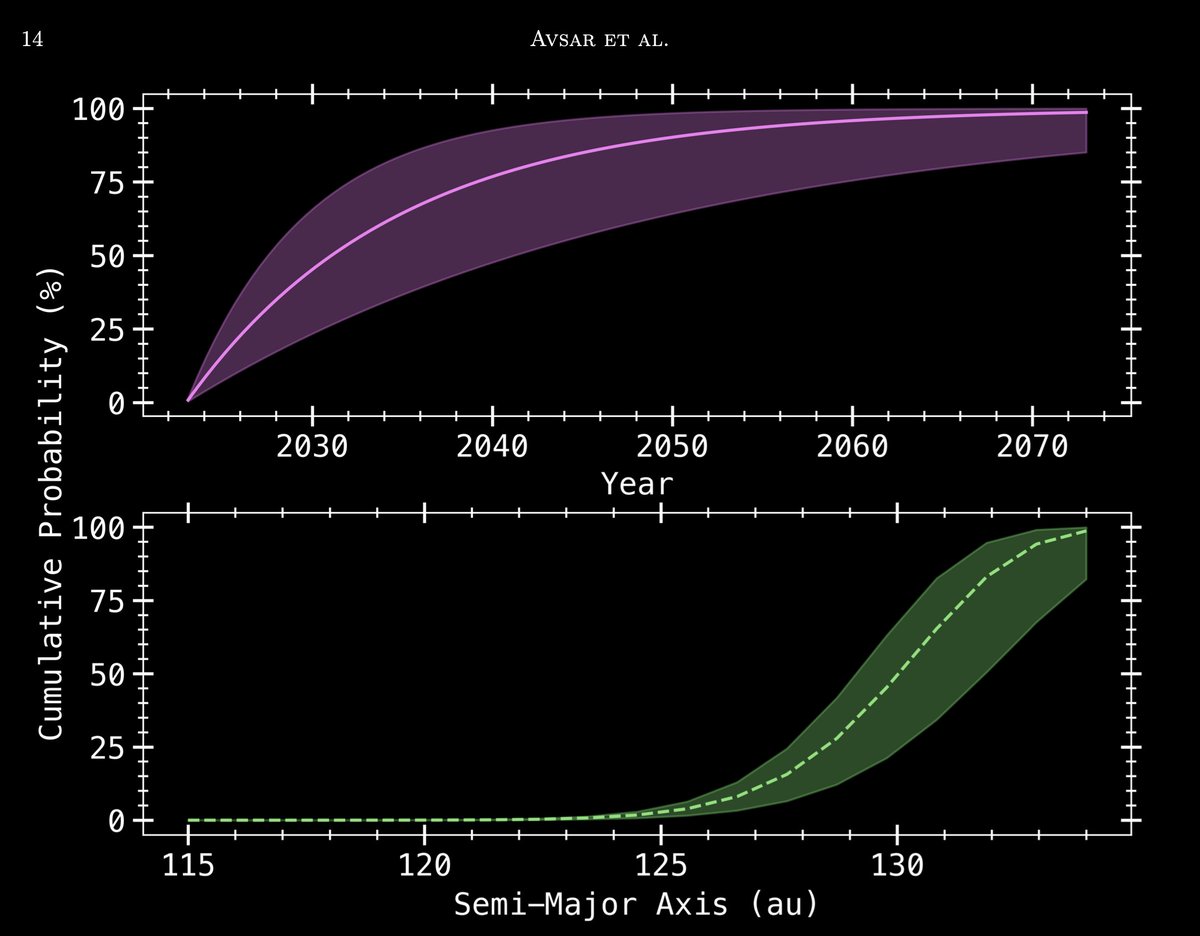
Highlighting a new paper from UA/LPL Grad Student Arin Avsar that places some of the first constraints on the population of planetesimals (~30-100km asteroids) around young stars! https://t.co/0NepEXTmir
This allows us to predict the next likely observed collision event in terms of time and separation from the star. With continued monitoring from HST, there's a ~50% chance of observing a third collision by the early 2030s. With JWST, those odds improve significantly.
Shout out to @e_douglas, @exoAS23b, @saturnaxis, and other co-authors for their help, ideas, and support in this study, and thanks to Pete Worden and @brkthroughprize for the motivation to explore this concept.
Please reply in the comments if you have any thoughts/questions.
Alpha Centauri A might host a habitable-zone giant planet. If confirmed, any moons orbiting this planet could be among the most promising nearby locations to search for life. Can we detect those moons by carefully monitoring the position of the planet?
https://t.co/5f5isLUF02
With access to space becoming cheaper, purpose-built observatories are becoming more feasible. For the same budget (or less) than @JimCameron's Avatar movies, which imagined a habited moon around a giant planet around Alpha Cen, this mission could become a reality.
I'm happy to share this exciting result that @StewardAstro PhD student @ggdoubleu played a major role in! WISPIT-2b is one of the few known accreting protoplanets, allowing us to directly study how planets form. Read more in the paper from Close et al.: https://t.co/cowgRXwAxs
@MarioNawfal That orbit fit showed that there's a ~52% probability that the planet (if real) had orbited too close to the star (from our perspective) to be detectable by JWST.
@MarioNawfal There's also a possible earlier sighting of the same planet in 2019. Not quite confirmation, but two detections are stronger than one! This is also how we figured out that it's likely "just hiding" - two detections allowed us to fit an orbit.
@AstroThayne The VLT detection is definitely not a speckle. We had over a dozen nights of data and saw it in every one. Unknown systematic is the only explanation if it’s not a planet.
Here’s the VLT campaign split into two independent datasets in two different ways.