🚨 Paper Day! 🥳
https://t.co/ME7uoRc309
✅New brown dwarfs, spectra, and parallaxes
✅Luminosities, masses, radii, temperatures, and gravities for 1000+ ultracool dwarfs
✅Polynomial relations (see Tables 5 and A1 👀)
✅Comparison to BT-Settl and ATMO 2020 atmospheric models
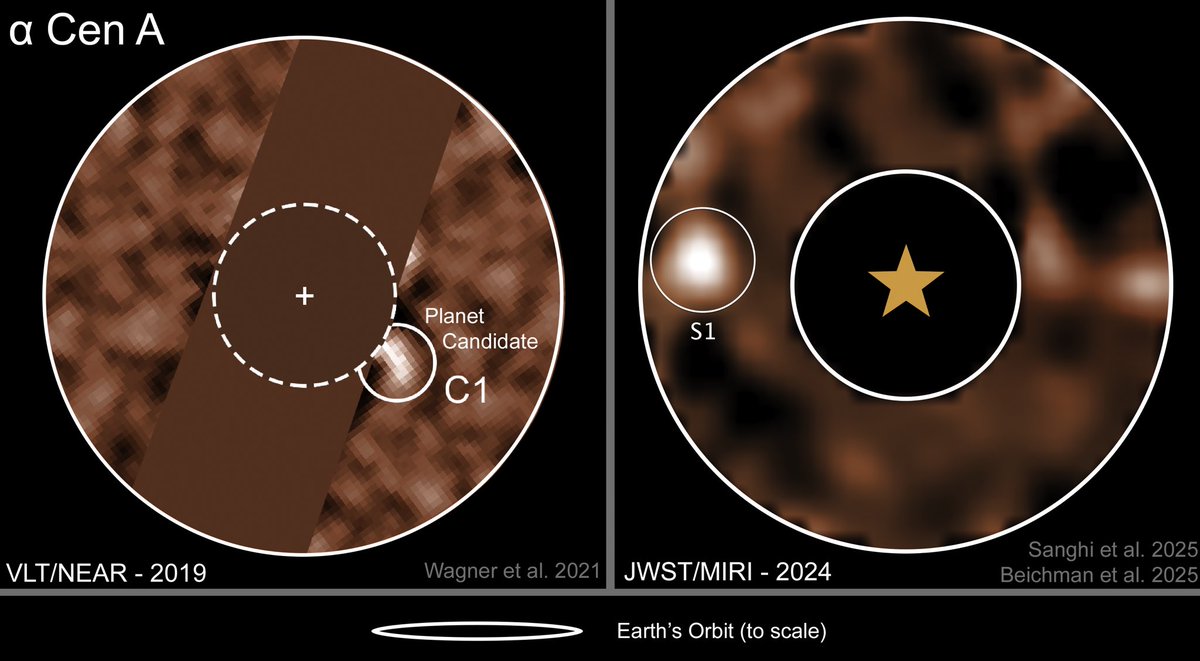
Alpha Centauri A is the closest star comparable to our Sun. Finding a planet there is a great achievement made possible by the James Webb telescope, the #MIRI instrument and its coronagraph. Many thanks to Chas Beichman, Aniket Sanghi @exoAS23b and the whole team !
Astronomers have used NASA's James Webb Space Telescope to find strong evidence for a planet orbiting a star in the triple system closest to our own Sun.
https://t.co/8DzQRghRbB
The biggest astronomy story of the day is the announcement of a giant exoplanet candidate near the habitable zone of Alpha Centauri A. Was only detected in 1 of 3 JWST observations though.
https://t.co/17emC0DyMi
While not yet confirmation, the fact that JWST sees a planet candidate in Alpha Centauri consistent with the one we identified in 2019 with VLT is extremely encouraging!
Well done @exoAS23b, Chas, and team - this was a very fun project to be a part of!
https://t.co/2YKUwMLJ2Z
Alpha Centauri A is the nearest Sun-like star. In the Avatar movie, it hosts a giant planet orbiting in its habitable zone. New JWST results suggest that it may be the case in real life too…
https://t.co/zgY3CqBxU8
#JWST#Exoplanets#AlphaCentauri#Avatar#Pandora
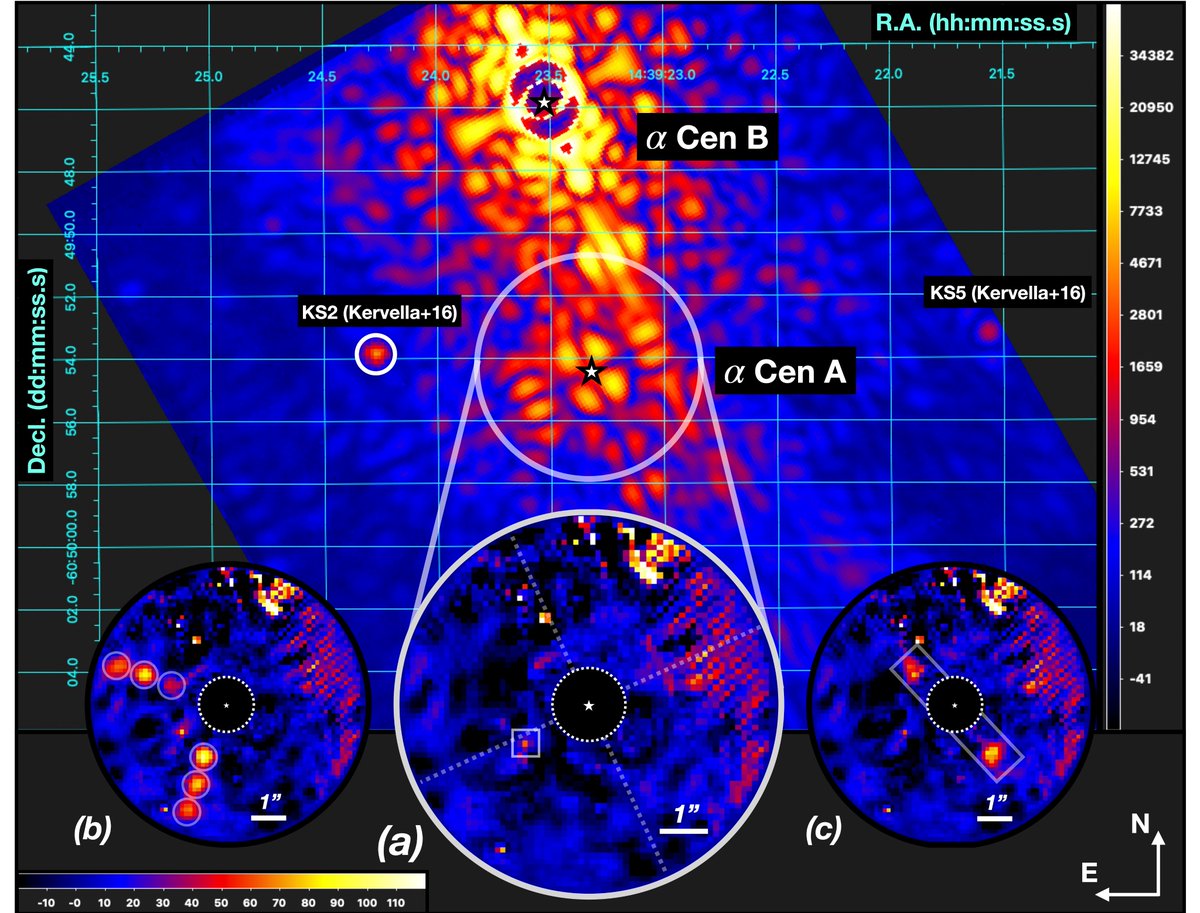
The figure above shows that while we did not detect any significant sources, we can place good upper limits on the presence of cold planets and exozodiacal emission around our nearest neighbor.
This must have been the craziest 1 month of grad school so far!
✅Passed Caltech Astro’s 1st year qualifying exam
✅Designed and observed 2.5 nights for my first PI program with the CHARA interferometer
✅Submitted Keck 2025A proposal
✅Led a JWST Cycle 4 proposal
I experiment with using a large PSF library to improve the performance of Reference Star Differential Imaging with Keck/NIRC2!
I have provided raw images, PSF-subtracted images, and contrast curves for ~4 years worth of survey observations on Zenodo.
https://t.co/5D6475xnoa
Exciting news: The UltracoolSheet v2.0.0 is live! Explore photometry, astrometry, spectroscopy, and multiplicity data for all your favorite LTY planetary-mass objects and brown dwarfs. https://t.co/0vlOcW4gMg
🚨 Paper Day! 🥳
https://t.co/ME7uoRc309
✅New brown dwarfs, spectra, and parallaxes
✅Luminosities, masses, radii, temperatures, and gravities for 1000+ ultracool dwarfs
✅Polynomial relations (see Tables 5 and A1 👀)
✅Comparison to BT-Settl and ATMO 2020 atmospheric models
🚨 Paper Day! 🥳
https://t.co/ME7uoRc309
✅New brown dwarfs, spectra, and parallaxes
✅Luminosities, masses, radii, temperatures, and gravities for 1000+ ultracool dwarfs
✅Polynomial relations (see Tables 5 and A1 👀)
✅Comparison to BT-Settl and ATMO 2020 atmospheric models
The synthetic photometry is publicly available at https://t.co/gXtyHpn9T5. This can be used to construct color-color plots which are helpful in distinguishing brown dwarf interlopers from high-redshift galaxies.
➡️Are you studying Brown Dwarfs with JWST but missing a parallax measurement?🪐
➡️Do you want to separate High-Redshift Galaxies from Brown Dwarf Interlopers?🔭
I have a new Research Note for you! 👇🥳
https://t.co/aGuPSBX33S
We synthesized JWST NIRCam photometry in several narrow, medium, and wide bands using NASA/IRTF SpeX prism spectra to derive absolute magnitude vs spectral type empirical polynomial relations. These can be used to obtain photometric distance estimates for ultracool dwarfs!