In this machine I can scan 1000s pages a day and never destroy a book.
No guillotine spines, no ripped the bindings..
just a normal book ready to be treasured for centuries.
Any large AI company can afford this both financially and ethically.
I’m a techno-optimist. The answer to mass surveillance is not to fear tech, but to use better tech. We already have powerful privacy tools at our fingertips. We are not helpless. We can take back our privacy and reclaim control.
🚨⚡️ A criminal mastermind in Italy… a hidden wall and 31 printers producing millions in fake euros across Europe! 🇮🇹💶
Italian police dismantled the most dangerous counterfeiting operation in the history of Naples, where a single man managed an industrial production line hidden behind a secret electronically operated wall inside his garage.
He printed €11 million in €20, €50, and €100 notes, distributing €8 million across 10 European countries (mainly France).
The European Central Bank confirmed the counterfeits were extremely high quality, with holograms and security features appearing completely authentic.
Authorities seized 31 digital printing machines running nonstop, along with €3 million ready for shipment.
The criminal alone was responsible for 27% of all counterfeit euros in Europe—Naples once again proves to be a capital of “criminal artistry.”
A Zimbabwean merchant using crutches walked normally at the 139th Canton Fair -- thanks to a wearable exoskeleton. He bought it on the spot and now aims to bring the technology to Africa. Innovation meets opportunity. #CantonFair#exoskeleton#robotics
MOST PARASITE ADVICE IS WRONG
HERE'S THE TRUTH
1. Garlic doesn't "k!ll parasites" - it makes your gut too hostile for them to stay.
2. Pumpkin seeds don't remove parasites they paralyze them so your body expels them.
3. Papaya seeds don't "break parasites" - they disrupt their survival enzymes.
4. Coconut doesn't cleanse - it attacks parasite fat membranes.
5. Cloves aren't for parasites - they're for destroying their eggs (the real problem).
6. Oregano doesn't k!ll everything - it wipes both good & bad bacteria if overused.
7. Ginger isn't anti-parasite - it fixes the sluggish digestion parasites thrive in.
8. Turmeric doesn't k!ll parasites - it reduces inflammation they hide behind.
9. Pineapple doesn't "cleanse" - it digests proteins, including parasite coatings.
10. Fermented foods don't k!ll parasites - they outcompete them for survival.
✨🙌🏽💫
This is the moment NVIDIA should be seriously worried.
In the next couple of weeks DeepSeek V4 will be launched. It’s a direct attack on the entire AI stack that American companies have spent years locking down. Full “de-NVIDIA-ization”, a complete shift away from CUDA into Huawei’s CANN ecosystem, running on Huawei Ascend chips. That means one thing, breaking the dependency that made NVIDIA untouchable.
35x faster inference vs early versions. Nearly 3x the performance of NVIDIA’s H20 on a single card. 40% less energy consumption. Over 95% CUDA compatibility with migration times collapsing from months to hours.
Even Jensen Huang has already admitted it. If this works at scale, it’s a “terrifying outcome” for US companies.
Because here’s the real problem, this isn’t happening in isolation.
Chinese tech giants like Alibaba, ByteDance, and Tencent are already ordering hundreds of thousands of Ascend chips. Market share is shifting fast, domestic chips now at 41%, NVIDIA slipping to 55% in China’s AI server market.
Additionally DeepSeek V4 is reportedly offering API costs at a fraction of US competitors. $300 for massive workloads that would cost $2,500+ on OpenAI models, or even $5,000 on Anthropic.
So this isn’t just about one model. It’s about China building a fully independent AI stack, chips, frameworks, models, and applications. Completely outside of US control.
NVIDIA doesn’t just lose sales. It loses its grip on the global AI standard.
He’s not holding back one bit. Calling the Netherlands modern day Sodom & Gomorrah. The level of depravity he’s exposing is insane. If Dems get midterms, THIS is what we'll be seeing too! 😬
So Israel is…
- Creating a mini state in Argentina
- Buying 40 Greek islands
- Establishing New Jerusalem in Ukraine
- Already running independent Oblast in Russia
- Annexing Gaza, West Bank, and S. Lebanon
While simultaneously passing “Antisemitism” laws and establishing armed private security forces inside every western nation.
🚨 Africa is a $3.32 trillion economy in 2026
Yet it holds the resources that could make it $10 trillion if it controlled what's underneath it👇
The biggest economies:
🇿🇦 South Africa $444B
🇪🇬 Egypt $400B
🇳🇬 Nigeria $334B
🇩🇿 Algeria $285B
🇲🇦 Morocco $196B
Now look at what those numbers hide:
🇨🇩 DR Congo $88B GDP
Sits on $24 trillion in mineral wealth.
Cobalt. Copper. Coltan.
Every EV. Every phone. Every weapon.
Runs through here.
🇳🇬 Nigeria $334B GDP
2nd largest oil reserves in Africa.
Still imports refined fuel.
🇩🇿 Algeria $285B
Africa's largest gas exporter.
Europe's new lifeline after Russia.
Here's the brutal truth:
📌 3 countries control 35% of Africa's entire GDP
📌 The richest nations in resources have the poorest GDPs
📌 The wealth leaves. The poverty stays.
Africa doesn't have an economic problem.
It has a value capture problem
💡 Subscribe to my newsletter for weekly breakdowns on commodities & geopolitics ☑️Link in my bio
Yesterday I did a thread on Argentina's regional personalities
A few Brazilians showed up in the comments like "you should do Brazil, we're WAY more diverse"
Fine. Challenge accepted
Let's talk about how Brazil is basically a mini world in and of itself 🇧🇷🧵
let me explain the ramifications of this…
→ 150,000 people just got locked out of their own cars… across 46 states… for 6 days straight and counting
→ not a software bug. not a glitch. not AI permissions gone wrong.
→ hackers flooded Intoxalock’s servers and all these vehicles just stopped starting…
→ these are court ordered breathalyzer devices… people who messed up in the past but have been doing everything right since (hopefully)… and now they can’t drive to work because someone else’s security system failed
wild
connect the dots…
your electric car talks to a server to start. one breach and it’s a 50,000 dollar paperweight
your insulin pump syncs to a server. your pacemaker data lives on a server. one breach and it’s not a car that stops working… it’s a body
your smart home lock runs through a server. one breach and your front door either won’t open or won’t close
now zoom out…
Gartner projects $2.5 trillion going into AI this year… only $240 billion into securing the systems it runs on.
that’s a 10 to 1 bet that nothing goes wrong
the four biggest tech companies (Alphabet, Microsoft, Meta, and Amazon) are rumored to spend $700 billion on AI infrastructure this year alone…
while cybercrime is projected to cost the world $10.5 trillion
now imagine this happens to Tesla. to a hospital network. to the power grid…
every new AI integration is a new attack surface. every API is a new door. every device that “talks to the cloud” is one more thing that can be turned off by someone you’ll never meet
and I’m not saying every one of these systems will experience something
who really knows what’s secure or isn’t
but if you’re building right now…
security isn’t the last layer you add.
it’s the first one.
→ 150,000 people have just found out what happens when nobody prioritizes that…
archaic government systems and legacy businesses are likely first on the chopping block
I hope the rest of us continuously learn from it instead of living it
the weakest link in every system is the one nobody bothered to secure
like what wild system vulnerability will we see next? does someone hack Area 51?
Kenya, Ethiopia, Nigeria Early African Winners as They Harvest Windfall from the Misery of US–Israel vs Iran War
As the world reels from the escalation of the US–Israel vs Iran war that erupted on 28 February, the humanitarian suffering is profound. Yet in the realm of global commerce, a quieter upheaval is underway. With the Red Sea and Strait of Hormuz rendered near impassable – shipping traffic down by 90% – Africa has emerged as the world’s most vital logistics corridor.
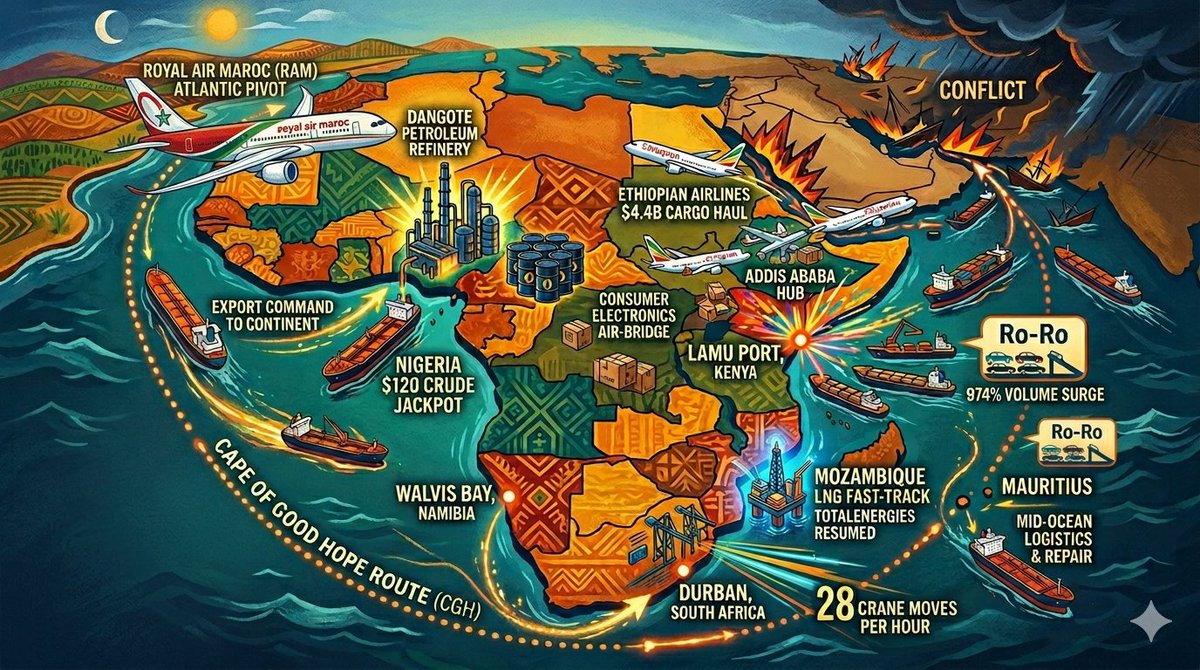
•In KENYA, the once-forgotten LAMU PORT has roared to life. Long dismissed by critics as a white elephant, it has seen a 974% surge in volume. Ultra-large vessels, too deep for Mombasa and too exposed for Gulf waters, now dock at Lamu’s 18-metre natural depth.
•ETHIOPIA'S national carrier Ethiopian Airlines has seized the moment. With Dubai and Doha mostly paralysed by airspace risks from Iranian missile and droke strikes, Addis Ababa has become the continent’s primary air-bridge. Cargo revenue is up 14%. High-value goods – electronics, pharmaceuticals, perishables –are now routed through Bole International, bypassing the 40-day sea detour.
•NIGERIA is counting its crude. Brent prices hit $120 per barrel in March. Against a budget benchmark of $64.85, daily revenues have doubled. The government has stumbled into an unexpected multi-billion dollar fiscal cushion.
•DURBAN, South Africa’s main port, has shed its reputation for congestion. It is now clocking 28 crane moves per hour, processing thousands of ships rerouted around the Cape of Good Hope with a rare level of precision.
•MOROCCO'S Royal Air Maroc has moved swiftly. Ten new international routes –including Los Angeles and Beirut – have siphoned off transit passengers who once relied on Middle Eastern hubs. Casablanca traffic is up 12%.
•WALVIS BAY in Namibia has become the first reliable refuelling station for ships emerging from the South Atlantic. Bunkering demand is up 30%.
•The DANGOTE Petroleum Refinery has in Nigeria, is cashing in. In March, it issued an export tender for 84,000 metric tonnes of jet fuel and diesel. It is no longer just a domestic project – it is replacing Persian Gulf supplies for the continent.
•MOZAMBIQUE'S $20 billion LNG project has been fast-tracked. TotalEnergies resumed operations in early 2026. Over 4,000 workers are racing to meet an accelerated production date. Iranian gas is out. Mozambican gas is in.
•At Mozambique's PORT of MAPUTO, volumes grew by 16% in the weeks following the war’s outbreak. Chrome and coal exporters have abandoned northern routes in favour of the safer Indian Ocean–Cape corridor.
•MAURITIUS, ever shrewd, has leveraged its mid-ocean position into a 15% revenue increase. High-end logistics and emergency repair services are now its bread and butter.
But no doubt, the most intriguing twist is the Roll-on/Roll-off (RoRo) revolution in Lamu. Manufacturers are using RoRo ships – where vehicles are driven on and off via ramps – to offload thousands of cars. These are then ferried to the Gulf on small, low-risk boats to avoid the $200,000+ war risk insurance premiums slapped on large carriers entering the Strait of Hormuz.
To protect this windfall, Kenya and Ethiopia have launched joint military operations along the once-languishing Lamu Port–South Sudan–Ethiopia Transport (LAPSSET) corridor. This unprecedented coordination is designed to ensure that the new “safe harbour” of Lamu remains shielded from regional spillover.
And because the closure of the Strait of Hormuz marooned shipping containers, an emergency air-bridge has formed. Nairobi and Addis Ababa are now the primary transit points for consumer electronics flown from Asia to Europe—bypassing the the 17,700KM sea detour.
US leader Donald Trump despises Africa, once labelling its countries "sh*thole", but while many of them will be hit hard by rising energy and fertilisers from America and Israel's attack on Iran, several of them will get a bounty he would never have wished for them.
On March 12, India formally asked China for emergency urea to keep its fertilizer plants running.
On March 16, China halted NPK fertilizer blend exports and extended its phosphate suspension through August.
Read that sequence again. The world’s most populous nation asked the world’s largest fertilizer producer for help. The response was a lockdown.
This is the second trap.
The first trap is Hormuz. One-third of global seaborne fertilizer trade physically blocked. Transit collapsed 97 percent. Gulf urea, ammonia, and sulfur stranded behind mines, drones, and an insurance market that has fractured beyond repair.
The second trap is China. Beijing looked at the Hormuz crisis, calculated that Gulf sulfur (over half of China’s imports) would not arrive, and made the rational decision to protect 1.4 billion of its own people first. Strategic sulfur reserves activated. Commercial nitrogen and phosphate stocks released early. NPK blends locked down for export. Phosphate banned through August. The 725 million tonne grain target in the 15th Five-Year Plan does not bend for India’s Kharif season.
Nobody should be surprised. This is exactly what China did in 2022 when the Ukraine shock hit. It is what China will always do. And it is what every government with the capacity to hoard will do when the molecules run short. The crisis does not produce global solidarity. It produces national triage. And in national triage, the countries with domestic production and strategic reserves survive. The countries that depend on imports from those countries do not.
India has 17.7 million tonnes of fertilizer stockpiled, up 36.5 percent year-over-year. That is a buffer, not a solution. Plants are running at 60 percent capacity. The subsidy bill has been revised to 1.86 lakh crore rupees, over 40 percent of the entire subsidy budget, with urea sold at 242 rupees per bag against international prices many times higher. If Skymet’s 60% probability of below-normal monsoon materializes during Kharif, India faces a food production challenge of a severity not seen since the crisis that prompted the Green Revolution.
Bangladesh has shut 4 to 5 of six urea factories. Boro rice season is underway with no domestic nitrogen. Pakistan’s debt service consumes 81 percent of tax revenue. Egypt feeds 69 million on bread subsidies at prices it never budgeted while owing $28 billion in external debt. Southeast Asia faces granular urea above $700 per tonne. Sri Lanka, the country that already proved what happens when fertilizer vanishes, faces 15 to 30 percent yield risk from the same import dependence that collapsed its rice output 40% in 2021.
Now map the sulfur cascade that almost nobody is tracking.
Roughly half of global seaborne sulfur trade is Gulf-sourced. Sulfuric acid is the chemical required to convert raw phosphate rock into plant-available fertilizer. Without Gulf sulfur, phosphate processing breaks globally. Morocco’s OCP, the world’s largest phosphate exporter, imports roughly 3.7 million tonnes of Gulf sulfur annually. China imports over 4 million tonnes. The sulfur shortage does not just constrain nitrogen supply. It simultaneously fractures the phosphate chain, creating the first simultaneous disruption of all three primary crop nutrients since the Haber-Bosch process was industrialized.
Two forces are now converging on the global food system from opposite directions. Iran blocks the molecules physically. China blocks them administratively. Neither is acting irrationally. Both are executing national survival logic. And the countries caught between them, the ones with no domestic production, no strategic reserves, and no fiscal capacity to compete on the spot market, absorb the full force of both.
318 mn people were at crisis-level hunger before either trap snapped shut.
The math does not require malice to produce catastrophe. It only requires geography, chemistry, and a planting calendar that waits for nobody.
https://t.co/iFmUcarGdV
Swiss Sovereignty vs. Brussels: Reject the Globalist Power Grab in the June 14 Vote
What if the real problem isn't the "No 10 Million Switzerland" initiative, but the systematic effort by Brussels and its local allies to dismantle Swiss self-determination?
Behind the smokescreen of "partnership," a coordinated assault on Swiss sovereignty is underway >>one that seeks to bind our nation to EU dictates while Swiss elites, seduced by globalist networks, facilitate the takeover.
The evidence is unmistakable. The EU's "colonial submission treaty" would force Switzerland to automatically adopt EU law, with Swiss courts sidelined and Brussels bureaucrats>>not Swiss citizens calling the shots. When private equity billionaires and corporate executives jet to Washington bearing gold bars to cut backroom deals, they demonstrate exactly who these globalists serve: not the Swiss people, but their own transnational interests. The same elites who mock concerns about 10 million now push a deal requiring Swiss payments to EU cohesion funds while importing foreign judges.
The Davos class, with its EU Commissioner Ursula von der Leyen and its contempt for national borders, views Swiss democracy as an inconvenience to be managed, not a right to be respected.
They preach openness >> while demanding Switzerland surrender its unique direct democracy to unelected European Commission officials.
When our government pleads "strategic necessity" for subordination, it parrots globalist talking points >> not Swiss interests.
This June 14, the choice is clear: either we remain a self-governing people who decide our own demographic future >> or we become a passive appendage of the EU project.
Vote YES on "No 10 Million Switzerland" >> for our sovereignty, against the globalist elites who would trade it away.