🚨New from NTU and @TheBuckeyeInst's @aswinp7
Ohio’s Blueprint: How Market-Oriented Energy Reform Can Help States Win the AI Race
https://t.co/b6m90b3pem
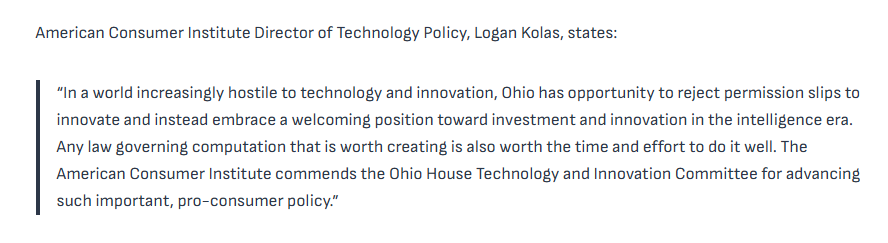
New from me at @NTU: Ohio's HB15 is a blueprint for states racing to power AI data centers, covering permitting shot clocks, behind-the-meter generation rights, and undoing past subsidy mistakes.
Again all draws.
They have to shorten the time controls and make the game more interesting for the general public.
Also terrible broadcasts with too many breaks. No excitement or stories behind the players. Football should learn from chess.
A lot of economists should understand the incentives that explain top academics becoming left-wing slopulists.
It's the best way to sell millions of books, get feted across the globe at conferences/UN etc, and get widespread coverage from the progressive mainstream media.
Fully agree with @pat_hedger here. Investment in skilled trades is going to be vital in the next decade, and this investment from @Meta is a prime example of what companies can do to help, and exactly what I wrote about in my policy brief with @Libertas. https://t.co/0AIG0UXGSC
"The United States Must Reject Government Control of Artificial Intelligence"
a new @RSI essay outlining the 4 dangers of government attempts to nationalize AI firms. 👉
I really loved this article. A one-time increase in per capita growth from 2% to 2.1% for a single year, then dropping back to 2%, would permanently raises the level of GDP per capita - and because that small gain recurs and compounds every year afterward across the population, it would add up to roughly a trillion dollars in cumulative value. https://t.co/aaUHcLslRd
When people talk about pausing AI development, I can't help but think about the enormous cumulative value that would get lost over time, the higher rates of absolute poverty that would persist across the world, and the needless deaths from delayed medical advances. There may be worlds where some version of this is something to consider, but the evidentiary bar for delaying technological development should obviously be pretty high.
Our internal data shows Claude is accelerating AI development—a possible path to recursive self-improvement, or AI autonomously building a more capable successor.
It’s happening faster than we thought, and the implications deserve greater attention. https://t.co/OVVPJO7VQx
Economics of AGI episode w Alex Imas and Phil Trammell.
There's a bunch of important questions about how we deal with AI that only economics can answer.
What is the optimal way to tax and redistribute the wealth that will be generated? How should countries not in the AI supply chain index into the gains? Is there any world where inequality doesn't explode?
It might seem like these questions have obvious answers, but the first thing economics teaches you is that your intuitions can often be entirely wrong.
It was very helpful to chat through these things with Alex and Phil.
Look up Dwarkesh Podcast on Apple Podcasts, YouTube, or Spotify. Enjoy!
00:00:00 – Will capital share increase?
00:19:36 – Messy Middle scenario
00:25:57 – How to tax and redistribute AI wealth
00:30:02 – Why demand collapse is unlikely
00:39:26 – Human employees would be hard to integrate into the machine economy
00:43:08 – What if some humans (or AIs) value wealth accumulation intrinsically?
01:01:28 – What should developing countries do?
A "compute tax" fails on basically all the basics of optimal taxation.
- Don't tax capital
- Don't tax intermediate goods
- Don't tax easily manipulable things
- Don't tax small tax bases
Overall, a dumb idea.
https://t.co/v3lNfI8anq
I'm honestly embarrassed by my work from a year ago, now. I wonder if I will feel the same way about my work now in a year. I suspect, no -- I am happy with what I write now. I have finally achieved the level of quality I aspired to achieve, long ago.