US Oil Refiners Running at Max Capacity
Nationwide, refiners have been running at or above the 95% utilization rate that’s widely regarded as full capacity for almost two months, government figures showed. In at least one region, the Rocky Mountains, fuelmakers have surpassed the 100% mark twice in the past few weeks, a pace that even the refining industry’s main lobbying group warns is untenable.
Running near max capacity is “raising the likelihood that equipment failures tighten fuel supply and amplify price volatility,” Rapidan Energy analysts said.
Several major refiners already have postponed maintenance to keep capacity online. Motiva Enterprises LLC delayed a turnaround at the biggest crude unit at its Port Arthur refinery in Texas by a year to the fall of 2027.
Any major outage could have an outsized impact because domestic fuel stockpiles are unusually low. Inventories have been strained by robust demand for US diesel to replace production lost to the conflicts in Russia and the Persian Gulf, and a drop in gasoline imports to a 29-year seasonal low. (Bloomberg)
Diesel prices are surging.
- 93% YTD
- Up 65% since the war began
That's the highest level since the war began.
Diesel is the most important fuel for the global economy.
Brace for inflation
🚨 WARNING: MONDAY WILL BE THE WORST DAY OF 2026!!
Japan just hit the panic button.
They will dump OVER $6 TRILLION of foreign securities, mostly U.S. Treasuries, stocks, and ETFs.
If you hold any assets right now, you MUST be prepared for the biggest sell-off of the year:
The BOJ is moving capital back into Japan.
And the biggest carry trade in history is starting to unwind...
This is NOT normal.
Here's what's really happening:
For decades, Japan kept interest rates near zero.
That made the yen the cheapest funding currency in the world.
Investors borrowed trillions of yen.
And invested that money into U.S. Treasuries, stocks, real estate, crypto, and markets across the globe.
That trade is now breaking.
Japan is dealing with soaring debt.
A rapidly aging population.
Massive pension obligations.
And years of pressure from a weak yen.
Now policymakers want that capital to come home.
By any means necessary.
Finance Minister Satsuki Katayama said pension funds, including GPIF, the world's largest pension fund, should make substantially larger investments in Japanese assets instead of foreign ones.
GPIF alone manages around $1.8 trillion.
Hundreds of billions of dollars are now at the center of this shift.
Japanese investors have already sold tens of billions of dollars worth of U.S. Treasuries this year.
And the Bank of Japan's latest rate hike only gives investors another reason to keep money at home.
This is the Reverse Carry Trade.
And it's one of the biggest liquidity risks in the world.
Because when Japanese money comes home...
Someone else has to buy what Japan is selling.
More Treasuries hit the market.
Bond yields move higher.
Liquidity dries up.
And financial conditions tighten everywhere.
That's how market stress spreads.
Quietly at first.
Then all at once.
After decades of financing global markets...
Japan is starting to finance itself.
And that changes everything.
More volatility.
Less liquidity.
That's not a good combination.
Pay attention.
Most people won't realize why markets are collapsing until it's already happening.
I’ve studied markets for over a decade and called nearly every major top and bottom.
If you want to survive the 2026 cycle, follow and turn notifications on.
I warned you before.
And I'll warn you again soon.
A lot of people will wish they paid attention earlier.
El severo hundimiento del índice de oscilación del sur, es uno de los mejores indicadores de la fuerte intensidad de acoplamiento entre la atmósfera y el océano, necesarias, para la continuidad y madurez del evento #ElNiño.
Estos valores los hemos observado en 1983 y 1997. No los hemos visto en el 2015. Tampoco en el 2023.
El colapso del anticiclón enfrentado a un tren continuo de bajas presiones en latitudes más bajas, es consecuencia de la fuerte contracción del índice de oscilación del Sur.
I'm tired of seeing these misleading "global oil inventories" charts showing only 500 million barrels lost.
Do the math. Its closer to 1.5 billion barrels of missing production from the gulf countries. The other billion barrels was product drawdowns, invisible Chinese inventories, other not visible global stocks.
So China had a few hundred million barrels of petroleum inventories we didn't know about? Fine. The world had a larger buffer going into the conflict than we thought.
But everyone is conflating this lack of visible inventory drawdown as demand destruction. It is not. Crack spreads are telling you the drawdown of untracked product stocks is done. China pulling hard on invisible stocks was a cool party trick but is not an infinite one - its pretty hard to hide a few hundred more million barrels.
When these invisible stockpiles run out, everyone will be shocked at the resilience of demand and pace of VISIBLE inventory draws despite much higher prices.
When Hormuz is finally resolved and prices fall, people will be doubly shocked at what they perceive to be even stronger demand when it is really a restock of the billion barrels of invisible stockpiles.
🟦🟦🟦Why Refilling the Strategic Petroleum Reserve Is Not as Bullish for Oil as Many Believe
🔵🔵🔵Why China's Recovering Crude Imports Are Not a Strong Bullish Signal for the Oil Market
Listen: 👇👇👇
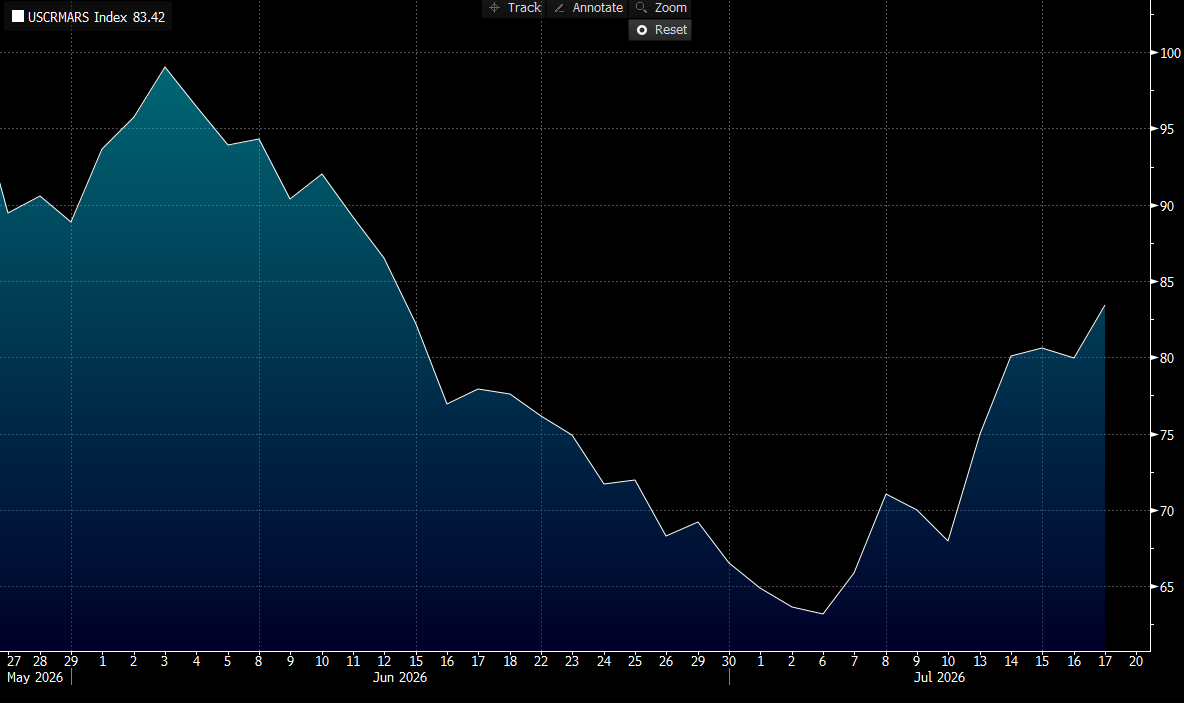
US Mars crude (preferred grade by Asia) prices back on the rise, after the MOU fell apart with Asian refiners scrambling for US cargos again
(Chart: Bloomberg)
Looks like I was right: Xi have the Americans one chance to make the MOU stick. They tapped their reserves. Now that Trump screwed it up they’re back in the market. We are staring down a major energy crisis - Western leaders are sleepwalking. Scary. 🇺🇸🇨🇳🛢️
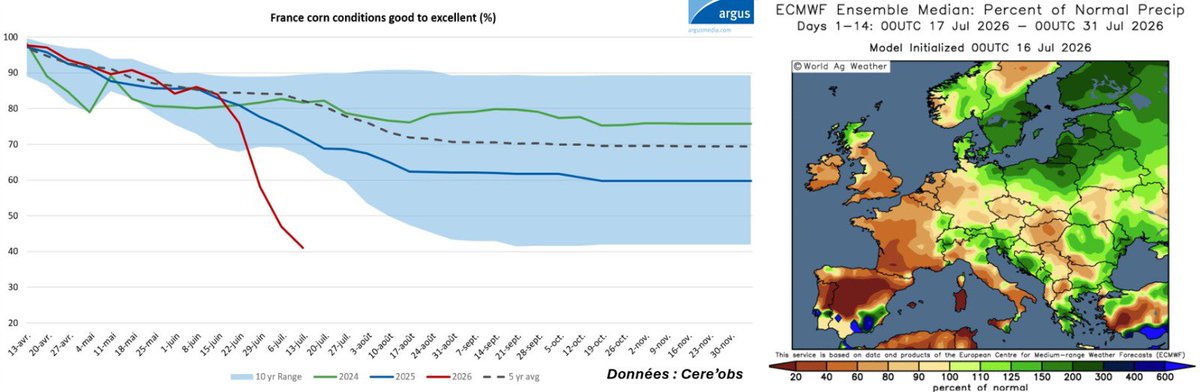
🇫🇷 French corn conditions deteriorated again last week, the crop now rated just 41% good/excellent.
That's down 43 pts in 4 weeks. For U.S. corn, only one 4wk period (June 1988) recorded a 43 pt drop.
Some analysts think France's corn crop could be the smallest in 50 years.
Diesel crack spreads are now higher than the price of crude itself.
- WTI: $80
-Diesel crack spread (refining margin): $86
Since the start of the war, diesel crack spreads have surged >4x.
🌾Big crops = big supplies? Maybe not.
Comfortable grain supplies can erode more quickly than expected, even when harvests are historically large.
My latest guest column for Reuters examines why global grain inventories could look different in 2026/27.
https://t.co/MeZRdeiRgX
China's car exports have almost doubled since Feb. '26. There's nothing organic or good about this. This is about heavy-handed industrial policy and chronic currency manipulation that keeps the Yuan undervalued. An economic assault on the entire world...
https://t.co/D5yGvHEnEm
🇧🇷 Conab increased Brazil's 2025/26 corn crop, now expected to exceed last year's levels. That was on a boost to second corn production.
Soybean production rose slightly, though ending stocks still sit below the month- and year-ago levels.
Global refinery runs have fallen 7 million barrels a day to multi year lows.
86.8 down to 79.3, in a matter of months.
The Middle East and Russia together hold 18% of global refining capacity.
Russia alone has 6.7 million barrels a day of capacity and is currently running only about 4.
This is not a regional story.
It is a 7 million barrel a day hole in the global system, concentrated in exactly the 2 regions under attack.
https://t.co/FnWkWuivTS
Stocks to Use vs Corn Prices 🌽
🟡 Yellow = stocks to use %
🟢 Green = front month corn highest price of the year
Last week the USDA dropped our new crop carryout down to 11% from 12%
I threw on our stocks to use for old crop and new crop from last month in red. With the updated stocks to use in yellow
Normally to get front month corn much above $5.00 you typically need to see the stocks to use at or below 10% (labeled bull on the chart)
New crop is not in a bull market territory or anything yet
But if yield or acres ultimately come in light, you could absolutely argue there is definitely potential for this to get tighter later this year and into next
Given that this 11% uses a 183 yield and 95.3 million acres
***
Try our daily grain market updates & alerts for free
👉 https://t.co/JvQ1KIqvNs
The feared drop in Russian oil production that sent oil to $130 in 2022 has finally materialized and oil is <$80. Never mind that ~10mmb/d has been offline in the Persian gulf for 4.5 months now.
Two 🔑factors have kept oil from exploding higher: SPRs and a Chinese buying strike. With the US SPR ~ 1 month away from minimum levels, we watch for an inevitable return of Chinese buying. Extreme tightness already seen in refined products...crude oil is next with Strait CLOSED.
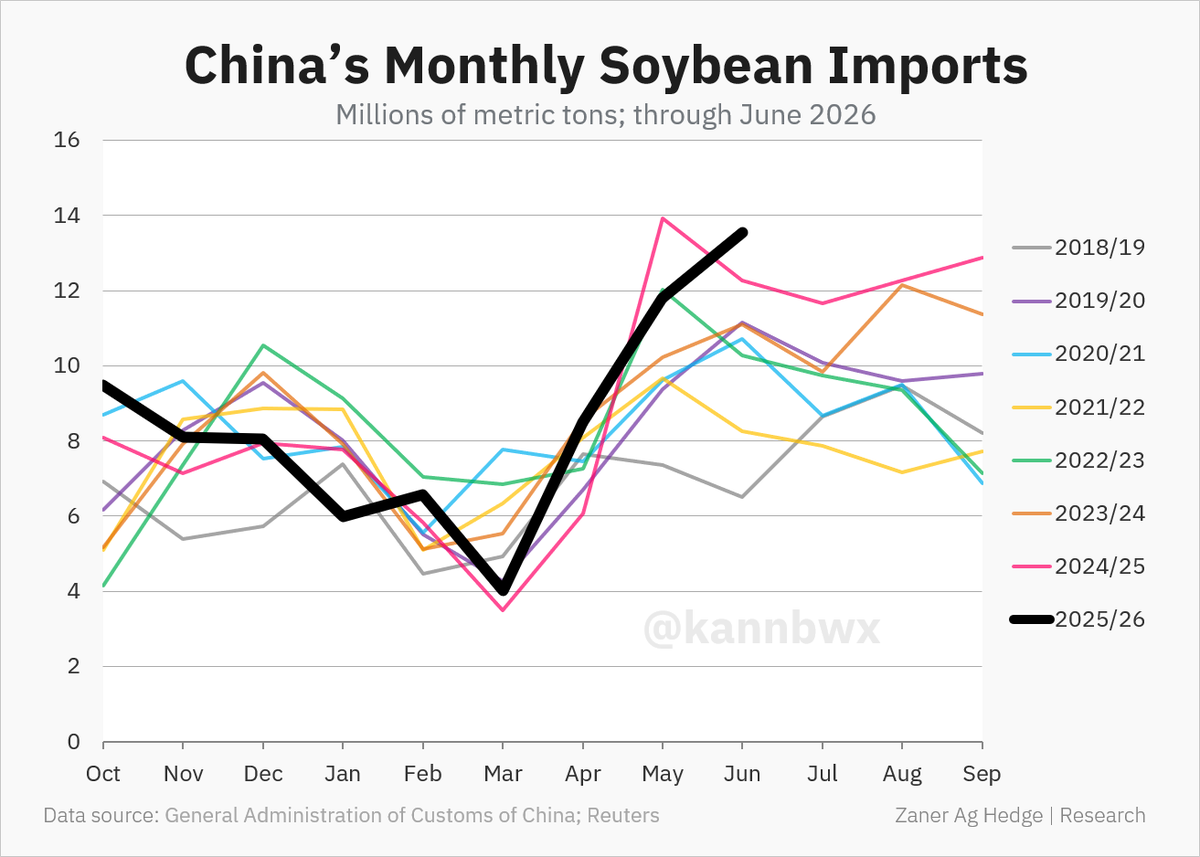
🇨🇳 China imported 13.55 million metric tons of soybeans in June, a monthly record and up nearly 11% from a year ago.
Through nine months of the 2025/26 marketing year, imports totaled a record 76 mmt, up 5% from the same period last year.
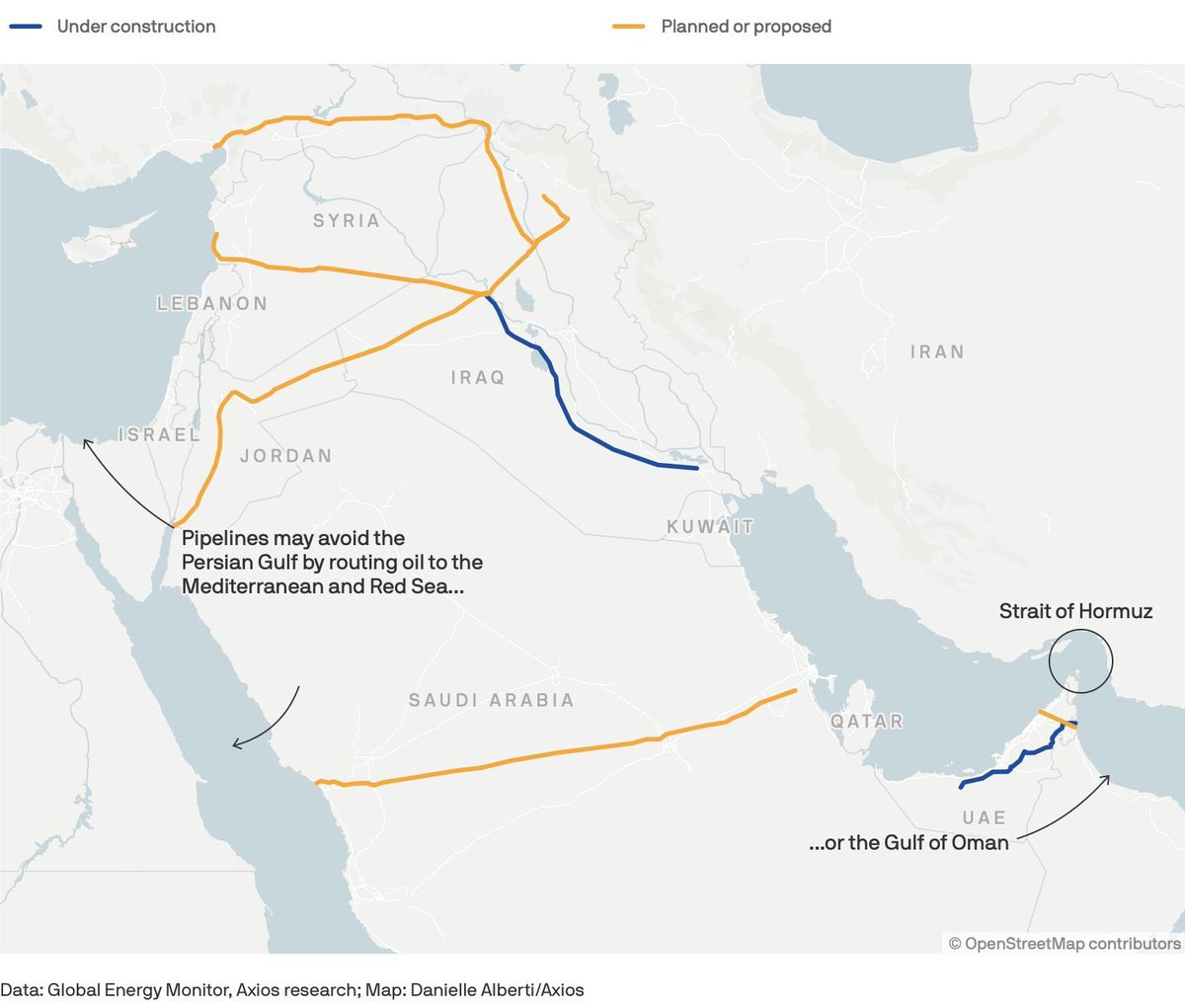
The world is not waiting to find out who controls Hormuz. It is building around it.
Goldman Sachs tracked 7 pipeline and export projects now under construction or planned across the Gulf.
1. By end of 2027, over 45% of pre-war Gulf exports could bypass Hormuz entirely.
2. By end of 2028, that rises past 60%.
3. Median Gulf pipeline construction time: 2.5 years, faster for disruption driven projects.
7 to 9 million barrels a day will still need Hormuz no matter what gets built. Qatar's LNG has no alternative route at all.
The era of Hormuz as irreplaceable is ending. It is not ending fast enough to matter this year.
source @MarioNawfal