Atoma Network has joined the NVIDIA Inception Program
🚀 Big news: Atoma Network is now part of the NVIDIA Inception Program that is dedicated to accelerating startups growth.
At Atoma, we use NVIDIAs GPUs to power our decentralized private AI inference network.
Through NVIDIA confidential computing on Atoma, you can run AI inference on any data and verify that all data is secure.
Our goal is to provide accessible, private, and cost efficient AI inference globally and being part of the NVIDIA inception program moves us a step forward to achieving this.
Want to know more? ���
Atoma-infer is our open-source Rust based AI infrastructure to serve LLMs efficiently.
We just crossed 100 stars 🚀. If you’re a developer interested in open-source AI infra, feel free to connect with us.
https://t.co/PxdSt3P7ip
@Jason We can solve that problem with Atoma securing all GenAI workloads. You can send encrypted prompts to OpenAI and it will only process with full confidentiality.
We're excited to partner with @SentientAGI to bring security and verifiability to AI workloads through Atoma's platform.
Look out for more updates from Atoma AI + Sentient GRID.
3/ Verifiable AI
GRID also integrates verifiable AI partners to address one of the most critical challenges in AI deployment: trust and transparency. Users need absolute certainty that models are executing as intended, outputs are authentic, and data remains secure throughout the entire pipeline. Our verifiable AI partnerships give users the peace of mind that comes with knowing their AI is actually doing what it's supposed to do, ensuring users can deploy AI with complete confidence:
@PhalaNetwork: Allows users of the GRID to run AI models inside Trusted Execution Environments (TEEs)—ensuring truly verifiable, zero-trust workloads.
@nillion: Provides cryptographic infrastructure for verifiable AI, ensuring models and their outputs can be proven, trusted, and privacy-preserving.
@lagrangedev: Verifiable AI inference, so users can be certain that an LLM’s output corresponds to the given input.
@LitProtocol: Decentralized key management network enabling programmable signing and encryption for agents
@Atoma_Network: An open-source AI network that offers security and privacy through confidential computing for AI workloads such as inference and fine-tuning.
Great to see an open model from @OpenAI that pushes the open-weight model ecosystem forward.
With AI models becoming freely available, it is critical to choose the right infrastructure partner.
At Atoma, we provide the most security and privacy for the users of GenAI models.
gpt-oss is a big deal; it is a state-of-the-art open-weights reasoning model, with strong real-world performance comparable to o4-mini, that you can run locally on your own computer (or phone with the smaller size). We believe this is the best and most usable open model in the world.
We're excited to make this model, the result of billions of dollars of research, available to the world to get AI into the hands of the most people possible. We believe far more good than bad will come from it; for example, gpt-oss-120b performs about as well as o3 on challenging health issues. We have worked hard to mitigate the most serious safety issues, especially around biosecurity. gpt-oss models perform comparably to our frontier models on internal safety benchmarks.
We believe in individual empowerment. Although we believe most people will want to use a convenient service like ChatGPT, people should be able to directly control and modify their own AI when they need to, and the privacy benefits are obvious.
As part of this, we are quite hopeful that this release will enable new kinds of research and the creation of new kinds of products. We expect a meaningful uptick in the rate of innovation in our field, and for many more people to do important work than were able to before.
OpenAI’s mission is to ensure AGI that benefits all of humanity. To that end, we are excited for the world to be building on an open AI stack created in the United States, based on democratic values, available for free to all and for wide benefit.
As the US pushes to lead in trusted AI, platforms like Atoma will be essential.
Infrastructure that ensures privacy, integrity, and freedom is not a luxury, it’s the foundation for a future where AI truly serves society.
The recently announced American AI Action Plan sets the right tone for the future of AI: secure, open, privacy-preserving, and aligned with free speech and objective truth.
This is exactly the future Atoma is building toward.
Atoma enables this future by combining:
– Confidential computing for private, verifiable AI
– Open infrastructure to support scientific and enterprise AI
– Decentralization to safeguard against centralized bias
Personal Superintelligence is coming soon and we now have a way to provide the security and privacy that will protect everyone's data.
Atoma is building the platform to provide the best security to GenAI companies and their end-users.
Open-source AI is democratizing intelligence at a rapid pace. However, running these models on a decentralized and private network will offer the biggest advantage and value prop.
Atoma runs Open-source AI powered by Confidential computing on a permissionless network for everyone to participate in.
Most builders don’t think about storage — until it breaks, gets censored, or costs a fortune.
That’s why decentralized storage matters.
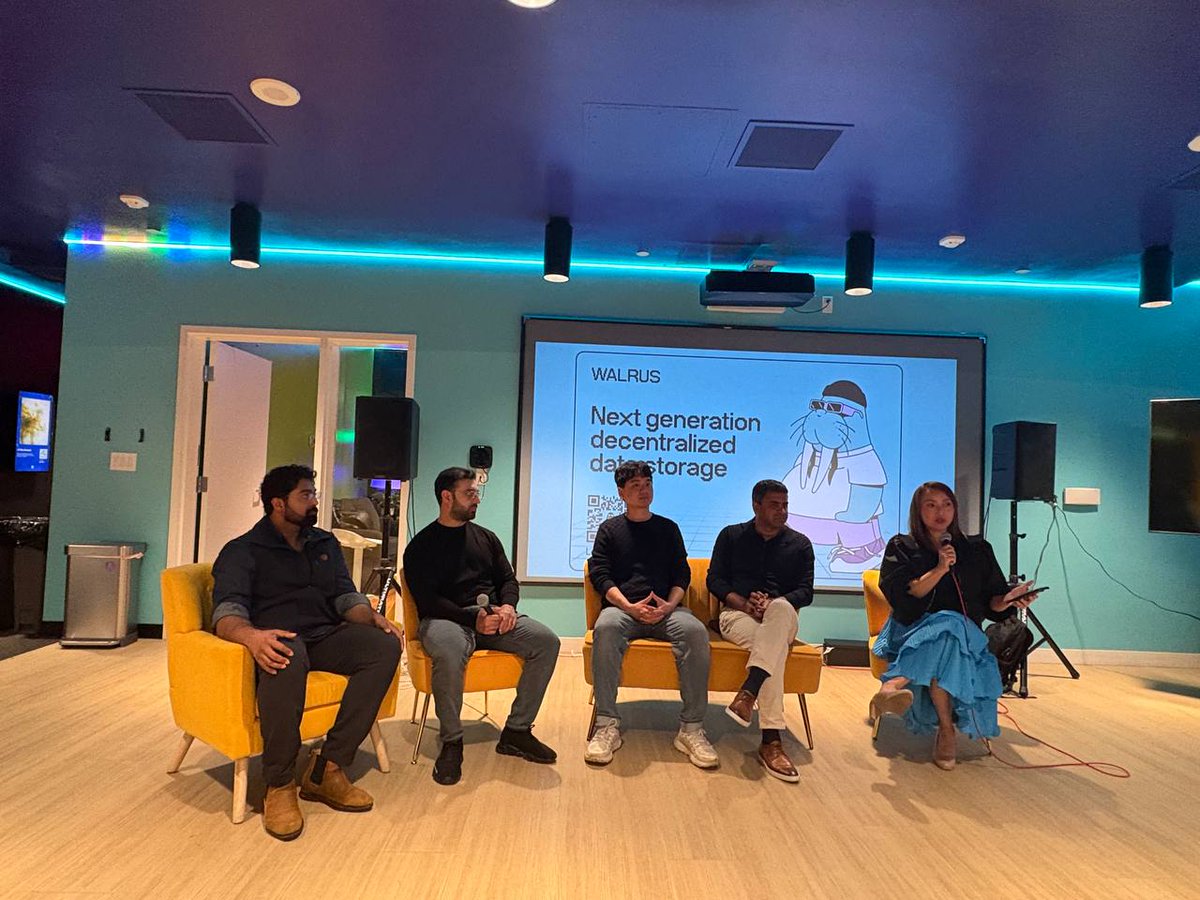
Watch this video to hear why @tuskytools, @plumenetwork, @atoma_network, and @talusnetwork chose Walrus for storage.
At Atoma we are building the infrastructure that will become the standard for global AI compute, that protects sovereignty of individuals and nations.
Open-source models have democratized AI but it is critical to run them on infrastructure that provides control, privacy and ease of use. Atoma combines the best properties of on-prem and cloud.
The future of AI must run on neutral, decentralized rails.
The last two @theallinpod episodes touched on some really important topics around AI. First of all, it was a big win for the US to secure the deals in the Middle East. They want to invest in the future of AI and it is obviously a better choice for them to do so with US companies rather than China.
Having @DavidSacks as the AI czar has already created a massive opportunity for AI companies. He talks about the details of the deal which are hugely in favor of the US:
- Matching investment provision: for every $ they spend on data centers buildout in the ME region, they must invest the same $ amount in the US AI infrastructure
- US ownership of the compute: 80% of the chips must be owned or operated by US cloud service providers
- G42 is building a 5GW data center and will invest the same $ in the US
The conversation then shifts to the device openai is working on and @Jason and @DavidSacks both call it a surveillance device which I totally agree with. Openai has been training on all sorts of data without respect for any boundaries and it is foolish to think they won’t be training on such rich context user data. If you go near Jason with one of these, get ready to be punched in the face.
So what’s the conclusion?
Atoma and other new AI clouds have the opportunity to benefit from such deals. Data protection against surveillance and loss of ip is important for companies today and in the very near future, AI will become a national security threat if the citizens of any given country are sharing all of their data with a very small number of powerful companies. By building an open source cloud secured with confidential computing, Atoma offers a novel solution that will allow everyone to benefit from AI without being compromised and leaking their data.
At @Atoma_Network , we are building the infrastructure that will become the standard for global AI compute, that protects sovereignty of individuals and nations.