Seeking advice on a career / grad school decision.
Background: I’m a CS undergraduate from China. I applied to CS/ML PhD programs for Fall 2026, but did not receive a PhD offer. I currently have a co-first-author ICML paper and two industry internships.
My research interests are mainly in LLM reasoning and alignment, RL, optimization, test-time scaling methods, self-evolving methods, and agentic systems.
When I applied for PhD programs, my ICML paper was not finished yet, so it was not included in my application materials. After being rejected from the NYU PhD program, my application was automatically considered for the MS program, and I unexpectedly received an offer from NYU Tandon MSCS.
The difficult part is the cost. The total two-year cost would likely be around $110k, and I would need to finance almost all of it through loans.
This means the decision only seems financially reasonable if I can either:
1. find a job in the US after graduation, or
2. use the MS as a bridge to a PhD program.
If the loan repayment period is short, I may need to prioritize finding a job first to avoid serious debt pressure, even though my long-term interest is still research. And I hope to enhance my research capability to a greater extent to better cope with possible changes in the future.
The upside of accepting the offer is that NYU could give me access to the US job market, possible on-site RA opportunities, in-person interaction with faculty, and maybe a better platform for applying to PhD programs or ML/SWE/Applied Scientist roles.
The risks are also obvious: high financial cost, visa uncertainty, and the possibility that I may not be able to convert the MS into either a good US job or a PhD opportunity.
I’d really appreciate advice from people who have gone through similar decisions. In particular:
1. How helpful is NYU Tandon MSCS for US job search and/or PhD applications?
2. Is taking a large loan for this program worth it?
Any honest thoughts or experiences would be appreciated.
I did my undergrad at RUC. It is a good school in China, but it is not THU/PKU-level in terms of international CS reputation, so I am not sure how much of a disadvantage that creates.
My main concern is indeed recommendation letters. My current letters are from supervisors in mainland China who supervised my previous papers. They can write strong letters, but I think that their letters may carry less weight than a strong letter from a US professor, especially for U.S. PhD admissions. That is one of the main reasons I am considering an MS program like NYU. But indeed, the financial cost of pursuing a master's degree is too high for me. It's not a sum of money that I can casually come up with
Thank you for your comment. It allows me to weigh this issue from more perspectives
Yeah, that makes a lot of sense. If I choose to do an MSCS at NYU, the main purpose would be to find RA opportunities, build connections, get stronger recommendation letters, and do some research to make a future PhD application more competitive.
If money were not a major constraint, that might still be a reasonable strategy. But if I have to finance it through loans, the repayment pressure could easily disrupt my later plans.
Thanks for the comment, it’s genuinely helpful.
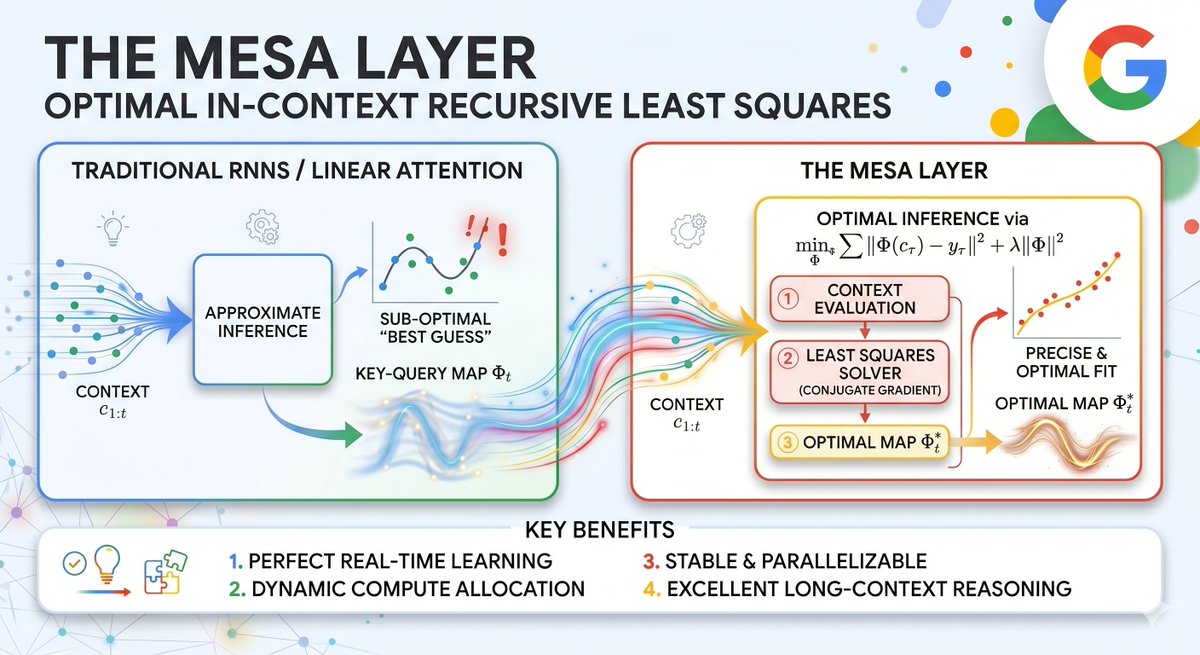
MesaNet is interesting because it reframes sequence representation as a solved local regression problem rather than a softmax attention lookup. That makes the architecture less a simple Transformer replacement and more an adaptive memory mechanism, where compute is spent to fit the state to the observed context.
Google presents a new Transformer alternative at #ICLR2026! Join Nino Scherrer & Yanick Schimpf at the Google booth (#411) at 10AM to learn about MesaNet, proposing a new linear sequence layer that optimally learns in-context given a fixed memory budget.
@OpenAI I’ve been waiting all day for the GPT-5.5 release, and it’s finally here.
As one of the most powerful models, I’m really looking forward to seeing how it performs in research and coding, as well as the overall user experience compared with GPT-5.4.
I am trying to make peace with the fact that I failed this year’s PhD application cycle. Only my own hesitation, exhaustion, fear, or whatever it was that kept me from finishing what I meant to do. I just let this application season pass, and now I am sitting with the weight of that. It is a strange kind of failure, grieving something that never fully took shape. I keep thinking maybe I should have pushed harder, been more disciplined, been less afraid, been better. And now the cycle is over, and I am left with this quiet, stupid ache of knowing I wanted something and still could not bring myself to reach for it in time.
Still, I think part of me knows this is not the end of the story, even if it feels like one. Missing this year does not erase the reasons I wanted a PhD in the first place. It does not mean I am incapable of doing serious work or that I was foolish to imagine a different future for myself. It just means I am here, and maybe the only thing to do now is be honest about that, without turning it into a final verdict on my life.
I can accept the result and admit that I was not fully prepared for this year’s PhD applications. I decided to apply too late, and in a competition that has become more intense each year, my record was not enough. I do not want to hide that behind excuses. I did put in a great deal of effort, and that is what makes the outcome harder to accept.
In the end, I received only one interview, from a famous university. For this round of applications, this university was undoubtedly my dream school, which made that interview especially important to me. That interview felt like a meaningful chance, but I could not turn it into the result I hoped for. In the end, I was considered on the waitlist, and was not the top candidate among those the professor interviewed.
When I received the news that the professor could not offer me a position, I was extremely disappointed. Even though I knew the possibility was small, I still could not stop myself from hoping. I was in Tokyo then, trying to release some of the pressure, and I had already told myself that I probably would not get an offer. But knowing something is likely and actually hearing it are still two different things.
I feel quite lost. I do not know what the next step should be. I am not sure whether it would be better to find a job first or to try to join a lab in the US as an RA or intern. Financial considerations are also an important factor. Although my supervisor told me that doing RA work may not be the best option, because many professors recruit a large number of interns without being able to guarantee a return offer, and in many cases the position may not even be paid, choosing to work directly also comes with its own difficulties. With only a bachelor’s degree, it is hard to find a position that is truly research-oriented.
It really feels like a dilemma. My long-term goal is actually quite clear: I still hope to go further on the path of research. Exploring the boundaries of a field is something that genuinely excites me, and I have never felt that research is dull or meaningless. Of course, salary is also an important consideration. From a practical perspective, if I complete a PhD before entering industry, my earning potential would likely be much higher than if I start working now with only an undergraduate degree.
But the most important question is still: what should I do now? What is the right choice for the next stage of my life?
During a class study trip, I had the chance to talk with a very impressive friend of mine, hoping to get some advice from him. Although we are the same age, he has much more experience than I do, and as someone who succeeded in this year’s application cycle, he understands the process far better than I do. I thought I might be able to gain some key insights from him, and that turned out to be true.
In the context of PhD applications in the US, the phrase “connection is all you need” really does contain some truth. Under similar conditions, having one or two strong recommendation letters from US-based advisors can be a major advantage. In some cases, even if an applicant’s publication record is not as strong as that of someone with only recommendation letters from mainland China, they may still be in a more favorable position because of those stronger connections. Based on this, his advice to me was that if I still want to apply for a PhD, it would be best to join the lab of a well-regarded and kind advisor as an RA, do research that the advisor truly recognizes, and build a stronger academic connection. Even if I cannot get a return offer in the end, obtaining a strong recommendation letter would still give me a much better chance in the next application cycle.
I'm very grateful to him. At least after that conversation, I was no longer as completely at a loss as before. Although the road ahead is still uncertain, it seems that I can finally see a clue to keep moving forward.
@Google Excited to see stronger open source models reach the community! Bringing high quality reasoning and agentic workflows onto local hardware could materially expand both research and real world deployment. Looking forward to seeing the actual performance of Gemma4.