FOR THE FIRST TIME IN 53 YEARS, THE KNICKS ARE NBA CHAMPIONS 🏆
New York defeats San Antonio 4-1 in the NBA Finals, capturing their third championship in franchise history!
The US government, citing national security authorities, has issued an export control directive to suspend all access to Fable 5 and Mythos 5 by any foreign national, whether inside or outside the United States, including foreign national Anthropic employees.
The net effect of this order is that we must abruptly disable Fable 5 and Mythos 5 for all our customers to ensure compliance.
Access to all other Claude models is not affected.
We apologize for this disruption to our customers. We believe this is a misunderstanding and are working to restore access as soon as possible.
Read our full statement: https://t.co/bwn0sximKZ
🌟 HISTORY MADE!
⚽️ Julián Quiñones has joined the exclusive club of players who scored the very first goal of a FIFA World Cup .
🇫🇷 1930: Lucien Laurent
🇦🇷 1934: Ernesto Belis
🇩🇪 1938: Josef Gauchel
🇧🇷 1950: Ademir
🇷🇸 1954: Milutinović
🇦🇷 1958: Corbatta
🇦🇷 1962: Facundo
🇧🇷 1966: Pelé
🇧🇬 1970: Dermendzhiev
🇩🇪 1974: Breitner
🇫🇷 1978: Lacombe
🇧🇪 1982: Vandenbergh
🇮🇹 1986: Altobelli
🇨🇲 1990: Omam-Biyik
🇩🇪 1994: Klinsmann
🇧🇷 1998: Sampaio
🇸🇳 2002: Bouba Diop
🇩🇪 2006: Lahm
🇿🇦 2010: Tshabalala
🇧🇷 2014: Marcelo (OG)
🇷🇺 2018: Gazinsky
🇪🇨 2022: Enner Valencia
🇲🇽 🆕 2026: Julián Quiñones
👊 Mexican hero writes his name in World Cup history on opening day!
On June 10, 1926, Antoni Gaudí died in Barcelona.
In 2026, 100 years later, his legacy remains inseparable from Sagrada Família — the unfinished basilica that became the defining work of his life.
A century after his death, Gaudí’s architecture still shapes the identity of Barcelona and continues to influence architects, designers, and admirers around the world.
"My client is not in a hurry."
One hundred years ago today, on June 10, 1926, Antoni Gaudí died in Barcelona, three days after being struck by a tram on his way to confession. Because of his simple clothes and unkempt appearance, many mistook him for a beggar and delayed helping him. By the time he was identified, it was too late.
A century later, the man known as "God's architect" is being remembered not only for his genius, but for the faith that inspired it.
Today, Pope Leo XIV will visit the Basilica of the Sagrada Família to bless the newly completed Tower of Jesus Christ, the final and tallest of Gaudí's planned towers. Rising 172.5 meters (566 feet), it makes the Sagrada Família the tallest church in the world.
Gaudí devoted the last years of his life almost entirely to the Sagrada Família, convinced that he was not building a monument to himself but offering a work of praise to God. He famously accepted that he would never see it completed, saying, "My client is not in a hurry."
One hundred years after his death, the basilica remains a testament to a faith capable of imagining eternity—and to a man whose greatest masterpiece was never really about architecture at all.
The choir in the Sagrada Família is putting on the performance of a lifetime.
The vocals perfectly complement the stunning visuals of Gaudí’s cathedral!
Demà dia 10 de juny, quan el sol es pongui, la torre de Jesucrist quedarà il·luminada durant la seva inauguració. A partir de les 19:45 podràs seguir-ho a les nostres xarxes socials en directe!
Xi Jinping asked Trump if the United States and China can avoid the 'Thucydides Trap', a theory that suggests high likelihood of war between rising and established powers, during their summit.
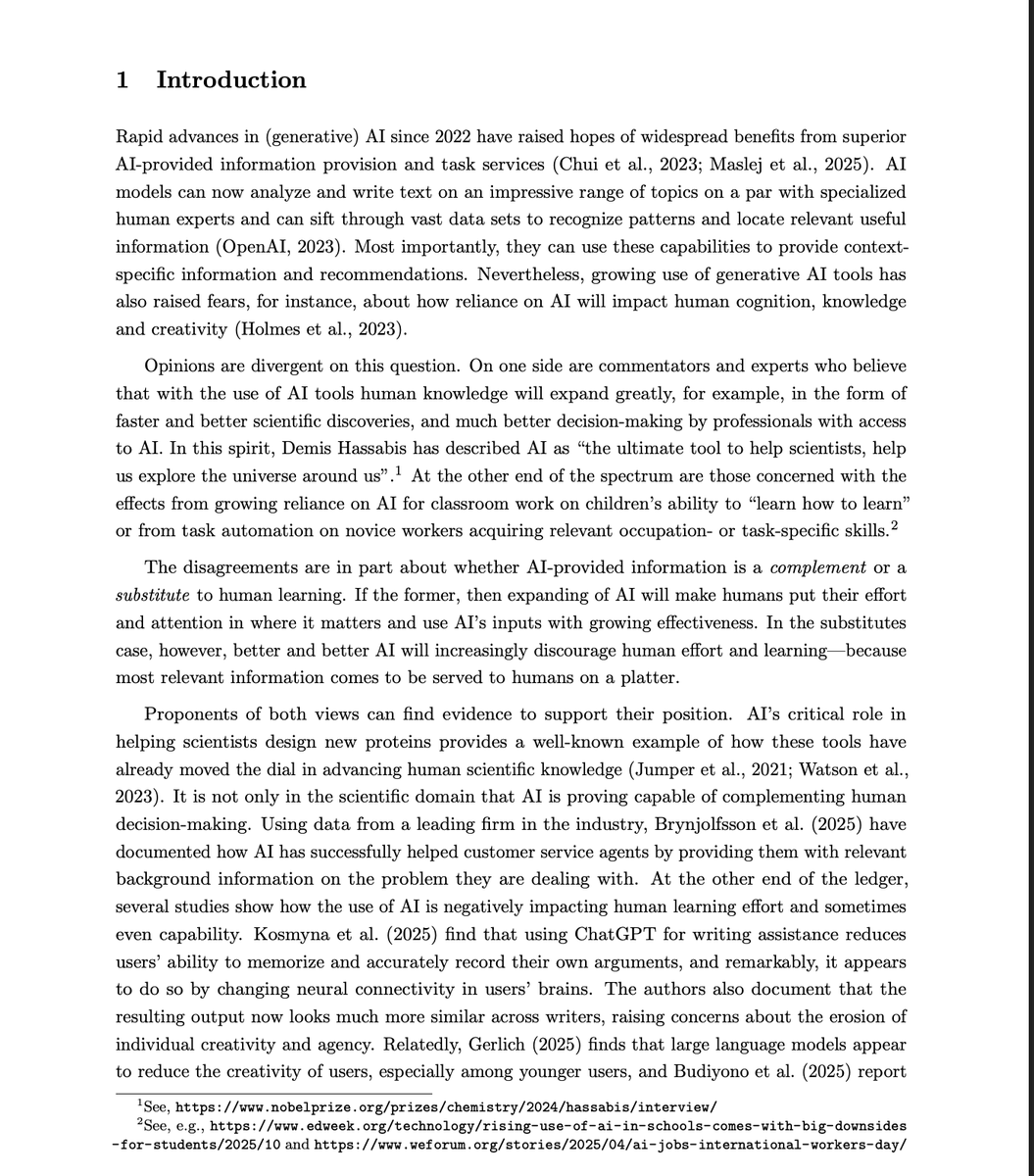
MIT's Nobel Prize-winning economist just published a model with one of the most alarming conclusions in the AI literature so far.
If AI becomes accurate enough, it can destroy human civilization's ability to generate new knowledge entirely.
Not gradually degrade it. Collapse it.
The paper is called AI, Human Cognition and Knowledge Collapse.
Authors: Daron Acemoglu, Dingwen Kong, and Asuman Ozdaglar. MIT. Published February 20, 2026.
Acemoglu won the Nobel Prize in Economics in 2024. He is not a doomer blogger. He is the most cited economist of his generation, and his models tend to be taken seriously by the people who set policy.
Here is the argument in plain terms.
Human knowledge is not just a collection of facts stored in individuals. It is a living system that requires continuous reproduction. People learn things. They apply them. They teach others. They build on prior work to generate new work. The entire engine of science, medicine, technology, and innovation runs on this cycle of active human cognition.
What happens when AI provides personalized, accurate answers to every question people would otherwise have to learn themselves?
Individually, each person is better off. They get correct answers faster. They make fewer errors. Their immediate outcomes improve.
But they stop doing the cognitive work that sustains the collective knowledge base.
Acemoglu's model shows this produces a non-monotone welfare curve.
Modest AI accuracy: net positive. AI helps at the margin, humans still do enough learning to sustain collective knowledge, everyone gains.
High AI accuracy: net catastrophic. AI is accurate enough that learning yourself feels unnecessary. Human learning effort collapses. The knowledge base that AI was trained on is no longer being refreshed or extended. Innovation stalls. Then stops.
The model proves the existence of two stable steady states.
A high-knowledge steady state where human learning and AI assistance coexist productively.
A knowledge-collapse steady state where collective human knowledge has effectively vanished, individuals still receive good personalized AI recommendations, but the shared intellectual infrastructure that enables new discoveries is gone.
And the transition between them is not gradual.
It is a threshold effect. Below a certain level of AI accuracy, society stays in the high-knowledge equilibrium. Above that threshold, the system tips. And once it tips, the collapse is self-reinforcing.
Because the people who would have learned the things that would have pushed the frontier forward never learned them. And the AI cannot push the frontier on its own. It can only recombine what humans already knew when it was trained.
The dark irony at the center of the model:
The AI does not fail. It keeps giving accurate, personalized, useful answers right through the collapse.
From the individual's perspective, nothing looks wrong. You ask a question, you get a correct answer.
But the collective capacity to ask questions nobody has asked before, to build the frameworks that generate new knowledge rather than retrieve existing knowledge, that capacity is quietly disappearing.
Acemoglu has been the most prominent mainstream economist skeptical of transformative AI productivity claims. His prior work found that AI's actual measured productivity gains were much smaller than the technology industry projected.
This paper is a different kind of warning. Not that AI will fail to deliver promised gains.
But that if it succeeds too completely, it will undermine the human cognitive infrastructure that makes long-run progress possible at all.
The welfare effect is non-monotone.
That is the sentence worth sitting with.
Helpful until it is not. Beneficial until it crosses a threshold. And past that threshold, the same accuracy that made it so useful is precisely what makes it devastating.
Every student who uses AI instead of working through a problem is a data point.
Every researcher who uses AI instead of developing intuition is a data point.
Every generation that grows up with accurate AI answers and no incentive to develop deep domain knowledge is a data point.
Individually rational. Collectively catastrophic.
Acemoglu proved this is not just a cultural concern or a vague anxiety about screen time.
It is a mathematically coherent equilibrium that a sufficiently accurate AI system will push society toward.
And there is no visible warning sign before the threshold is crossed.
Prolonged AI use may make it harder to think critically and creatively, recent research suggests. But there are ways to keep the brain fit https://t.co/eIheci4G6q
If you're a regular drinker of coffee or tea, you might rely on that morning cup to think more clearly through the day. A new study suggests your daily habit might help your brain in the long term, too. #HarvardHealth
https://t.co/C32DYjq3Jm