The most trusted and important #Bitcoin mempool in the world is running on my node. The second most important mempool belongs to the miner who mines the next block validating and adding my transaction to the Bitcoin timechain.
> A big chunk of bitcoiners would rather fight each other than channel their efforts to advocating for bitcoin
It is important to recognise when Bitcoin is under attack and defend Bitcoin. In 2016, Bitcoin was under attack from the "large blockers", winning that battle was important. Perhaps more important than wider advocacy at that point in time, which could come later. Had BIP-101 (the large blocker proposal) activated, the blocksize limit today would have been 312 MB. That means up to 312 MB of stupid image spam and NFTs per block. Users would therefore not be able to run nodes and Bitcoin would have failed. Winning that battle was necessary. And yes, that did mean sometimes people came accross as "rude" or "toxic", rather than presenting a nice happy image, which could have helped with wider advocacy. But that fight was absolutely necessary.
Fortuntely the battle against the spammers was won in 2017. We have a reasonable blocksize limit in place and we can sleep easy, knowing Bitcoin is safe from spam images and perhaps focus more on advocacy.
At the same time, today, BIP-110 is another attack on Bitcoin. Attempting to change the protocol rules on block validity, without consensus, can be an attack. Recognising this is an important part of understanding Bitcoin. In the case of BIP-110 it is pretty clear, many BIP-110 advocates want to change Bitcoin's protocol rules as a way of "hitting spammers in the nose". This makes it obvious that BIP-110 is an attack on Bitcoin. BIP-110 does all kinds of outragoues things, like banning sends to P2PK outputs (That Satoshi used) and it messes up people's inheritance plans if they use OP_IF in Tapscript. This will freeze user funds. I have spoken to people with Bitcoin in these contracts that will lose their Bitcoin if BIP-110 activates! BIP-110 is a horrendous attack. If not enough people recognise attacks and step up to defend Bitcoin, Bitcoin will fail. Yes it can be ugly, but it is necessary. Just like the fight against BIP-101 was.
Many people may legitimtely conclude that BIP-110 is not a significant attack and therefore not worth defending against. That may be the case. However, vigilence against threats its important.
I just did a full IBD with assumevalid=0 in 32 hours on a 5 year old laptop. That's real progress. Monetary UTXOs linger and spam does too but as each UTXO gains value the incentive to consolidate gets stronger.
Fees price out junk and consolidation happens naturally. The chain was much smaller years ago with far less usage. As adoption grows the chain grows too. That's reality not failure.
Bitcoin was designed to solve the double spend problem without a trusted third party. It's doing exactly that. Full nodes are still practical and hardware improves faster than the chain grows so running one stays affordable. We fight centralization by verifying the rules ourselves not by complaining that sync times don't magically shrink while real usage explodes.
It's works as designed.
We've past feature freeze for Bitcoin Core v31, which should be released in early April. Headliners include:
* Cluster Mempool
* Embedded ASMap
* Private Broadcast
* A new tx output index
* Improvements to the IPC Mining interface
* More bitcoin kernel progress
@barackomaba A bunch of Knots people have made this grievance their whole personality, so that’s all they post about every day. People that think it is a nothing burger don’t talk about it all day. Hope that helps.
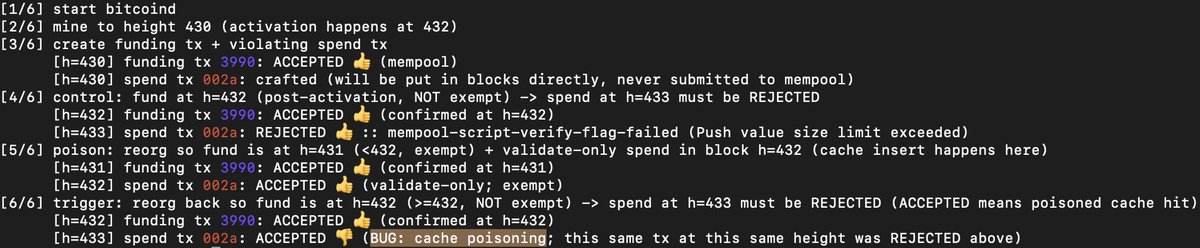
# BIP-110 ReducedData: script-execution cache poisoning via activation-boundary reorg
Found a serious consensus bug in Bitcoin Knots' BIP-110 implementation: a shallow reorg across the activation boundary can poison the script validation cache, causing a node to accept a block containing BIP-110 invalid transactions.
Full disclosure with reproducers can be found on the pending PR: https://t.co/htLRWD7yTM
Kevin (@KLoaec) has been devoting a lot of time to explaining why BIP-110 is risky. This is one post that summarises it very well.
Still not sure you get it? Read more of what he’s posted.
Don’t trust him? Read what @nunchuk_io is posting.
BIP-110 is *not* safe.
@SatsAndSilver@baclfoo@CunyRenaud BIP 110 is an excellent solution to this dispute. I can’t wait for the proponents to fork off with Bcashjr in August/September.
NOTICE: Wallet Migration bug present in Bitcoin Core wallet 30.0 & 30.1.
Under rare circumstances, migrating a legacy (BDB) wallet can delete all wallet files on the same node. If those wallets aren’t backed up, this can result in a loss of funds.
A fix will become available in Bitcoin Core 30.2. Until that is released, do not migrate legacy wallets using 30.0 or 30.1.
Only the legacy wallet migration process is affected. All other uses are unaffected. You can continue using Bitcoin Core normally, including existing wallets and running a node without wallets.
Just want to show my gratitude for these Bitcoiners going into the new year.
@Rob1Ham - A friend and mentor for life.
@JeremyRubin - Most cracked engineer (Teacher).
@Wiz - Most gracious host. (Long Shot)
@theblackmarble - Bitcoin philosophy and theory.