Researchers published the most uncomfortable paper on vibe coding.
ETH Zurich tested 100 developers in a controlled, commercial-grade vibe coding environment to see who actually succeeds.
And the results are a brutal reality check.
For the last two years, the hype has been nonstop: English is the new programming language. Just describe what you want, iterate on the output, and let the LLM handle the rest.
So researchers put that claim to the test.
They took 100 university students and placed them in a purpose-built vibe coding environment designed to mirror commercial AI tools.
Eight experts curated the exact tasks.
Then they measured three things:
- Written communication skills
- Domain-general cognitive ability (raw reasoning)
- Actual computer science achievement
Writing skill mattered. If you can’t structure your thoughts and specify intent clearly in plain English, the AI builds garbage.
But here is the part the hype cycle completely missed.
Computer science fundamentals were a massive predictor of vibe-coding performance.
Even after controlling for general cognitive skills and raw intelligence, CS knowledge still heavily dictated who succeeded and who failed.
Why? Because vibe coding removes syntax. It does not remove engineering.
Anyone can prompt an AI to generate a clean UI.
But the second the app breaks under the hood, you have to iterate from observed behavior. If you don’t understand how software actually works, you don't even know what to ask the AI to fix.
Natural language lowers the floor.
Computer science still decides the ceiling.
all HW founders, this one's for you. 💪
>how it started vs. how it's going 🚀
>from an ugly project to a loved robot
>every prototype was a grind, 10/10 would do it again ☺️
QT your V1 vs. now.
let's celebrate ugly prototypes
Introducing Bambu Lab S1.
Our new 3D scanner is designed to make professional scanning simpler, from setup to post-processing.
Pick from 14 built-in presets, or answer a few simple questions to get scan settings tailored to your object.
Then refine your model with 8 advanced editing tools in Bambu Scan.
From real object to printable model, with fewer steps in between.
Easy in hand. Pro in every scan.
Available at: https://t.co/xh55iG7NJw
The driver is officially out.
Our @LucidMotors Gravity robotaxis driven by @nuro are now testing fully driverless on public roads in the San Francisco Bay Area. Employee rides are next.
The future of mobility is getting closer—coming to @Uber in early 2027. https://t.co/hM5swhIpqP
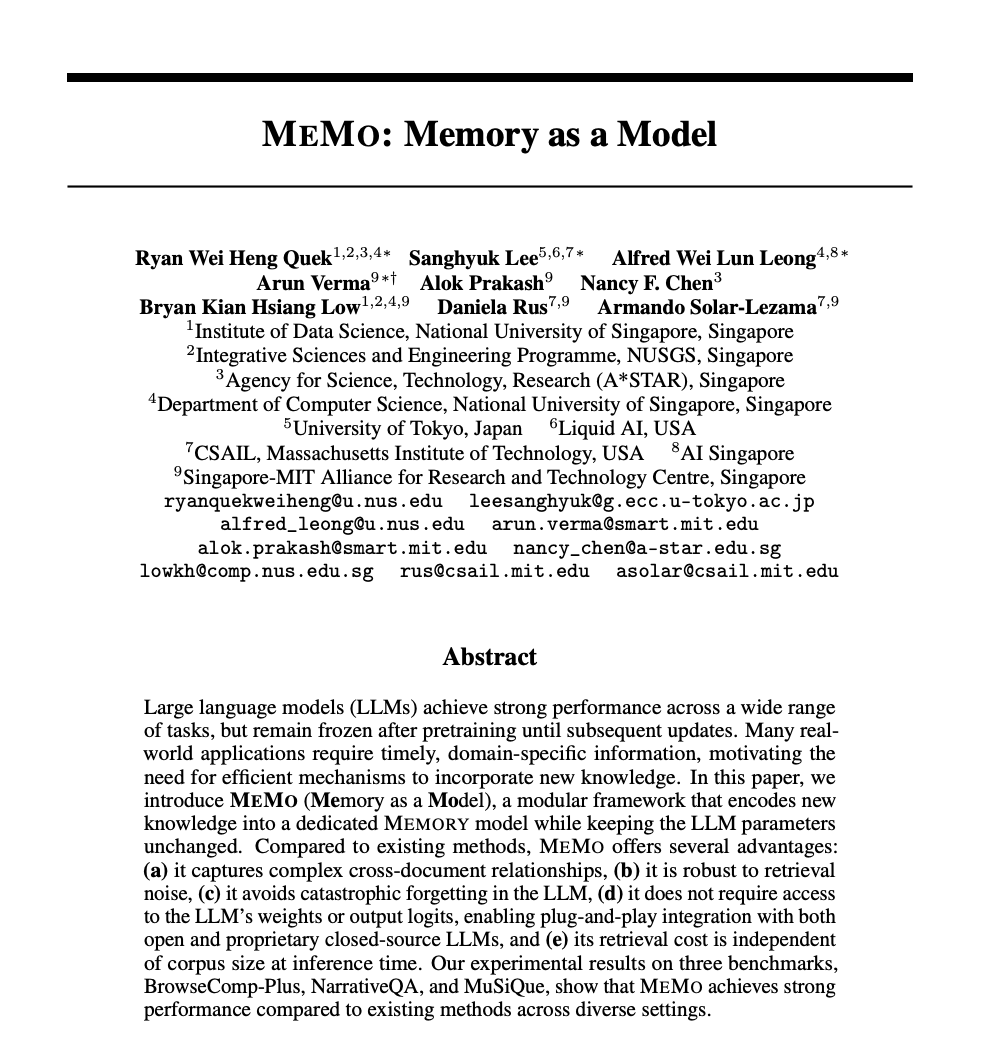
RAG is officially dead 🤯
MIT built an AI that doesn't need RAG.
It’s called MeMo, instead of storing knowledge in a database, you train a small, dedicated Memory model on your documents.
At inference time, your main frontier LLM stays 100% frozen. No vector DB. No chunking. No weight access.
It simply interrogates the Memory model in 3 quick turns, like a detective questioning a witness, to pull exact facts and synthesize the answer.
The results are brutal:
• NarrativeQA (long documents): 53.6% vs. RAG’s 23.2% (more than 2x better).
• Noise test: Doubled the corpus with fake distractors. RAG tanked -6.2%. MeMo didn't flinch (+0.55%).
And the sleeper advantage? It’s completely plug-and-play.
Train the Memory model once. When they upgraded the main LLM from Qwen2.5-32B to Gemini 3.0 Flash with zero retraining, accuracy jumped +26.7% overnight.
We spent 3 years trying to fix AI memory by building better search engines.
It turns out, the answer was giving the model a second brain.
I am so dang impressed with how good SolidCraft is
This is the "clean room" port of Fusion 360. It's so fast and the MCP makes agentic design so easy
This is going to completely take over the hobbiest space
🎉 Seven months after LingBot-Map, we're excited to release LingBot-Map 2.0!
Streaming 3D models drift over long sequences and usually need an external loop-closure back-end to correct it. LingBot-Map 2.0 handles loop closure inside the model ⚡ It rewrites its own memory in one feed-forward pass: no loop detector, no pose-graph back-end 🚀
It achieves ~27 FPS on 512×288 resolution on a consumer GPU over kilometer-scale sequences (20k+ frames), and it is more accurate than loop-closure back-ends and offline models!
Two key insights behind LingBot-Map 2.0:
🔑 Bring SLAM's hindsight into the model: Geometric Context Reconsolidation lets later views rewrite the cached context through bidirectional attention over all keyframes
🔑 Make both streaming and reconsolidation end-to-end learnable — no hand-crafted priors, no optimization, no post-processing
Let's check out our demos 👇
I am exploring a version of Mighty with a Color Global Shutter Camera + LiDAR ToF.
This variant streams RGB + Depth + VIO + Voxel Map all in this tiny package!
Want to fine-tune Gemma 4 on your own data, audio, receipts, or reasoning tasks?
Our new fine-tuning hub is live on https://t.co/0LtUIr7f3X: 17 guides and 40+ illustrations covering the entire training pipeline. Ranging from continued pre-training and custom chat templates, all the way to (Q)LoRA and GRPO.
We made a billing mistake at launch of GPT-6.2 that incorrectly discounted GPT-6.2 Astra and Sol usage for most users.
We’ve fixed this now, so the same work will use more of your plan’s usage allowance. Comparing to last week, you will reach your limits 40% faster on GPT-6.2 Astra and 25% faster on Sol. You should still see these go further in usage compared to 6 Astra and 6.1 Sol. Other models weren’t affected, and we won’t charge you for the difference on past usage.
As a small token to apologize for the mistake, we’ll be adding one banked reset for everyone on Go, Plus, Pro, and Business.
The ADAS dashboard software is now open source under the Autoware Foundation.
#ROS2 RViz is a great tool for developers. It shows every topic, frame and marker. For a driver, or a visitor at a booth, that is too much information. The dashboard shows only what matters: what the autonomous driving stack sees, what it plans, what it does, and who is in control of the car.
🧵
TIL: We have superintelligence but we still don't have level-5 autonomous driving.
A task that most 17 year olds can learn in 20 hours of practice.
And we have (you have) billions of hours of training data.
We don't have robots that can come close to doing what an 8 year old can do with no prior training.
And let's not talk about cats.
That's a rather strange kind of superintelligence.
In case anyone is curious:
We’ve had a ~pixel-perfect world model since last year, which is critical for synthetic data generation.
The (much) smaller version of that in the car is a conditional mean-flow model, based on the recent sequence of Tesla Universal Vision Encoder features, which are the same ones that are plugged into the 3B encoder model that produces the driving actions.
We fork off from these UVE features, then run a separate ~1B diffusion model. This takes in the previous reality-view generation with added noise and then denoises it to the current visualization.
It then produces a small video chunk (8 images at 36 fps, at the resolution of the UI screen). This work is done by 1/2 of a TRIP engine every UVE frame at 18 hz and is spread over 4 cycles.
Currently, the latency is a bit high due to compute constraints, but we have ways to interleave newer UVE features along the diffusion transformer layers to cut roughly 35% of the latency.
I was tired of the Hyundai app, so I built one myself! It even connects to my @comma_ai so I can view my interior camera.
Hackable software will win. Made entirely from my phone w/ Exact Build & AppDrop.