We’re live coaching for important work that gets stuck.
In a session, we help you get clear on what matters, then notice when you drift, freeze, or overthink as you work through the next concrete steps.
Over time, you build the skill of reliable deep work despite resistance.
When I launched Attention Copilot, I mostly thought of it as a way to help people get unstuck in one session:
Bring a task that feels ugh, reconnect with why it matters, and do it while a coach tracks your attention and inner state. When resistance shows up, we work with it in the moment instead of just talking about it or white-knuckling through it.
That still feels core! But after watching people work with us over weeks and months, one pattern stands out: important work is where this stuff shows up.
The work that matters asks for more clarity, courage, patience, or focus than your default habits make easy. So when you practice working with resistance while actually doing it, your relationship to work starts to change.
For some people, especially at high-growth startups, this looks very practical. Everything wants your attention, and sessions protect time to get clear on what matters, do deep work, and move it forward.
For others, AC feels like finally bringing meditation and inner work into the work itself, right when the reactive patterns show up.
Either way, the training rep is the same: stay with what matters, work with what comes up, move the thing forward, and get better at doing that outside the session too.
A few of the people we’ve worked with for a while put it better than I can!
For people who meditate and take inner work seriously: the hard part is bringing that clarity into the workday itself.
We help you practice right when the pattern shows up, so work becomes less forced, more effective, and more enjoyable.
https://t.co/uQkCx1enXE
Quinn is a senior engineering manager. He already had a meditation practice, and he took self-work seriously.
Over 4 weeks in January, he worked with all three of our coaches to bring those skills into the workday instead of leaving it on the cushion.
A couple months later, he’s reporting less tension while working, more productivity, and more fun!
We’re live coaching for important work that gets stuck.
In a session, we help you get clear on what matters, then notice when you drift, freeze, or overthink as you work through the next concrete steps.
Over time, you build the skill of reliable deep work despite resistance.
When I launched Attention Copilot, I mostly thought of it as a way to help people get unstuck in one session:
Bring a task that feels ugh, reconnect with why it matters, and do it while a coach tracks your attention and inner state. When resistance shows up, we work with it in the moment instead of just talking about it or white-knuckling through it.
That still feels core! But after watching people work with us over weeks and months, one pattern stands out: important work is where this stuff shows up.
The work that matters asks for more clarity, courage, patience, or focus than your default habits make easy. So when you practice working with resistance while actually doing it, your relationship to work starts to change.
For some people, especially at high-growth startups, this looks very practical. Everything wants your attention, and sessions protect time to get clear on what matters, do deep work, and move it forward.
For others, AC feels like finally bringing meditation and inner work into the work itself, right when the reactive patterns show up.
Either way, the training rep is the same: stay with what matters, work with what comes up, move the thing forward, and get better at doing that outside the session too.
A few of the people we’ve worked with for a while put it better than I can!
For scaling founders, the problem isn’t “not working enough.” It’s choosing what matters when everything wants your attention.
We guarantee time to get clear on what matters, do the deep work, and build the attention skills to make it a habit.
https://t.co/Q6EvGiqnZT
Nick co-founded Kettle & Fire (@kettleandfire) at 19 and helped build it into a 10-figure brand. Now he’s building Light Labs (@lightlabsinc), which is even more of a rocketship!
At this stage, everything can feel like it needs attention, so it’s easier for the important work to get crowded out. We use session times as protected deep work to get clear on what matters and actually moving it forward.
Doing that repeatedly has become training, helping him get better at finding the important thing and staying with it outside of sessions.
When I launched Attention Copilot, I mostly thought of it as a way to help people get unstuck in one session:
Bring a task that feels ugh, reconnect with why it matters, and do it while a coach tracks your attention and inner state. When resistance shows up, we work with it in the moment instead of just talking about it or white-knuckling through it.
That still feels core! But after watching people work with us over weeks and months, one pattern stands out: important work is where this stuff shows up.
The work that matters asks for more clarity, courage, patience, or focus than your default habits make easy. So when you practice working with resistance while actually doing it, your relationship to work starts to change.
For some people, especially at high-growth startups, this looks very practical. Everything wants your attention, and sessions protect time to get clear on what matters, do deep work, and move it forward.
For others, AC feels like finally bringing meditation and inner work into the work itself, right when the reactive patterns show up.
Either way, the training rep is the same: stay with what matters, work with what comes up, move the thing forward, and get better at doing that outside the session too.
A few of the people we’ve worked with for a while put it better than I can!
want-based productivity
Your to do list? Just a lot of wants!
Many shoulds? Just a want, covered with shame
Feeling resistance? A fight between competing wants
We think everyone can move into higher agency, even if that doesn't look like culturally agreed upon notions of High Agency
The best way to do that is to build skills to:
1. recognize what you're avoiding
2. process emotions underneath that agency
3. do the avoided thing
I’m a huge fan of High Agency. But 2 things I now understand about it:
1) Not everyone can develop High Agency—and High Agency people will find it hard to accept this
2) It has major professional upsides, but also creates chronic anxiety in life situations you can’t control
We've found that doing this (to whatever depth there's access) makes the work far more effective! "Work meditation" can be done with conceptual think-y work just as much as it can be done with physical work (eg "washing the dishes")
work has never been more zen. you can meditate 15m of every hour while your agents churn, like zen monks meditating15m out of every hour doing chores. spend the 45m in awake awareness flowing with your agents, rest in formal practice, ends up at 4hrs of formal practice a day
A way to view @attncopilot: we teach you how to apply jhana practice to work!
Mental tension blocks sustained, enjoyable focus on the task at hand. Tension comes from ambivalence and avoided emotions.
We live debug those mental micro movements in sessions going from 90m to 3h
oh shit just realized i should totally book an @attncopilot sesh to help me practice guitar! i start working on a song and then run into something hard, and then the big ugh field overtakes me, and then i stop practicing hahaha
Most of what I actually need help with, I never think to tell a model. But why is it on me to remember?
Our new paper asks: what if AI could proactively specialize to individuals and the tasks they’re carrying out at this very moment? 🧵
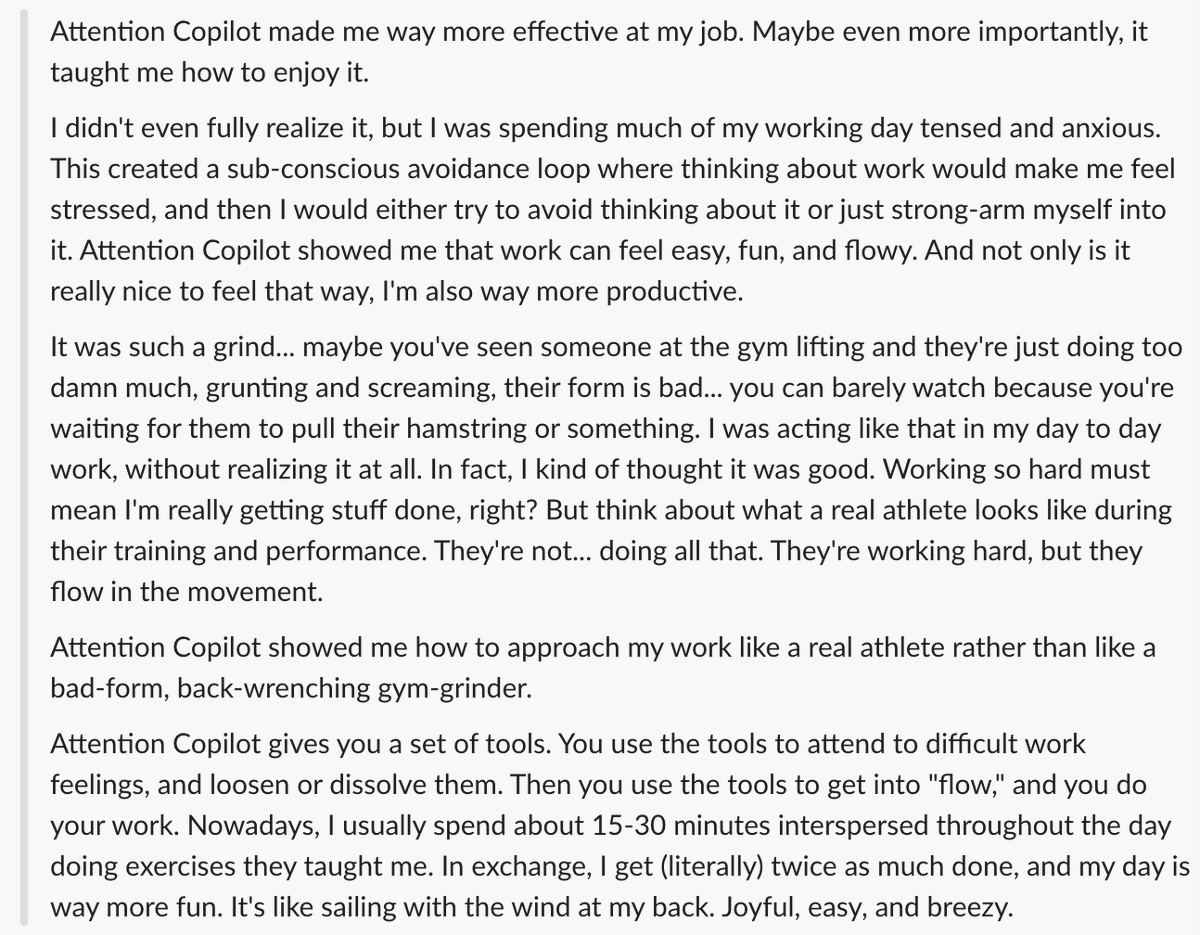
"I get (literally) twice as much done, and my day is way more fun"
Testimonial from a Sr. Data Eng Manager who had one month of Attention Copilot sessions across our coaches @minnowpark and @leofstevenson!
i sometimes have the experience of reading a section of a doc, feeling a snag, and then talking myself out of it rather than commenting on it—i assume either the author knows better than i do, or that other people who've seen it have already signed off. then, later, someone else leaves a comment naming what i felt inchoately but never allowed myself to articulate
i think it helps to remember that editing is a) as somatic as it is analytical, and b) the only authority you have is your own attention
Building an operating system for a company that teaches people to actually feel their way through resistance instead of white-knuckling productivity. Root-cause focus coaching. The market needs more of this.
I think what @attncopilot are doing is super interesting. Essentially, they're teaching unclenching practice whilst you're at work to find more flow + enjoyment.
(i.e. its a superb inner-work trojan horse + typically leads to more productivity)