Dashboards aren't it. Existing tools aren't it.
There are teams who harness AI + humans thoughtfully, without burning token budgets mid-year. They work with a new architecture.
Join us Thursday 6/25 for The Future of Work (webinar).
Register: https://t.co/uq5FCDle7k
Every enterprise is in the AI arms race.
More models and more agents aren't the advantage.
As Jeff Klebanoff explains, the real edge comes from identifying the signals historical data misses and getting them to the people who can act in time. #FutureOfWork
Most enterprise leaders can't answer a simple question: Where are the actual bottlenecks inside the company right now?
More dashboards, more data, and more AI don't necessarily make them visible.
Jeff Klebanoff shares why leading enterprises are shifting from information overload to actionable signals delivered to the right people at the right time.
Join us June 25 at 12 PM ET for The Future of Work.
Register: https://t.co/ZZgjFCtGLk
For this event, attendees will learn:
• The hidden cost of automation
• How data becomes actionable signals
• How signals reach the right leaders in time
• A new framework for work: Labor, Capital, Code, and Attention
Most companies respond to operational drag by changing leaders.
But leadership is rarely the problem. The missing layer is coordination: getting the right signals to the right people in time to act.
Join us June 25 at 12 PM ET for: "The Future of Work: Signals, Attention, and the New Economics of Human + AI Coordination."
Register: https://t.co/oPA0yxlz18
The ROI column says ??
That's not a placeholder. That's where enterprise AI actually is right now.
The ones getting it right aren't spending less, they're measuring differently.
That's the Future of Work. June 25.
Register (webinar) → https://t.co/uq5FCDle7k
Most enterprises have more AI & data than they know what to do with.
The ones pulling ahead focus human attention on the decisions that matter.
That's the Future of Work.
June 25- live demo. Register:
→ https://t.co/XfYH7oY9AJ
"The most uncomfortable finding from decades of institutional failure analysis is not that organizations lacked foresight. It’s that they possessed it and could not act. The signal was there. The attention was not."
-@RajeevRonanki
White paper: Insitiutional Attention Infrastructure https://t.co/z8RcZ1h7EZ
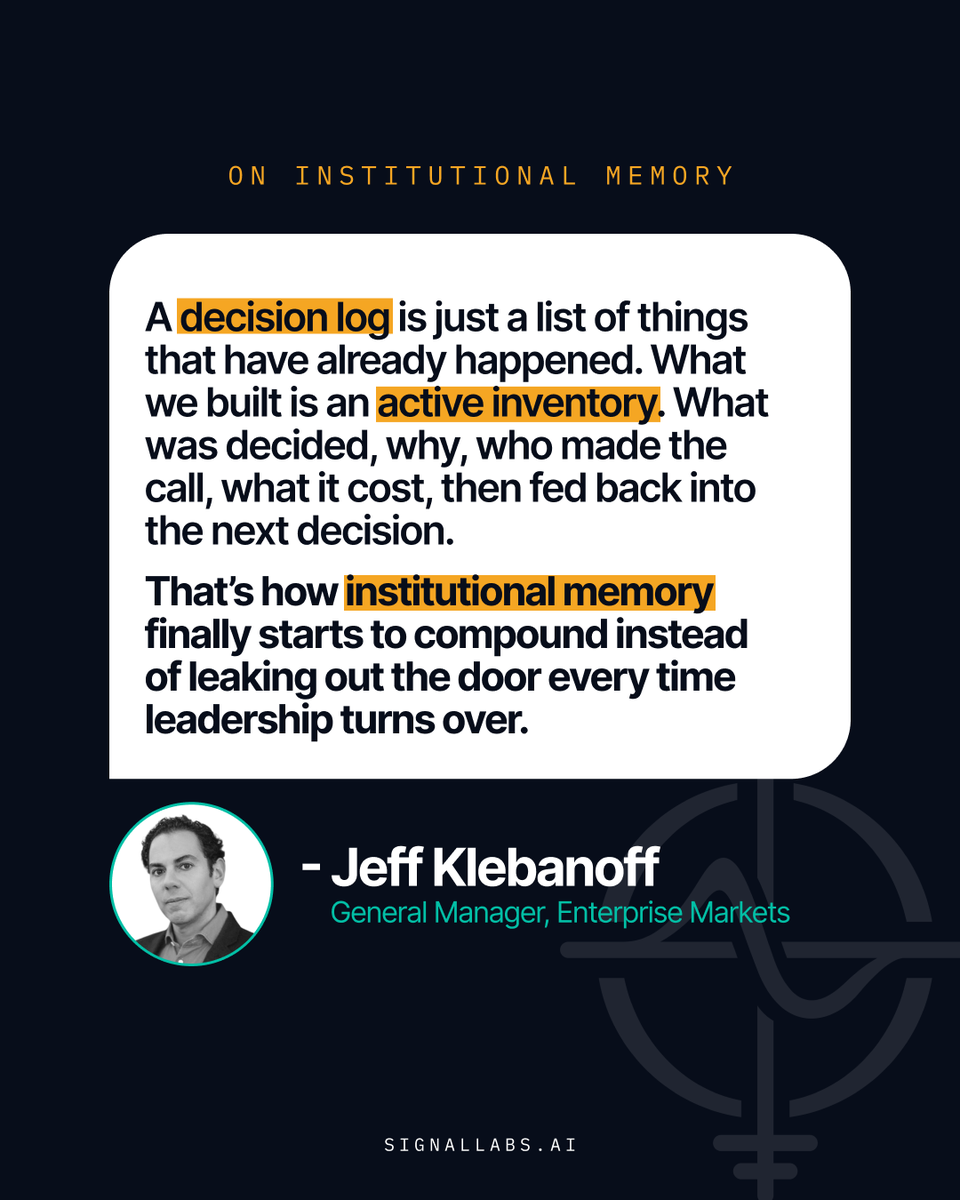
Most enterprises pay for institutional memory failures three times. Once when the lesson is learned. Once when it is forgotten. And once when it has to be relearned by someone new.
🔗 https://t.co/CGc6Gc0HVp
The cost most enterprises never measure is relearning what they already knew.
Institutional memory is one of the primitives Signal Labs is building inside Attention Infrastructure.
Jeff Klebanoff on what changes when memory becomes architecture.
👇 More in the comments.
A company accidentally spent $500 million on AI models in a single month, after failing to set spend limits.
This is where enterprise AI is right now: moving fast, with no clear view that shows what it's actually worth.
The question every C-suite should be asking: can you draw a line from your AI spend to measurable business value?
June 25, see how:
📅 Register: https://t.co/uJ1iGPqxQ3
"Just because we can automate something doesn't mean it actually benefits the member. If a new capability doesn’t solve a real problem for the people we serve, or empower our associates to practice at the top of their license, we shouldn't prioritize it."
-Prem Somasundaram, Chief Information Officer at BCBS MA. A takeaway from Monday's DHAI panel.
Mira at Thinking Machines called it a tandem bike: AI and humans pedaling together.
We like Prem's framing even better. It’s FSD (full self-driving):
"On a tandem bike, the human never stops working. With FSD, the human’s job changes. Less pedaling. More judgment. That’s the future of work in one sentence."
-@RajeevRonanki, Founder & CEO at Signal Labs
Join us 6/25 for an interactive virtual event on The Future of Work. Register: https://t.co/uJ1iGPqxQ3
Mira Murati says frontier AI should be built like a tandem bike:
"Having humans in the loop doesn't quite describe it because it sounds like a checkpoint where we're signing off something, and then you're good to go."
"It's more like creating systems that are not just autonomously advancing and leaving civilization behind, but are more like a tandem bike."
"When you're going up a hill, maybe whoever is stronger is pedaling harder. But both hands are on the wheel. That's quite important because that's a different system. It's a system designed for collaboration."
"It will increase the level of agency that people have, and also it will help us steer the research direction towards creating outputs that are more value-aligned."
@miramurati at Bloomberg Tech live with @emilychangtv
A signal that arrives after the moment to act has closed is operationally equivalent to a signal that never fired at all. Most banking dashboards are currently full of the second kind.
One household. Three lines of business. Four related signals.
Each team saw its own piece of the story. Nobody saw the whole household.
SignalGraph™ helps surface the right signals to the right individuals before the window to act closes.
#Banking#SignalGraph
Presenters:
Signal Labs Founder & CEO @RajeevRonanki helped start Deloitte's AI practice in 2011 and built platforms serving 45 million members at Elevance Health. Author of best seller "You and AI".
Alongside Raj: Jeff Klebanoff, who has delivered over $1.8B in measurable value across Elevance, Moody's, and PwC. Art Fitts, who has spent thirty years putting AI to work inside health plans.
Interactive session Thursday 6/25. Register here to join or get the replay: https://t.co/5f2woZ86vA
The enterprises that win the next decade won't just have better AI. They'll have better signal.
Live demo June 25: how leading companies put the right signal in front of the right leader, in time.
The Future of Work: Signals, Attention, and the New Economics of Human + AI Coordination
📅 Register: https://t.co/uJ1iGPqxQ3
Token trends:
Power users are “AI-pilled”: The most AI-heavy US firms now spend $7,500 monthly per employee on AI, still below a software engineer's roughly $16,000/month pay, according to Ramp's AI Index.
These top 1% of companies saw per-employee spend grow 14.1% last month.
The top 10% spend about $611, and the median just $11.38.
-TechCrunch https://t.co/sR2bj5uYBS