10 years ago, before the rise of AI, this would have been 14 man-months of a Senior Engineer's time.
Did this in 4 days.
For @w3arew3
I fucking love @claudeai
@w3arew3 is coming out Guns Blazing for 2026! It's time for real world value creation paired w/ a next-gen token model.
Over the past year, we've been blown away by the support we receive for this new approach. See what's different and what's coming.
https://t.co/GwGXgOUYKv
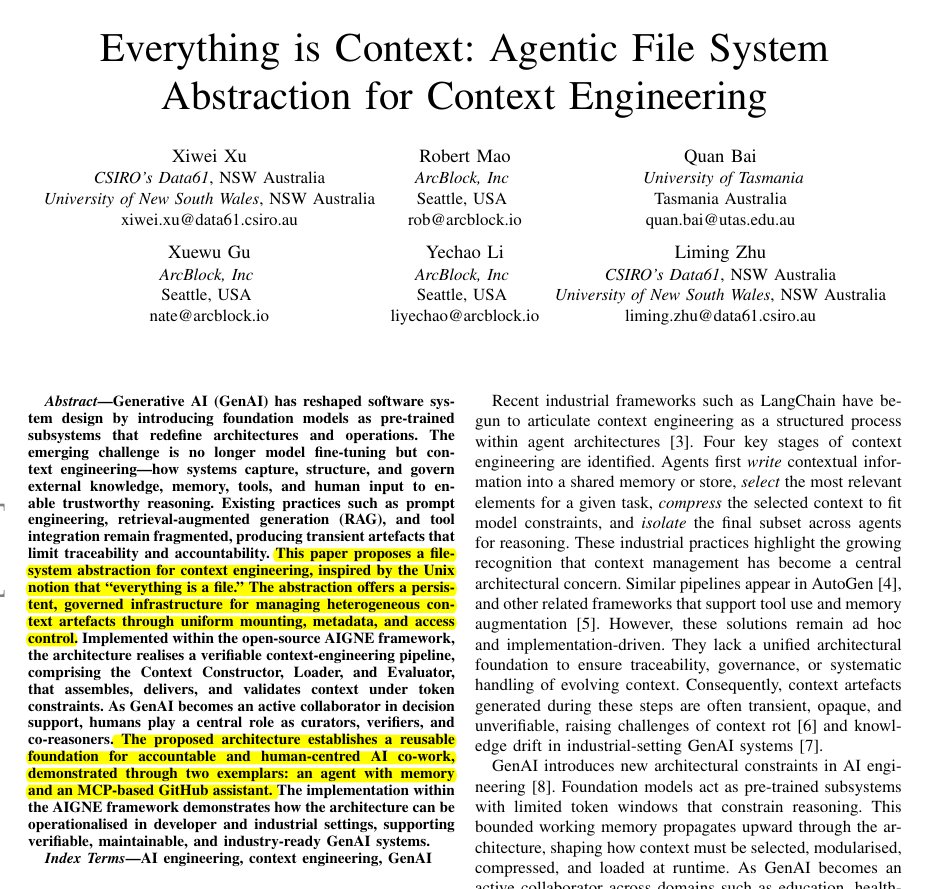
The paper says the best way to manage AI context is to treat everything like a file system.
Today, a model's knowledge sits in separate prompts, databases, tools, and logs, so context engineering pulls this into a coherent system.
The paper proposes an agentic file system where every memory, tool, external source, and human note appears as a file in a shared space.
A persistent context repository separates raw history, long term memory, and short lived scratchpads, so the model's prompt holds only the slice needed right now.
Every access and transformation is logged with timestamps and provenance, giving a trail for how information, tools, and human feedback shaped an answer.
Because large language models see only limited context each call and forget past ones, the architecture adds a constructor to shrink context, an updater to swap pieces, and an evaluator to check answers and update memory.
All of this is implemented in the AIGNE framework, where agents remember past conversations and call services like GitHub through the same file style interface, turning scattered prompts into a reusable context layer.
----
Paper Link – arxiv. org/abs/2512.05470
Paper Title: "Everything is Context: Agentic File System Abstraction for Context Engineering"
Main takeaways:
1. Filesystem offloading is an incredibly useful pattern, more destructive context steps should be treated like offloading.
2. Because Filesystem offloading is so important, Search is also very important. This includes good naming of files and models native ability to search just went way up in value (was already high)
Billions get lost in hacks.
Smart contracts are rigid.
dApps can’t think.
👉 What if Web3 had a brain that could adapt, learn, and protect itself in real time?
That’s what @w3arew3 is building. Let’s break it down 👇
While everyone's focused on big crypto headlines, the real alpha is in the 'deregulatory rule proposals to reduce compliance burdens.'
This isn't just about trading—it's about making programmable compliance actually feasible for complex multi-party workflows.
Infrastructure nerds, this one's for us.
Today, we released the Unified Agenda of Regulatory and Deregulatory Actions. This agenda reflects that it is a new day at the SEC.
Here's my full statement: https://t.co/ZguBGZ3a2U
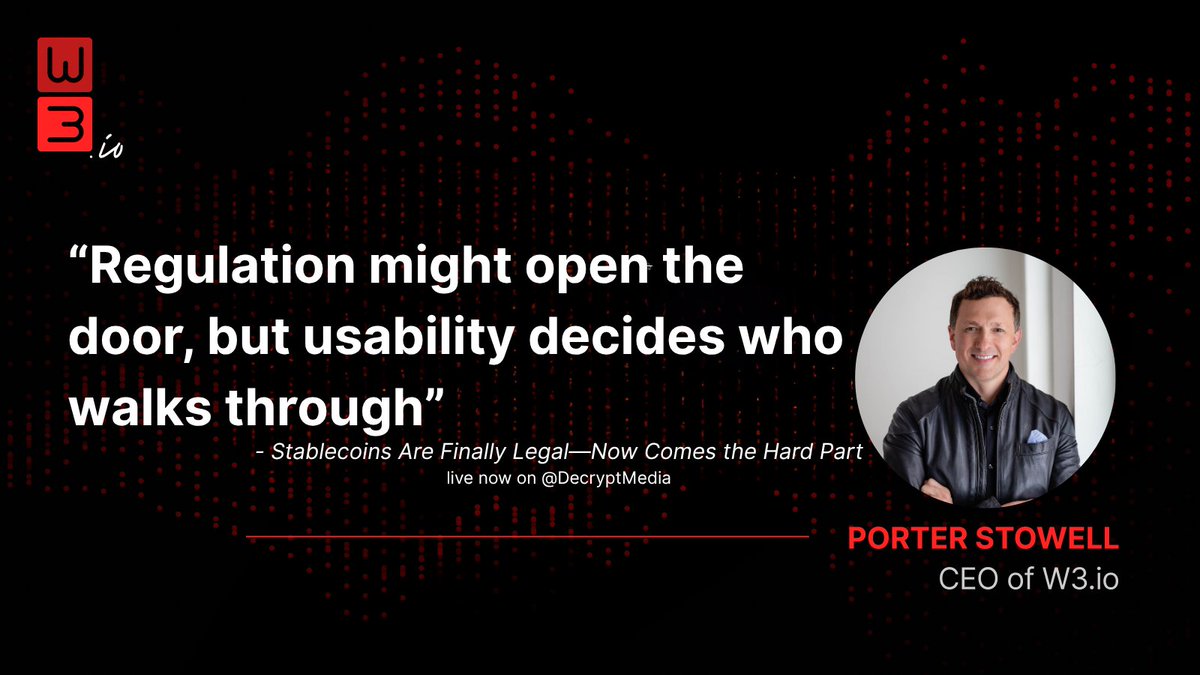
The headlines say crypto’s legal. But now comes the hard part: making it usable.
“If programmable money is the input, programmable infrastructure is the missing output.”
Read @StowellPorter's op-ed on @decryptmedia →
https://t.co/bTM6ignvkR #Web3#stablecoins#blockchain #crypto
@w3arew3 Time zone conversions for the Gen 2 Knights drop:
🇺🇸 PST: Aug 5, 9PM
🇺🇸 EST: Aug 6, 12AM
🇪🇺 CET: Aug 6, 6AM
🇦🇪 Dubai: Aug 6, 8AM
🇭🇰 HKT: Aug 6, 12PM
🚨 Web3’s next breakout moment is here.
The GENIUS Act could reshape global finance—and our CEO @StowellPorter breaks down why it’s such a watershed moment.
Don't miss this one👇
🔗 https://t.co/VU05WfBn5K
#Web3#CryptoPolicy#DeFi#GENIUSAct#W3io
How Prodigy Networks Unlock Next Level Intelligence on Chains Like @BNBCHAIN
1/ Our friends at @BNBCHAIN just wrapped up the BNB Incubation Alliance in Denver, showcasing some incredible innovation. The next leap for ecosystems like BNB? Programmability that powers intelligence.