OpenAI has just created an entirely new global function that's being led from London.
It will be headed up by @LauraModiano and will be focused on helping startups build, grow and scale on OpenAI from Day 1, through their start-up journey.
It will be a global function led from London and will span founder programs, technical activation, ecosystem partnerships, investor relationships and startup community engagement.
It is amazing to see @OpenAI continue to develop its presence here and double down on London.
Laura has become one of the most vocal and positive voices in European Tech and is overall such a powerful force for good in the ecosystem.
This is great news for her and the ecosystem, so a huge CONGRATULATIONS to her.
Today, we’re releasing a feature that allows Claude to control your computer: Mouse, keyboard, and screen, giving it the ability to use any app.
I believe this is especially useful if used with Dispatch, which allows you to remotely control Claude on your computer while you’re away.
Andrej Karpathy (@karpathy), OpenAI co-founder, ex-Tesla AI, "vibe coding" creator.
In just 4 mins, he explains why Claude Skills, MCP servers, and AI agents are past the hype and are now the new baseline for building.
Worth every second ↓
They say I make complex things simple, but the truth is I simplify them because I don't fully grasp them myself. The best way? Metaphors and analogies. Change how you view AI: like electricity, it's powerful but requires careful handling to avoid shocks.
Ethical concerns won't stop the AI race. The real business advantage? Not giant models, but smaller, private ones. Focus on what you own, not the internet. #AI#BusinessStrategy
Companies won't prioritize ethics if they feel pressured by competitors. The real oversight? Focusing on large language models. The secret is small, private language models—not internet-dependent ones. #AI#BusinessStrategy
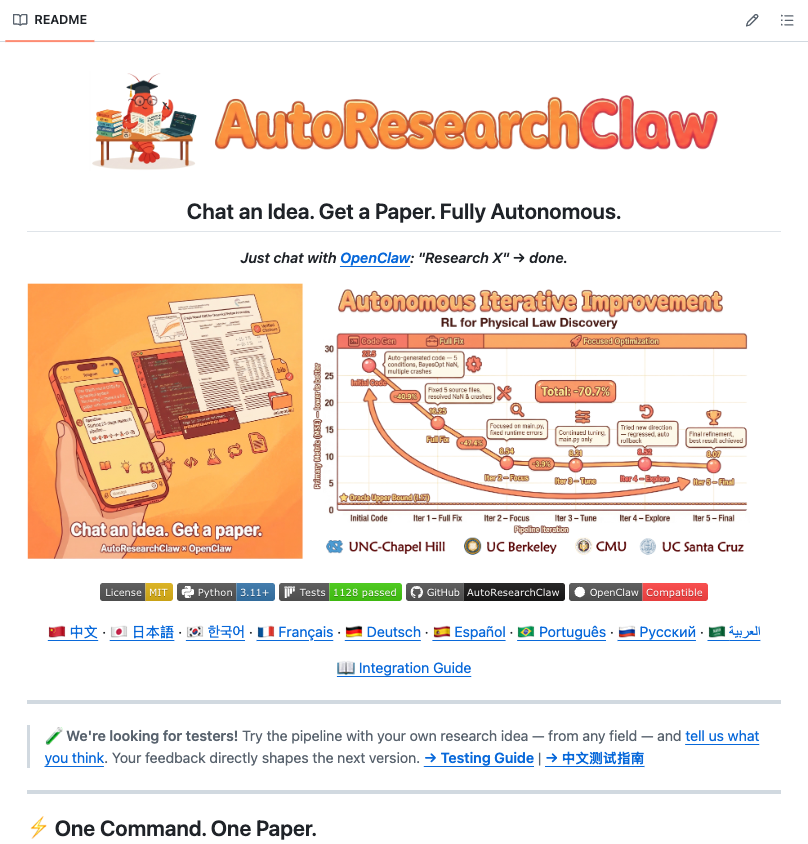
Holy shit...Someone built an AI system that takes a research idea and outputs a full academic paper. Real citations. Real experiments. Conference-ready LaTeX. Zero human input.
It's called AutoResearchClaw. And the pipeline is insane.
Here's what actually happens when you type one command:
It searches arXiv and Semantic Scholar for real papers. Not fake citations actual literature with 4-layer verification: arXiv ID check, CrossRef DOI lookup, Semantic Scholar title match, and LLM relevance scoring. Hallucinated references get killed automatically.
Then it designs and runs real experiments. Hardware-aware auto-detects whether you have NVIDIA CUDA, Apple MPS, or just CPU, and adapts the code accordingly. When experiments fail, it self-heals. When results don't support the hypothesis, it pivots to a new direction on its own.
Then it writes the paper. 5,000-6,500 words. Section by section. Multi-agent peer review with methodology-evidence consistency checks. Then it revises based on those reviews.
Then it outputs conference-ready LaTeX. NeurIPS, ICML, ICLR templates. Compile-ready for Overleaf. BibTeX references auto-pruned to match inline citations.
The whole thing runs across 23 stages and 8 phases. Three human-approval gates if you want them. Or just pass --auto-approve and walk away.
What you get back:
→ Full academic paper draft
→ Conference-ready LaTeX + BibTeX
→ Experiment code + sandbox results + charts
→ Peer review notes
→ Verification report on every citation
This is what autonomous scientific research actually looks like in 2026.
100% Opensource. MIT License.
Link in comments.