$NVDA nuked again after hours on reports that the company's board is preparing to fire him as CEO after news of a second affair surfaced.
I actually believe him being removed is the most bullish outcome possible, so I bought the dip on my Kalshi challenge account.
If he's removed it not only completely clears up the uncertainty around the situation, but it opens up the opportunity for a fresh face to take the company to the next level.
Run it back turbo.
ape the dip with me on Kalshi perps ➡️ https://t.co/LoIS5uJfrB
Single stock perps (SSPs) are here. And they're a truly great product. You don’t need to pay rollover fees like with futures, they’re simpler to trade than options, and you can go short just as easy as you can go long.
This is one of the most consequential products we’ve launched and I couldn’t be more proud of the team that worked for over a year to bring them to life. Just this morning, since the stealth launch, our users traded over $300m.
Grateful to be the ones bringing these to America in a regulated way 💚
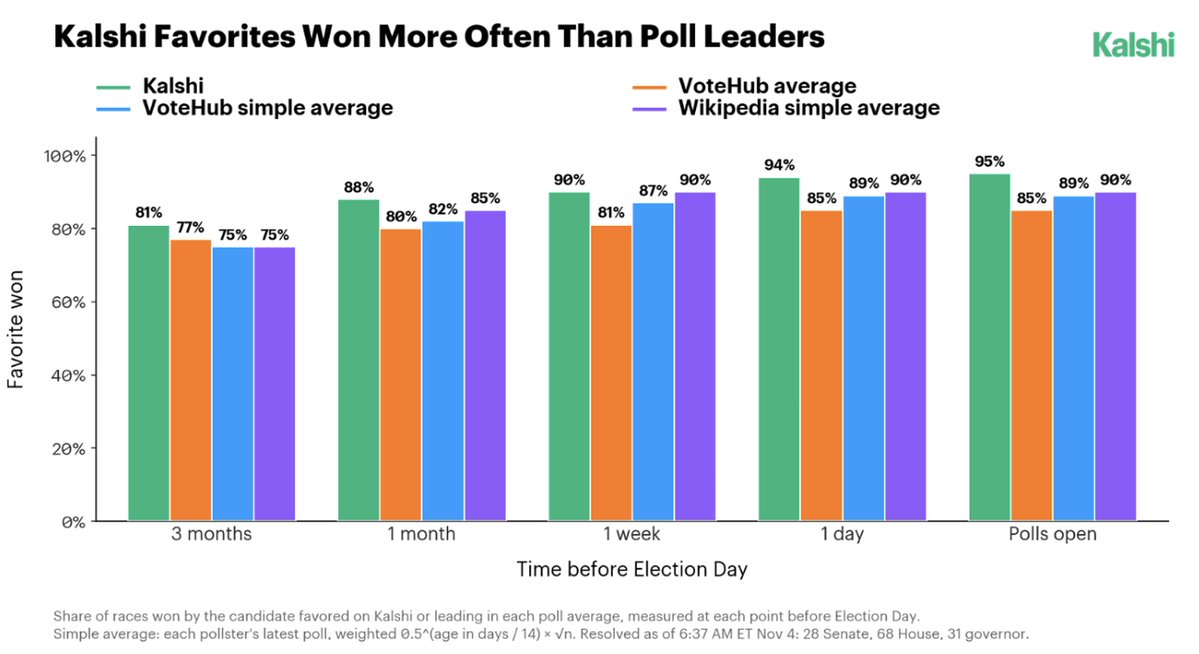
The favorite on Kalshi won 479 of 487 midterm races so far.
That’s 98%, forecasted before a single vote was counted.
The markets beat the polls and the models. The data 🧵
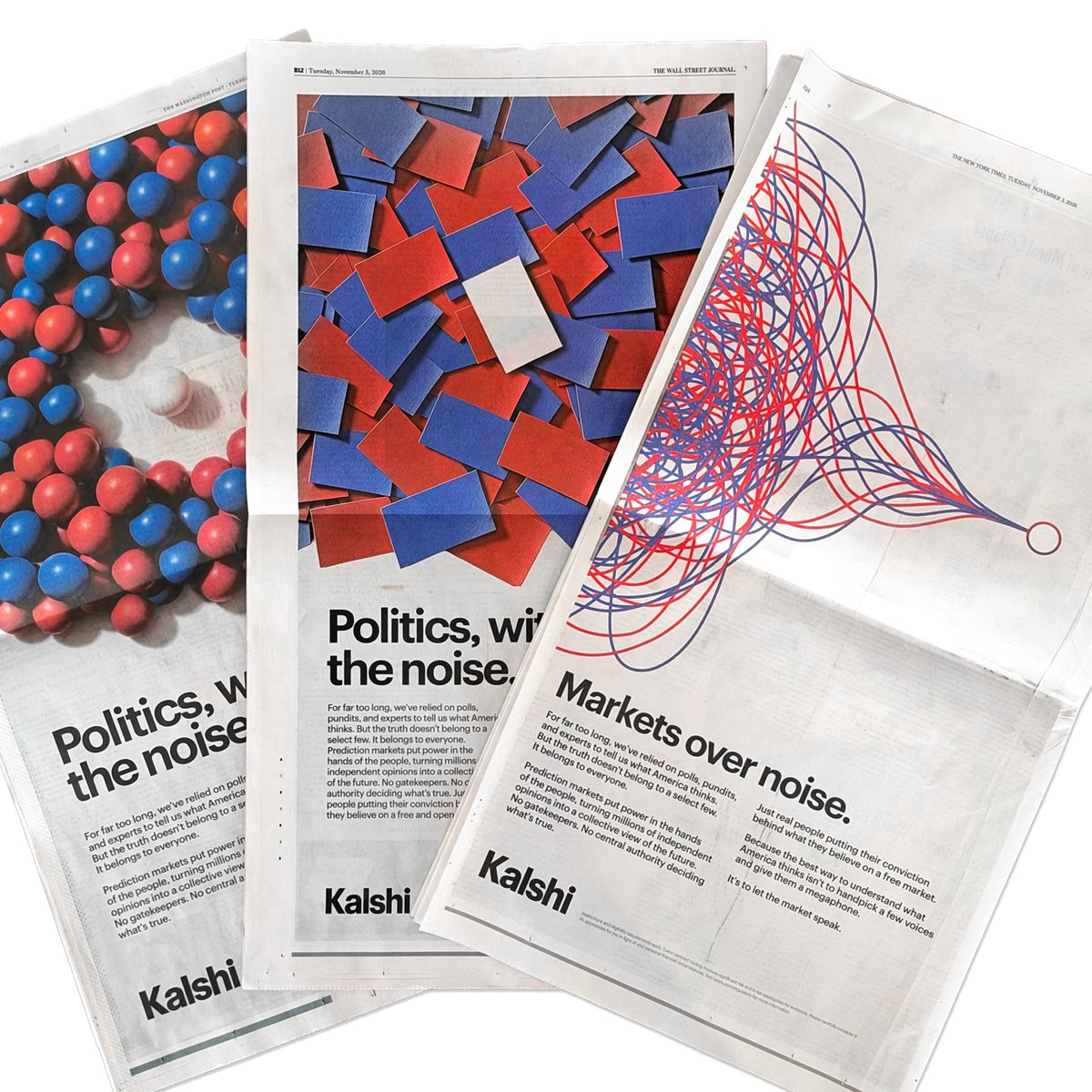
Markets over noise.
For far too long, we’ve relied on polls, pundits, and experts to tell us what America thinks.
But the truth doesn’t belong to a select few.
It belongs to everyone.
Prediction markets put power in the hands of the people, turning millions of independent opinions into a collective view of the future.
No gatekeepers. No central authority deciding what’s true.
Just real people putting their conviction behind what they believe on a free market.
Because the best way to understand what America thinks isn’t to handpick a few voices and give them a megaphone.
It’s to let the market speak.
joining Kalshi last year was the best decision of my life
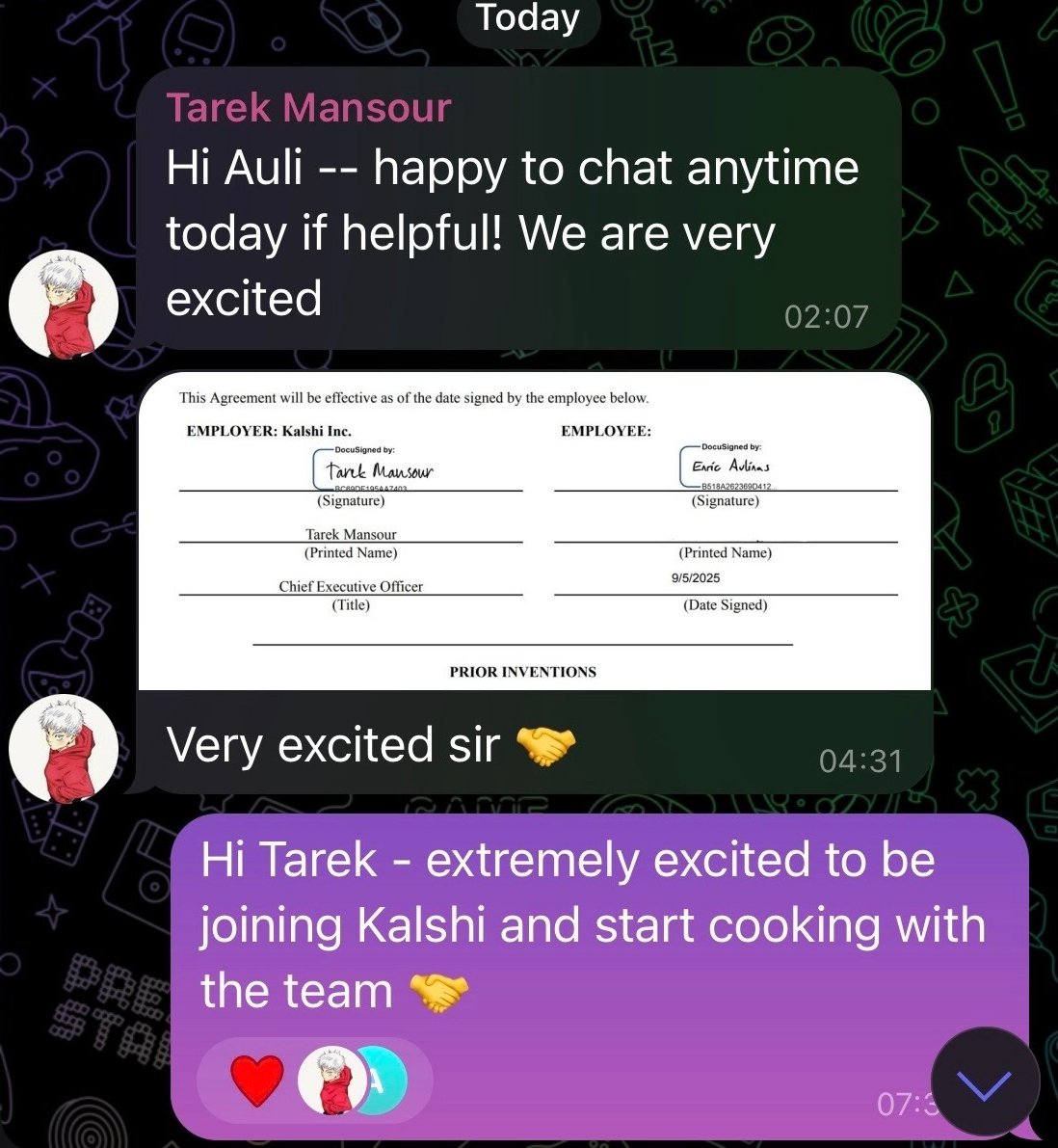
i'll always remember my call with Tarek before i joined:
"show me what you're working on right now. show me something you did this week that you're proud of"
from day one it was clear i had joined a generational company that wanted to win and would only hire people who could get shit done
proud and excited to keep building at the frontier every day
onwards
Kalshi just raised an additional $1B, valuing the company at $40B. This will help us expand into stocks, compute, indices, and institutional.
Tomorrow marks 8 years since we got accepted into YC and the journey began.
The odds of a kid from Lebanon getting here were pretty low.
Growing up there was great, but very challenging. We went through war. We had bombs explode in front of my house. I watched brilliant people’s lives destroyed for reasons beyond their control.
Lebanon is an unpredictable country. That unpredictability made it hard to plan for success. And yet despite it all, my mom sacrificed everything to give me and my brother the chance to go back to the US.
I found my refuge in two things: anime and math. Especially math.
I loved math because it calmed me. It was the opposite of unpredictable: clear, deterministic, orderly, and consistent. The proof is either right or wrong. I find that elegant and beautiful.
I was lucky.
I made it to my dream school, MIT (largely thanks to my mom), and my love for math quickly translated to a love for statistics, probability, and markets.
I love markets for a lot of the same reasons. Their incentives are clear: you get rewarded for being right and for pursuing knowledge. They are effective weighting machines for people’s opinions. They provide an incentive to be truthful, because they separate good information from bad information. They let people challenge the consensus and be rewarded for being right.
IMO, Hayek, Surowiecki, Hanson, Tetlock were the founding fathers of prediction markets. The more I read them, the more obsessed I got with the idea of applying market-based pricing to more things.
Markets bring rigor and critical thinking to more questions. And in an increasingly polarized and information-positioned word, I believe we need that more than ever.
Markets would also let people predict and manage more things outside of their control. And the world was becoming increasingly more unpredictable, and more like Lebanon, not less.
That love for markets got Luana and me to build Kalshi.
At first, it was mostly an idea we couldn’t stop talking about. We didn’t have much money. Luana’s sister bought the Kalshi domain name for us (for ~$1.7k). We moved to SF to get started, and embarked on a long, uncertain journey to build a regulated exchange.
The paranoia and anxiety from my childhood never left me. Even when things are going well, I think about what could go wrong. When people trust you with their money, that instinct serves a purpose.
I wanted us to build something that would hold up under pressure.
The first principle we defined at the company: regulatory-first. We worked with regulators for years before we listed a single market. We took every step to do things the right way and always asked for approval before proceeding. It was very hard at times, especially when we were being overtaken by competitors, but we believe doing things the right way matters.
Luana and I aren’t the only ones.
Our team put years of their lives into something far from certain. That’s especially true of Lior, Brandon, Rainer, Luis, Xavier, and Josef, who stuck with us for years. They believed when there was little to point to. And they stuck with us no matter how long it took. Kalshi is the result of an arduous journey through a long desert where, at times, most people didn’t understand why we were making the walk.
Many people still don’t understand what we’re doing and some disagree with us. Markets have historically taken time to be understood and accepted by some. But while not always obvious, their benefits are vast: capital markets help allocate capital and derivative markets help predict and manage uncertainty.
I firmly believe in these benefits, and that’s why I am dedicating my life to building this market.
Markets have caused issues many times in the past, and they certainly can present harms (manipulation, insiders, and addictive behaviors). These harms are more acute for certain types of markets (sports, short-term options, etc.) than others. It’s why I believe that guardrails need to exist and why we have taken the approach we have taken. We have consistently prioritized thinking critically about the risks and building the appropriate safeguards, sometimes beyond what the regulators require us to do. Many believe more needs to be done, and that’s a conversation I welcome.
Over time, I believe more people will see what we see: markets can help us get smarter and manage the future with more rigor, more precision, and more certainty than we have today.
To our tens of millions of users: you have made Kalshi bigger than anything Luana and I could have possibly imagined. Thank you for trusting us and thank you for coming along on the journey. I feel a strong responsibility to build a company worthy of that trust.
I am so lucky to spend my life building something I love. I hope everyone finds something they care about that much. Something that keeps you curious. Something that pushes you to your limits. Something that may put you at odds with the status quo. Something worth the hard days.
For me, it’s still markets. The more I learn, the more I want to understand.
I joined Kalshi a little over four years ago.
The exchange was live. There were almost no users. No one cared about us.
But I believed deeply in the vision: give anyone the ability to express a view, hedge a risk, or use markets to understand what’s likely to happen. On anything.
I couldn’t believe it didn’t already exist. I knew it had to.
There were about 20 people. Tarek and Luana were extremely smart, with huge ambitions. Meeting the rest of the team convinced me this was where I wanted to be.
Before I accepted, Tarek asked me to go for a walk on a Saturday. He pulled out a list and rattled off all the grueling things I’d be signing up for.
I told him I was ready. We agreed on a number on the spot, shook hands, and started the journey of a lifetime.
Since then, I’ve touched about every part of the company. These days, I focus on growth. It’s a lot more fun when the line goes up. For a long time, ours went sideways.
Market-maker partnerships fell through. We went through painful layoffs. Election markets were blocked, and we fought in court to get them live.
Believing something should exist and bringing it to life are very different things.
Even when we could barely get anyone to trade, Tarek and Luana were talking about building one of the most important financial exchanges in the world.
We just announced another $1B in funding at a $40B valuation.
$40B is a nice number on a piece of paper. What means more to me is the millions of people using prediction markets. The infrastructure we’ve built. The team we’ve assembled. How much closer we are to the vision that made me want to join.
I’m grateful to Tarek Mansour and Luana Lopes Lara for bringing me in, to everyone I’ve built alongside, and to the users who’ve made this possible.
Four years later, I believe in this more than ever. There’s still so much left to build.
Kalshi just raised an additional $1B, valuing the company at $40B. This will help us expand into stocks, compute, indices, and institutional.
Tomorrow marks 8 years since we got accepted into YC and the journey began.
The odds of a kid from Lebanon getting here were pretty low.
Growing up there was great, but very challenging. We went through war. We had bombs explode in front of my house. I watched brilliant people’s lives destroyed for reasons beyond their control.
Lebanon is an unpredictable country. That unpredictability made it hard to plan for success. And yet despite it all, my mom sacrificed everything to give me and my brother the chance to go back to the US.
I found my refuge in two things: anime and math. Especially math.
I loved math because it calmed me. It was the opposite of unpredictable: clear, deterministic, orderly, and consistent. The proof is either right or wrong. I find that elegant and beautiful.
I was lucky.
I made it to my dream school, MIT (largely thanks to my mom), and my love for math quickly translated to a love for statistics, probability, and markets.
I love markets for a lot of the same reasons. Their incentives are clear: you get rewarded for being right and for pursuing knowledge. They are effective weighting machines for people’s opinions. They provide an incentive to be truthful, because they separate good information from bad information. They let people challenge the consensus and be rewarded for being right.
IMO, Hayek, Surowiecki, Hanson, Tetlock were the founding fathers of prediction markets. The more I read them, the more obsessed I got with the idea of applying market-based pricing to more things.
Markets bring rigor and critical thinking to more questions. And in an increasingly polarized and information-positioned word, I believe we need that more than ever.
Markets would also let people predict and manage more things outside of their control. And the world was becoming increasingly more unpredictable, and more like Lebanon, not less.
That love for markets got Luana and me to build Kalshi.
At first, it was mostly an idea we couldn’t stop talking about. We didn’t have much money. Luana’s sister bought the Kalshi domain name for us (for ~$1.7k). We moved to SF to get started, and embarked on a long, uncertain journey to build a regulated exchange.
The paranoia and anxiety from my childhood never left me. Even when things are going well, I think about what could go wrong. When people trust you with their money, that instinct serves a purpose.
I wanted us to build something that would hold up under pressure.
The first principle we defined at the company: regulatory-first. We worked with regulators for years before we listed a single market. We took every step to do things the right way and always asked for approval before proceeding. It was very hard at times, especially when we were being overtaken by competitors, but we believe doing things the right way matters.
Luana and I aren’t the only ones.
Our team put years of their lives into something far from certain. That’s especially true of Lior, Brandon, Rainer, Luis, Xavier, and Josef, who stuck with us for years. They believed when there was little to point to. And they stuck with us no matter how long it took. Kalshi is the result of an arduous journey through a long desert where, at times, most people didn’t understand why we were making the walk.
Many people still don’t understand what we’re doing and some disagree with us. Markets have historically taken time to be understood and accepted by some. But while not always obvious, their benefits are vast: capital markets help allocate capital and derivative markets help predict and manage uncertainty.
I firmly believe in these benefits, and that’s why I am dedicating my life to building this market.
Markets have caused issues many times in the past, and they certainly can present harms (manipulation, insiders, and addictive behaviors). These harms are more acute for certain types of markets (sports, short-term options, etc.) than others. It’s why I believe that guardrails need to exist and why we have taken the approach we have taken. We have consistently prioritized thinking critically about the risks and building the appropriate safeguards, sometimes beyond what the regulators require us to do. Many believe more needs to be done, and that’s a conversation I welcome.
Over time, I believe more people will see what we see: markets can help us get smarter and manage the future with more rigor, more precision, and more certainty than we have today.
To our tens of millions of users: you have made Kalshi bigger than anything Luana and I could have possibly imagined. Thank you for trusting us and thank you for coming along on the journey. I feel a strong responsibility to build a company worthy of that trust.
I am so lucky to spend my life building something I love. I hope everyone finds something they care about that much. Something that keeps you curious. Something that pushes you to your limits. Something that may put you at odds with the status quo. Something worth the hard days.
For me, it’s still markets. The more I learn, the more I want to understand.
Yes, a bet and a trade often look similar.
But how they work is fundamentally different.
A sportsbook sets the odds and takes the other side of your bet. Prediction markets are markets, where buyers and sellers compete to discover and produce efficient prices and enable important public benefits.
What the market is about can change, but the structure doesn't.
My op-ed on prediction markets and regulation: