Prediction markets have a few unique qualities that make them valuable for tracking elections:
• They incentivize accuracy - people are rewarded primarily for being right (not eyeballs, power, etc)
• They're peer to peer - people set the odds, not a gatekeeper
• They're transparent - you can see the order book, the history, etc
• They move in real time - odds update as soon as new information comes in
That's why so many people and news outlets like CBS look to them during the midterms.
i've been studying the polls lately and it looking like to me that el-sayed has a clear shot for senate. voter turnout expected to be high & i be using AI to give me this lock,who yall got money on sayed or rogers
There's a deep, underappreciated economic lesson in this op-ed: regulation should be targeted at risks, not an industry.
Nuclear plants and wind farms both generate electricity. Nobody sensible thinks they require identical safety rules.
Uber and taxis both get you home. Yet ratings, GPS tracking and automatic payments on rideshare addressed some of the problems taxi regulation was targeted at. They didnt need to be regulated in the same way.
Exactly equivalent logic applies to prediction markets and traditional gambling. A sportsbook or a casino takes the other side of your bet. A prediction exchange matches traders, clears contracts and charges fees for transacting. The financial plumbing, incentives and risks of the two activities are completely different.
If we are to have regulation it should be targeted at the specific risks and harms given the actual structure of the activity. Otherwise, you punish firms for developing products and incentive structures that solve the very problems that justified regulation in the traditional industry in the first place.
Incumbent sportsbooks and casinos naturally love to extol a “level playing field.” But that's not how a good economist should think about regulation.
🚨HOLY CRAP:
Turn this off on your phone right now.
Go to your iPhone settings - accessibility - audio & visual - LIVE LISTEN.
Turn off LIVE LISTEN.
It even says it keeps TRANSCRIPTS.
This is NUTS.
Every election brings new polls, headlines, and predictions.
In a free and open market, those trades bring together information from people across the country to produce a market price that updates in real time.
As new information comes in, people can change their minds. The odds change with them.
Markets tell you the odds. Voters decide the outcome.
America, you're up 🇺🇸
Prediction markets on Phantom are now rolling out to all US users.
Call BTC’s next move, Sunday’s game, or election night—right where you already trade, swap and spend.
Discover. Chat. Predict.
Powered by @Kalshi
Abdul El-Sayed has a 68% chance to beat Mike Rogers in the Michigan Senate race, according to Kalshi traders.
But how does the volume split on El-Sayed differ by state?
• All Americans: 65%
• Michiganders: 49%
• Non-Michiganders: 65%
Factors that matter when determining if an event contract is a swap:
• Is the event “associated with a potential financial, economic, or commercial consequence”? 7 U.S.C. § 1a
• Is it “commonly known to the trade as a swap”? 7 U.S.C. § 1a
• Is it an off-exchange state-regulated wager? (If so, no). 17 C.F.R. § 1.3
• Is it within the CFTC and SEC’s further definition of ‘swap’? 15 U.S.C. § 8302
Factors that do not matter:
• Did a marketing intern call it a “bet” in an Instagram ad in 2025
"This source of information is a public good. The media cite Kalshi’s prices in areas such as technological benchmarks or entertainment, where not long ago they turned to 'experts' for analysis. The American public similarly looks to us for information. 3/4 of visitors to our website never trade"
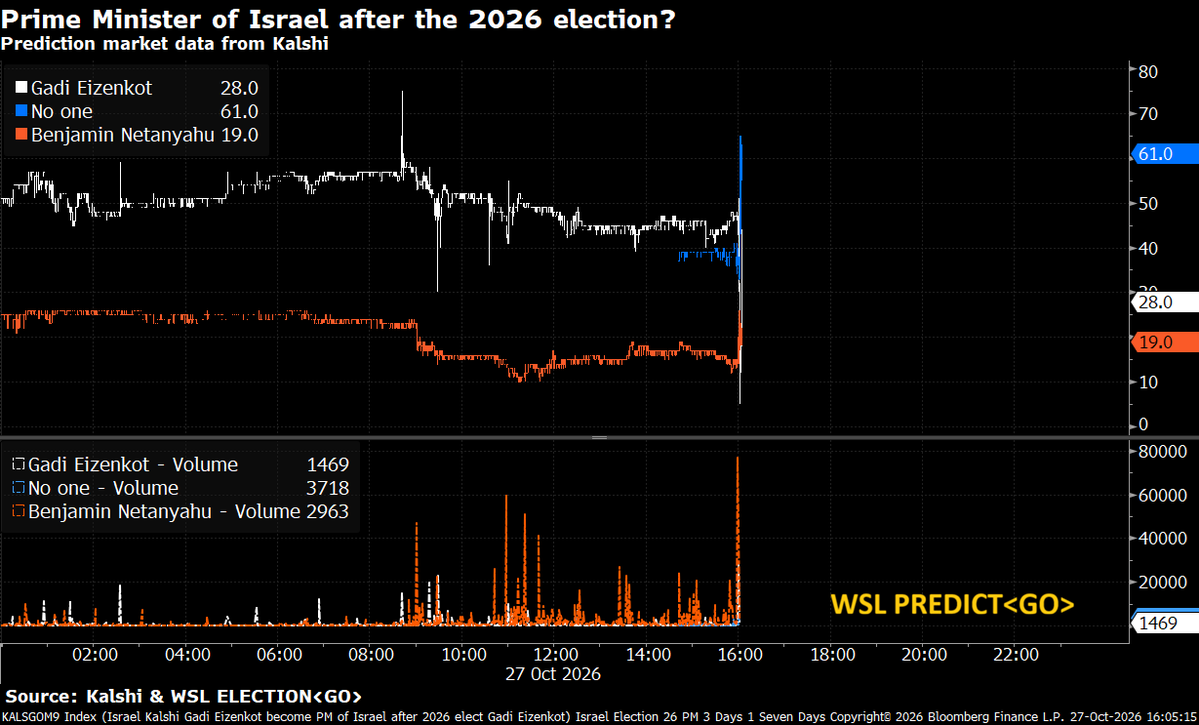
Israeli election news is starting to hit, with three exit polls showing the Eisenkot bloc leading but short of a majority.
Track the real-time reaction in @Kalshi prediction markets on @TheTerminal as more results come in.
"For all these reasons, many small businesses use prediction markets to mitigate risk—whether a farmer hedging against drought or a bar owner who fears that a home team’s elimination from the playoffs will collapse his revenue. That’s a real-world example: A bar owner in Los Angeles used event contracts on Kalshi to pay out if the Dodgers failed to advance. Few hedge risk by putting a sportsbook bet on their profit-and-loss statements."